
Full-grain leather is the gold standard in premium manufacturing, widely recognized for its durability, natural texture, and ability to develop a unique patina. For brand founders, product designers, and sourcing managers, understanding the technicalities of full-grain leather is essential for making informed procurement decisions, reducing return rates, and justifying premium retail prices.
In this guide, we break down what full-grain leather actually means for your business, the manufacturing challenges behind it, and how to evaluate a reliable supply partner.
Executive Summary:
- Sourcing Definition: Full-grain is the uncorrected topmost layer of the hide, retaining maximum fiber density.
- Business Value: It offers the highest leather durability, lower after-sales warranty costs, and justifies luxury price points ($100+).
- Technical Note: Requires high-precision skiving (0.4mm-0.6mm) and expert hand-sorting to manage natural surface blemishes.
full-grain leather
1. What is Full-Grain Leather & Why It Matters for Your Brand
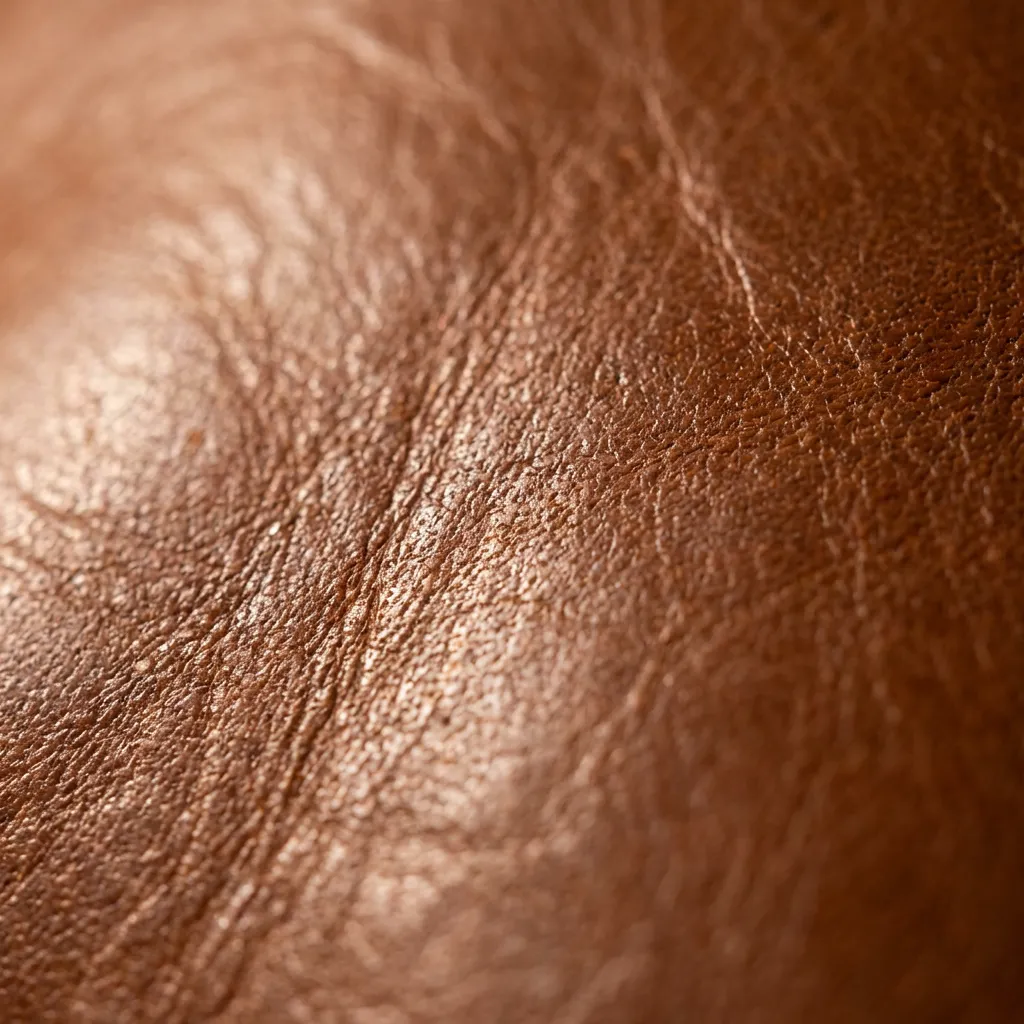
Full-grain leather is derived from the top layer of the hide and retains the complete natural grain. Unlike top-grain or “genuine” leather, it is minimally processed, preserving the hide’s original strength and fibrous structure. To see where this fits in the broader material landscape, check out our The Complete Leather Types Guide.
Strategic Business Significance:
- Superior Product Lifespan: Because the fibers are intact, it provides the highest leather durability available, significantly lowering long-term return rates.
- Market Positioning: Its ability to develop a rich patina creates an emotional connection with users, strengthening brand loyalty and driving repeat purchases. This phenomenon is a hallmark of world-class tanneries like the Horween Leather Co., whose full-grain hides are prized for their aging characteristics.
- Higher Margins: Consumers are willing to pay a premium for “Full-Grain” because it is a globally recognized symbol of quality.

full-grain leather accessories
2. Manufacturing Realities: The “Factory Side” of Full-Grain
While full-grain is a superior material, it presents unique challenges that only an experienced manufacturer can handle.
- Natural Imperfections & Sorting: Because the grain is uncorrected, hides show natural marks (insect bites, scars). Our artisans must meticulously hand-sort and cut around these areas to ensure consistency in your bulk order.
- The Skiving Challenge: For modern tech accessories like phone cases, leather must be shaved down to 0.4mm – 0.6mm to support wireless charging and MagSafe magnets. Achieving this thickness with full-grain without tearing the fibers requires high-precision machinery, such as Fortuna Skiving Machines, and highly seasoned technicians.
- Edge Painting Craftsmanship: Full-grain leather edges are dense. A professional finish requires multiple layers of hand-applied paint, followed by manual sanding and polishing to achieve a seamless look.
3. Pros and Cons for B2B Procurement
4. Sourcing Considerations: Vegetable-Tanned vs. Chrome-Tanned
Understanding tanning methods is critical for matching your product to your target market. For a detailed decision-making framework, read our comparison of vegetable-tanned leather vs chrome-tanned leather.
- Vegetable-Tanned Full-Grain: Uses natural tree bark tannins. It is eco-friendly and develops the most dramatic patina. This method, perfected by heritage tanneries like Wickett & Craig, is ideal for luxury Vegetable-Tanned Leather Phone Cases and heritage wallets.
- Chrome-Tanned Full-Grain: More pliable and water-resistant. Best for: High-fashion accessories and vibrant color collections.
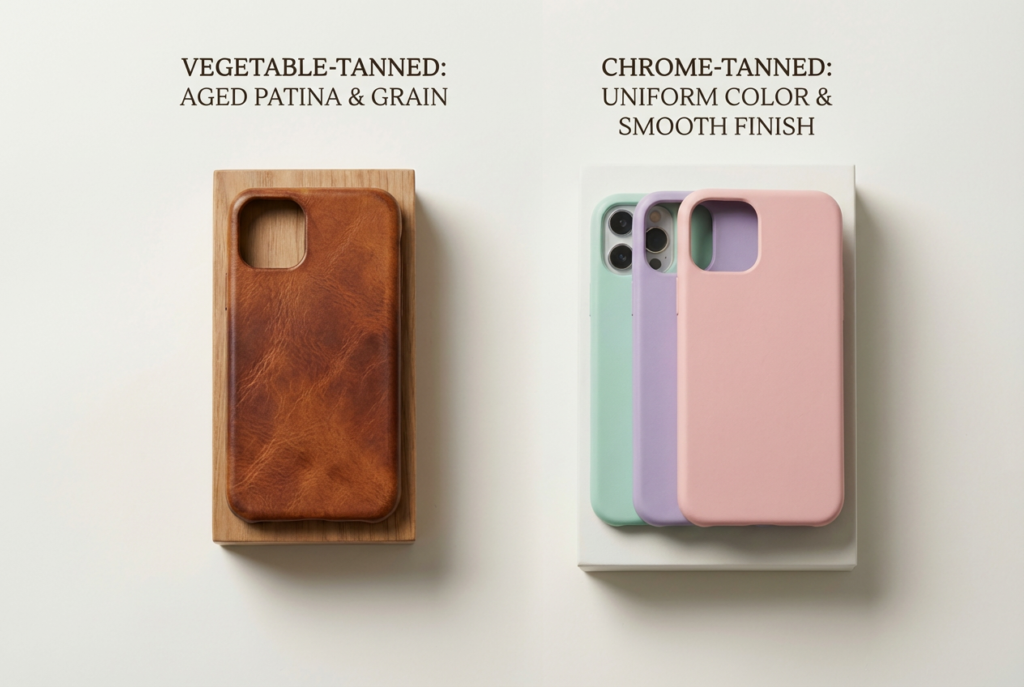
vegetable tanned leather phone case vs chrome leather phone case
5. How to Evaluate Supplier Reliability
When sourcing B2B leather sourcing partners, look for these indicators of quality:
Consistency Control: Does the supplier have a strict QC protocol to ensure unit #1 matches unit #1,000 in texture and color?
Sample Fidelity: Request a sample of the exact thickness (e.g., 0.5mm) required for your design to test fiber integrity.
Flexible MOQs: At our facility, we support growing brands with a Minimum Order Quantity (MOQ) of just 100 pieces, allowing you to test premium lines without excessive inventory risk.
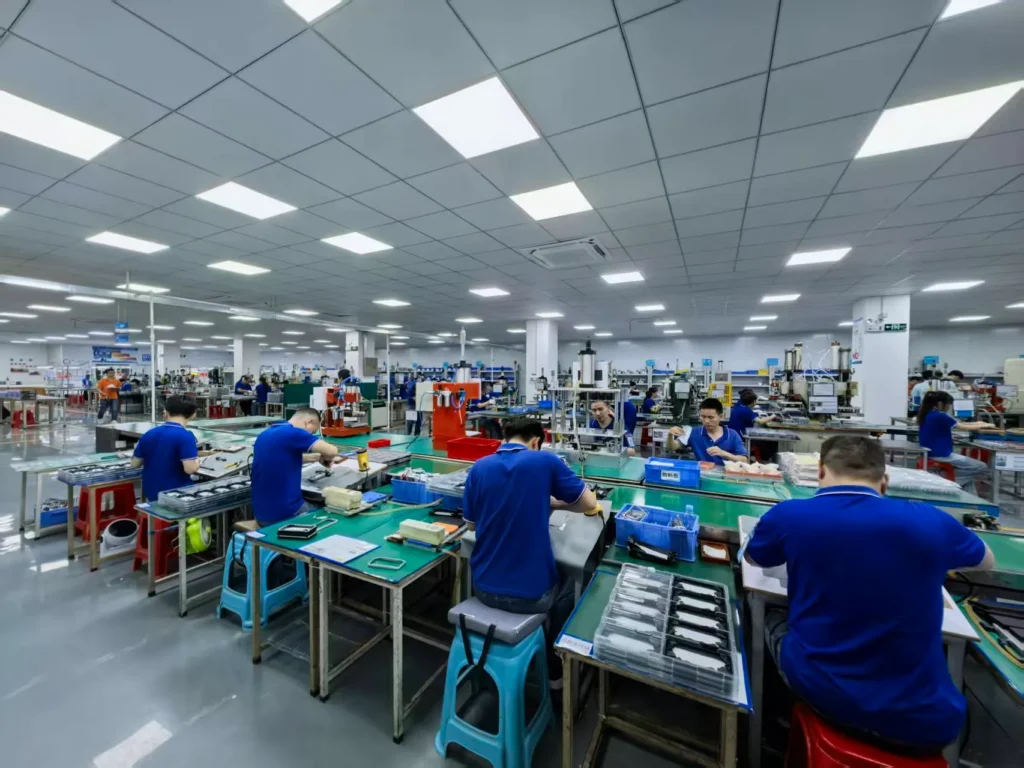
A Glimpse of the Factory
6. Product Lifecycle & Maintenance
Educating your end-users on care is vital for brand reputation. Full-grain leather requires periodic conditioning to maintain its suppleness. We recommend providing a Leather Care Guide with every purchase to ensure the product lasts for decades.
7. Comparison Table: Full-Grain vs. Other Leather Types
| Leather Type | Durability | Sourcing Cost | Use Case |
|---|---|---|---|
| Full-Grain | Highest | High | Luxury bags, Phone Cases, heirlooms |
| Top-Grain | High | Medium | Fashion accessories, mid-range footwear |
| Genuine | Medium/Low | Low | Budget-friendly fast fashion |
| Bonded | Low | Lowest | Promotional items, low-end upholstery |

Grade-Based Classification
For product teams comparing this material for commercial use, pair the material decision with OEM and ODM production planning, MOQ planning for custom leather goods, and the quality control checklist so appearance, durability, MOQ, and inspection standards are reviewed together.
FAQ
What exactly is “Full Grain Leather,” and how does it differ from standard “Top Grain”?
Full-grain is the highest tier of leather. It refers to the outermost layer of the hide that has not been sanded, buffed, or snuffed to remove natural marks.
- The Difference: While “Top Grain” leather is often sanded down to remove imperfections and then embossed with a fake grain, Full Grain retains the entire natural grain, making it the strongest, most breathable, and most durable part of the hide.
I noticed small scars, insect bites, or wrinkles on the surface. Is this a defect?
Not at all—it is the “fingerprint” of authentic leather. Because Full Grain is unaltered, it preserves the life story of the animal, including healed scars, growth lines (fat wrinkles), and subtle variations in grain density. In the world of fine leather, these “imperfections” are celebrated as proof of authenticity and character. If a leather surface looks perfectly uniform like plastic, it has likely been heavily processed or “corrected.”
Is “Genuine Leather” really the lowest grade of leather?
This is a common marketing myth. “Genuine Leather” is a broad industry term that simply means “real leather.” While some mass-market brands use it to describe low-quality “split” leather (leather pieces glued together with a polyurethane coating), the term itself isn’t a technical grade. The key is to look for the “Full Grain” label and the reputation of the tannery (e.g., Horween, Haas, or Hermann Oak) rather than just the word “Genuine.”
Why does my leather scratch so easily? How can I fix it?
High-quality full-grain leather often has a high oil and wax content, which allows it to “heal” itself.
- The Fix: For most surface scratches, simply rub the area firmly with your thumb. The friction creates heat, which redistributes the natural oils and waxes, causing the scratch to fade or disappear. This is known as the “Pull-up” effect.
What should I do if my leather gets wet or stained with oil?
Speed is key.
- Water: Immediately blot the area with a dry, clean cloth. Never use a hairdryer or direct heat, as this will cause the fibers to shrink and crack. Let it air dry naturally in a cool spot.
- Oil: Do not rub oil stains, as it will spread them deeper into the pores. Blot with an absorbent paper towel and let it sit. Over time, the leather will absorb the oil, and the spot will often blend into the natural patina.
Is there a simple way to verify if my leather is truly “Full Grain”?
Try the “Press Test.” Press your finger firmly into the surface of the leather.
- Full Grain: You will see fine, asymmetrical wrinkles radiating from the point of pressure, similar to how human skin behaves.
- Faux or Corrected Leather: The surface will often feel stiff, show large blocky folds, or provide no reaction at all.
Why is there such a significant price gap between different “Full Grain” products?
You are paying for Selection and Artisanship.
- Hide Selection: Only the cleanest, most flawless hides can be used for Full Grain because there is no sanding to hide mistakes.
- Tannery Reputation: World-class tanneries (like those in Germany, France, and the USA) use slow, traditional tanning recipes that result in a superior hand-feel, better aging, and higher structural integrity compared to mass-produced alternatives.
Will the leather change color? How long does it take to develop a “Patina”?
Only Vegetable-Tanned or high-oil Full Grain leathers will develop a significant patina. As the leather is exposed to sunlight, moisture, and the oils from your hands, it will darken and develop a rich, lustrous sheen. This process typically takes 3 to 6 months of regular use. If the leather is “Pigmented” (heavily coated with dye), the color will remain stable and will not develop a patina.
Conclusion: Partnering for Quality
Full-grain leather is more than a material; it is a statement of authenticity. However, sourcing the leather is only half the battle. You need a leather manufacturing partner who respects the material and has the technical capability to turn it into a flawless branded product.
Ready to elevate your product line? Contact our B2B sales team today to discuss your next OEM/ODM project or request our Premium Leather Swatch Book to feel the difference for yourself.
If you’re developing leather accessories for your brand, working with an experienced leather accessories manufacturer can help ensure consistent material quality and reliable production.