
Why “Leather” Doesn’t Mean the Same Thing
When shopping for bags, wallets, or phone cases, you’ll often see the same label—“leather”—with prices that differ by 5x or even 10x. At the same time, terms like “Vegan Leather”, “PU Leather”, and “Full Grain Leather” are used interchangeably, creating confusion for most buyers.
So what’s the real difference?
This is not simply a question of cheap vs expensive. It is a deeper trade-off between Short-term convenience vs long-term durability
In this guide, we’ll break down the real material differences, sustainability facts, and practical use cases—especially for everyday products like phone cases.
What Is PU Leather? (The “Vegan” Alternative)
Definition and Material Structure
PU leather (Polyurethane leather) is a synthetic material made by coating a fabric base with a plastic polymer layer. It is designed to mimic the appearance of real leather without using animal hide.
It is commonly referred to as:
- PU leather
- Vegan leather
- Faux leather
- Synthetic leather
Pros and Cons of PU Leather
Advantages
- Lower production cost
- Water-resistant surface
- Easy to clean and maintain
- Consistent appearance across batches
- Available in many colors and textures
Disadvantages
- Prone to cracking and peeling over time (typically 2–5 years)
- Poor breathability
- Feels synthetic and less natural
- Degrades faster under heat and friction
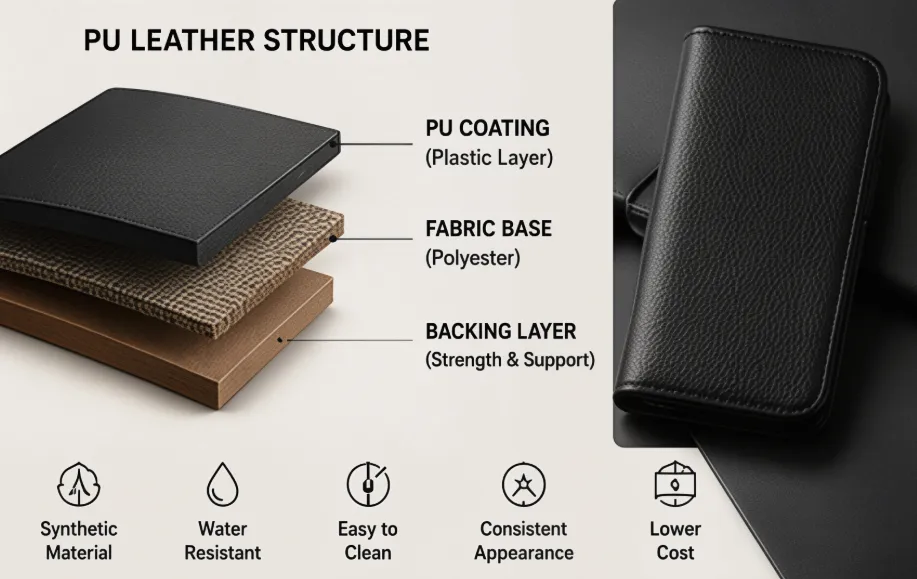
PU leather
What is full grain leather? (The Premium Standard)
Full-grain leather is the highest quality grade of leather. It is made from the top layer of the animal hide and retains the natural grain structure without heavy sanding or artificial correction.
This makes it fundamentally different from:
- Top grain leather (lightly sanded for uniformity)
- Genuine leather (lower layers, often reprocessed)
Pros and Cons of Full Grain Leather
Advantages
- Extremely durable (10–30+ years lifespan)
- Develops a unique patina over time
- Naturally breathable and flexible
- Each piece has unique natural markings
Disadvantages
- Higher upfront cost
- Requires occasional conditioning
- Natural imperfections may be visible (not defects, but authenticity markers)
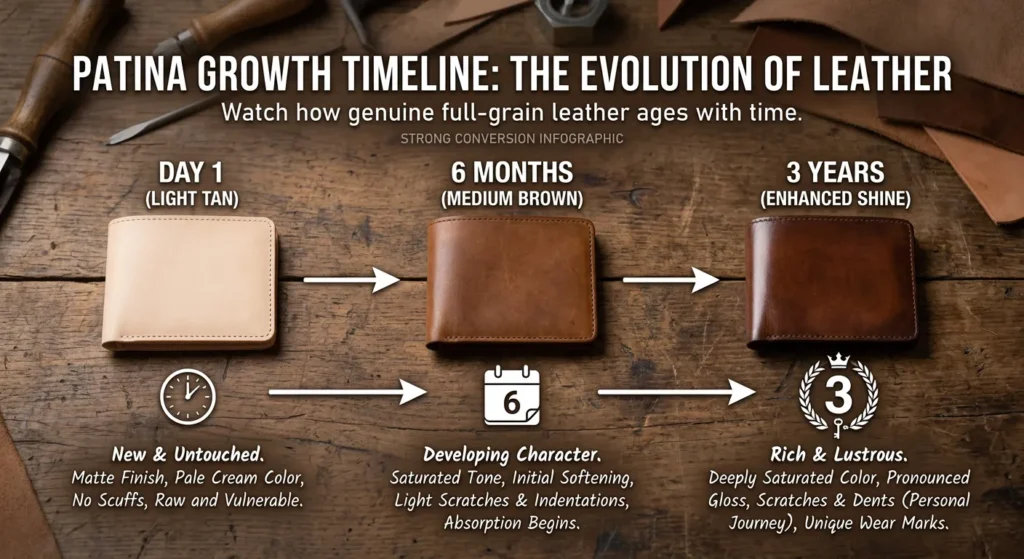
Full grain leather with patina
PU vs Full Grain Leather: Head-to-Head Comparison
| Feature | PU Leather | Full Grain Leather |
|---|---|---|
| Durability | 2–5 years | 10–30+ years |
| Material Type | Synthetic (plastic-based) | Natural animal hide |
| Aging | Cracks and peels | Develops patina (improves over time) |
| Breathability | Low | High |
| Maintenance | Very easy | Moderate care needed |
| Feel | Artificial and uniform | Natural and unique |
| Environmental Impact | Plastic waste, microplastics | Biodegradable (especially vegetable-tanned) |
Durability & Aging
PU leather deteriorates with time—its surface layer eventually cracks or peels, especially under heat and frequent use.
Full-grain leather, however, evolves. It darkens, softens, and develops a rich patina that reflects usage and age. Instead of degrading, it improves aesthetically over time.
Touch & Feel
PU leather feels uniform, smooth, and synthetic.
Full-grain leather feels warm, textured, and organic—no two pieces are identical.
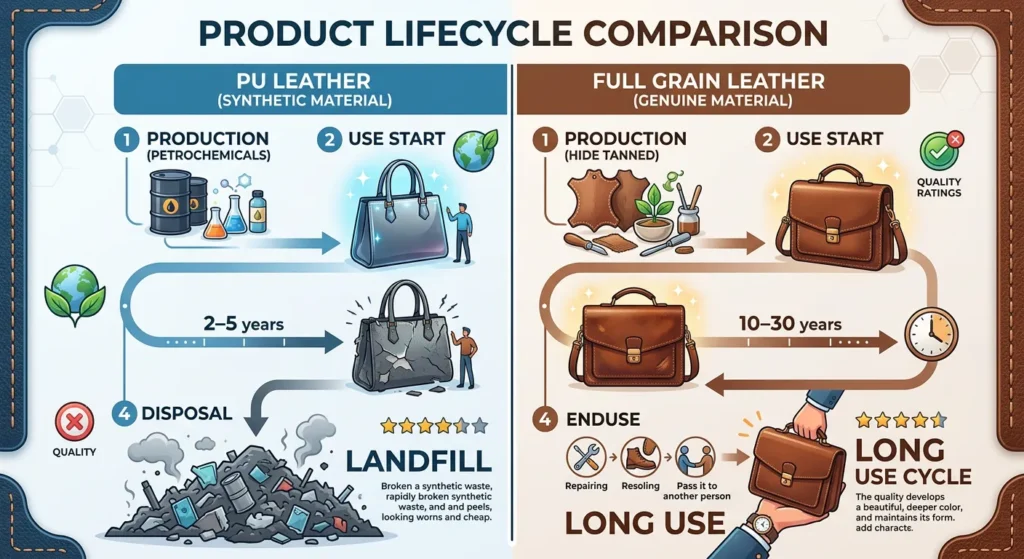
PU leather VS full grain leather of lifecycle
Is Vegan Leather Really Sustainable? The Greenwashing Truth
The term “vegan leather” is often associated with sustainability. However, this assumption is misleading.
The Plastic Reality Behind PU Leather
Most vegan leather on the market today is made from petroleum-based plastics such as polyurethane or PVC.
This leads to several environmental concerns:
- Non-biodegradable material
- Difficult to recycle
- Long-term microplastic pollution
- Short product lifespan → higher waste turnover
While newer plant-based alternatives (like apple leather or mushroom leather) exist, they remain niche and are not widely adopted in mass production.
The Sustainability of Real Leather
Real leather is often misunderstood. In most cases, it is a by-product of the meat industry, using materials that would otherwise be discarded.
Especially in the case of vegetable-tanned full-grain leather:
- It is more biodegradable than synthetic alternatives
- It avoids plastic-based pollution
- It lasts significantly longer, reducing replacement cycles
The Key Principle
Sustainability is not just about origin, but lifespan.
A leather product that lasts 10+ years is often more environmentally responsible than five synthetic products discarded within the same period.
Why Material Matters for Phone Cases
When it comes to phone cases, material choice directly impacts durability, aesthetics, and user experience.
PU Leather Phone Cases
Best suited for:
- Budget-conscious buyers
- Fast fashion or trend-based usage
- Users who frequently change styles
However:
- More likely to peel over time
- Can degrade in heat or friction-heavy environments
Full Grain Leather Phone Cases
Best suited for:
- Premium positioning and professional use
- Long-term daily use
- Users who value aging aesthetics (patina)
Benefits:
- Becomes more refined with use
- Better resistance to long-term wear
- Develops a personalized texture over time
Extreme Climate Example: Phoenix Heat
In hot and dry climates such as Phoenix, Arizona, material performance becomes even more critical.
- PU leather exposed to high heat (e.g., inside cars) can soften, deform, or peel over time.
- Full-grain leather performs more stably under dry heat conditions, especially with occasional conditioning using leather oil.
This makes material selection not just a style decision, but a climate-based performance decision.
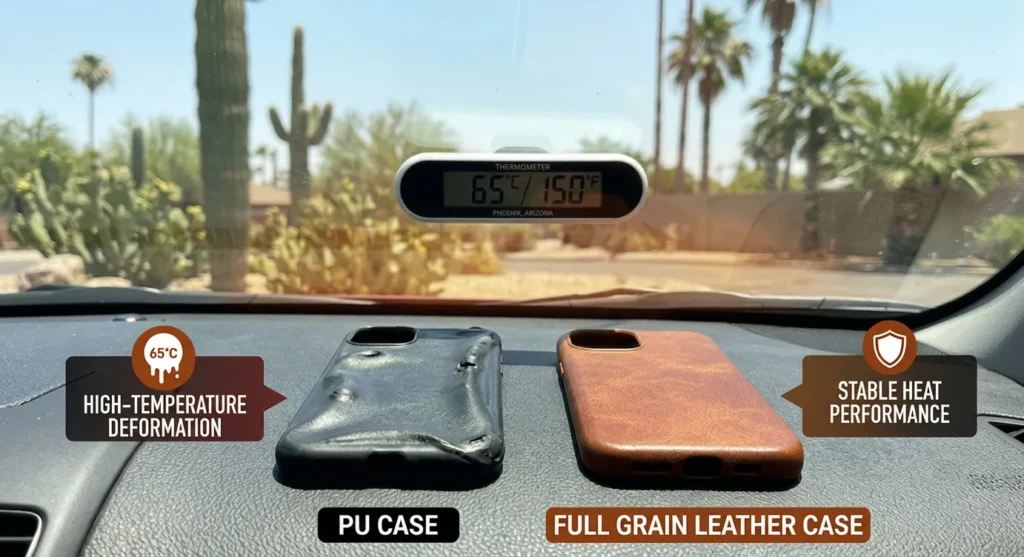
Comparison under high temperature
How to Tell the Difference (Quick Consumer Guide)
If you’re unsure whether a product is PU or real leather, use these quick tests:
Visual Test
- Real leather: irregular grain, natural fiber edges
- PU leather: uniform pattern, plastic-like edges
Smell Test
- Real leather: natural, slightly earthy scent
- PU leather: chemical or plastic odor
Water Test
- Real leather: absorbs moisture slowly (unless heavily coated)
- PU leather: water beads and slides off
Press Test
- Real leather: forms natural wrinkles when pressed
- PU leather: rebounds without texture change
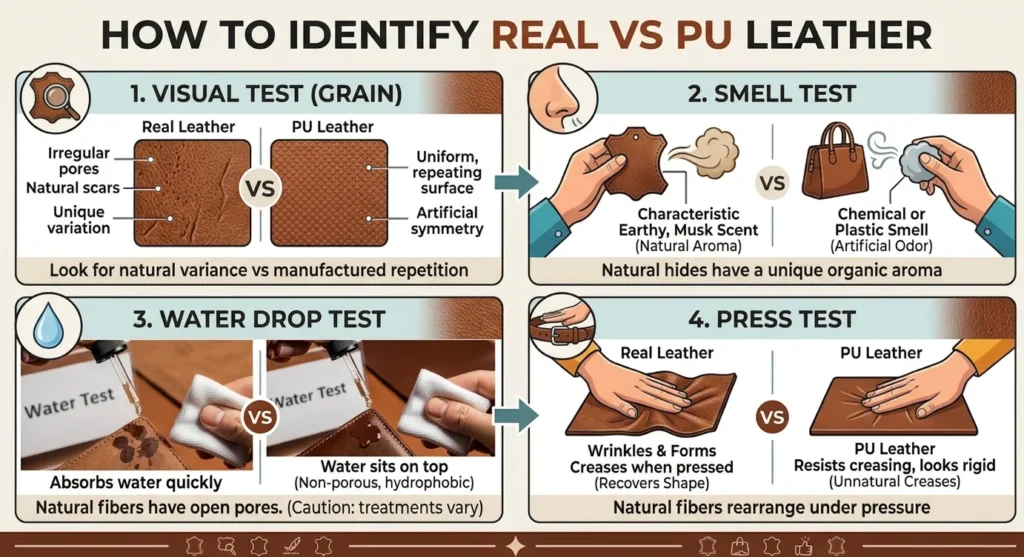
How to identify PU leather VS full grain leather
Final Verdict: Which Should You Choose?
Choose PU Leather if:
- You are on a limited budget
- You prefer frequent style changes
- You require vegan-certified materials
- You need short-term, trend-driven products
Choose Full Grain Leather if:
- You value long-term durability
- You prefer premium aesthetics and aging character
- You follow a “buy it once, use it for years” philosophy
- You want a product that improves over time
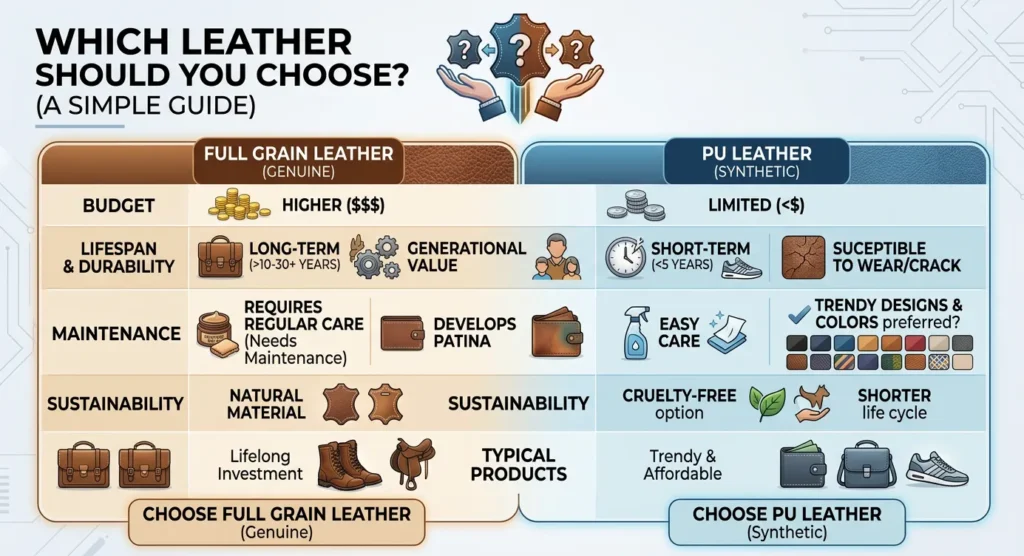
A simple guide
Conclusion: It’s Not About Better—It’s About Fit
There is no universally “best” material.
Instead, the right choice depends on how you define value:
- PU leather prioritizes accessibility and convenience
- Full-grain leather prioritizes longevity and character
The most sustainable product is not the one that looks eco-friendly today, but the one that lasts long enough to avoid replacement.
FAQ
1. Is PU leather real leather? Should I buy it?
No, PU leather is not real leather—it is a synthetic material made from plastic coatings.
If you’re looking for a budget-friendly, short-term option, PU leather can be a practical choice.
However, if you want a product that feels premium and lasts for years, full grain leather is a better investment.
Tip: Choose based on how long you expect to use the product—not just the price.
2. How long will a PU leather phone case last in daily use?
Most PU leather phone cases last around 2–5 years, but in real-world conditions (daily handling, heat, friction), they often show wear earlier—such as peeling or cracking.
If you prefer not to replace your case frequently, consider upgrading to full grain leather for longer-term use.
3. Is full grain leather worth the higher price?
Yes—if you value longevity and experience over time.
Instead of wearing out, full grain leather ages beautifully, developing a unique patina that reflects your daily use.
Think of it as “cost per year” rather than upfront cost—it often becomes the more economical choice over time.
4. Which material looks better after 6–12 months?
- PU leather: may start to look worn, especially at edges and corners
- Full grain leather: develops a richer tone and softer texture
If appearance over time matters to you, full grain leather delivers a noticeably better long-term look.
5. I live in a hot climate (like Phoenix). Which should I choose?
In high heat environments:
- PU leather can soften, warp, or peel, especially inside cars
- Full grain leather remains more stable, especially with occasional conditioning
For hot climates, full grain leather is the safer long-term choice.
6. Is vegan leather really a better environmental choice?
Not necessarily. Most vegan leather is still plastic-based (PU/PVC) and has a shorter lifespan.
A product that lasts 10+ years is often more sustainable than one replaced every 1–2 years.
If sustainability matters to you, consider long-lasting materials over short-term alternatives.
7. How can I quickly tell if a case is real leather before buying?
- Too perfect texture? Likely PU
- Plastic smell? Likely PU
- No variation in grain? Likely PU
When in doubt, choose brands that clearly state “full grain leather” rather than just “genuine leather.”
8. Which material is better for a premium brand image?
- PU leather → suitable for fast fashion / trend-driven products
- Full grain leather → ideal for premium positioning and long-term brand value
If you care about craftsmanship and perception, full grain leather aligns better with a premium image.
9. What do most people regret after buying PU leather?
The most common feedback is:
- Peeling after a few months
- Edges are wearing out quickly
- Feeling less “premium” than expected
If avoiding replacement hassle is important, investing upfront can save time and cost later.
Next Steps
If you’re exploring premium leather phone cases or accessories, consider evaluating not just the material, but how it will perform over years of real-world use.
Explore More:
- Shop Full Grain Leather Phone Cases (Patina develops over time)
- Learn How to Care for Full Grain Leather for Long-Term Use