
1. Why Logo Engineering Directly Impacts Your Profit Margin
When sourcing OEM leather iPad cases, most buyers focus on:
- leather grade selection
- structural design (magnetic / fold/pencil holder)
- unit price negotiation
- packaging appearance
However, in real OEM production environments, logo customization is one of the most underestimated engineering variables affecting final commercial success.
Unlike leather selection or structural design, logo decisions directly influence:
- how the product is perceived on retail shelves
- how consistent mass production appears across batches
- how premium or “cheap” the final product feels
- how stable tooling and sampling cycles remain
In many OEM projects, the product itself is structurally sound, but the branding execution reduces perceived retail value by 20%–40% simply due to an inappropriate logo method selection.
In real manufacturing logic, a logo is not a decoration. It is a production-linked value multiplier.
It affects leather behavior, heat-pressure response, tooling precision, and even stitching alignment.
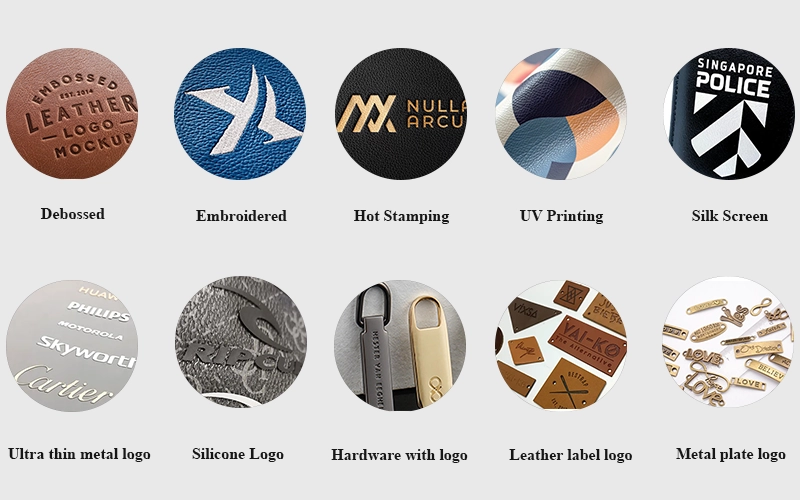
Logo option
2. Real Cost Impact of Wrong Logo Decisions (OEM Reality Layer)
In OEM production, logo mistakes are not cosmetic—they are financial.
If the wrong logo method is selected:
- Tooling modification delay: +5 to 7 working days
- Extra sampling cycles: 2–3 rounds minimum
- Production inconsistency risk: batch rejection probability increases
- Retail positioning downgrade: perceived value drop
- Engineering inefficiency: 15%–25% project cost increase
In real cases, the cost of correcting a logo issue can exceed:
leather material + stitching + packaging combined
Why this happens:
Because logo tooling is a fixed manufacturing asset, not a flexible design element. Once produced, any change requires:
- new metal dies
- re-adjusted pressure calibration
- re-sampling validation
- structural re-alignment
This is why experienced OEM buyers always finalize the logo method BEFORE sampling begins.
3. 10-Second OEM Logo Decision System
For fast decision-making, use this simplified engineering system:
| Project Type | Best Logo Method | Risk Level |
|---|---|---|
| Amazon / Private Label | Blind Debossing | Low |
| Premium Retail Brand | Metal Logo Plate | Medium |
| Corporate / Government | Debossing / Metal Plate | Low–Medium |
| Promotional Products | Screen Printing | High |
| Fashion / Lifestyle | Embossing | Medium |
| Minimal Tech Brand | Laser Engraving | Medium |
Engineering rule of thumb:
If uncertain, blind debossing is the safest default for OEM leather iPad cases.
Because it has:
- lowest defect rate
- highest material compatibility
- most stable mass production performance
4. Before / After Engineering Impact
Wrong Logo Engineering Outcomes:
- inconsistent logo depth across batches
- blurred embossing edges or uneven print wear
- unstable visual branding across SKUs
- reduced shelf impact in retail environments
Correct Engineering Outcomes:
- stable replication across mass production
- predictable tooling performance
- premium alignment with leather texture
- scalable branding across product lines
Key insight:
The difference is not visual—it is commercial scalability and production reliability.
5. Core Logo Methods
5.1 Blind Debossing
Blind debossing uses heat + pressure to press the logo into leather, creating a recessed impression.
Why OEM buyers prefer it:
- No ink → no fading or peeling
- Stable mass production yield
- Compatible with most leather types
- Strong premium minimal aesthetic
- Lowest defect rate in sampling and production
Engineering Constraints
To ensure stable production, the following thresholds are required:
- Minimum stroke width: ≥ 0.4 mm
- Minimum letter height: ≥ 3 mm
- Minimum spacing: ≥ 0.5 mm
- Distance from stitching: ≥ 5 mm
- Distance from magnetic/fold structure: ≥ 8 mm
Engineering Insight:
If below threshold:
- pressure distribution becomes uneven
- fine details collapse in natural grain leather
- edge definition becomes inconsistent
Blind debossing works best when treated as a precision-controlled mechanical process, not a visual imprint.
5.2 Embossing
Embossing creates a raised 3D logo effect.
Strengths:
- Strong visual identity
- Tactile branding experience
- Suitable for PU and microfiber leather
Engineering Risks:
- Full-grain leather → structural collapse under pressure
- Fine typography → detail loss
- Internal padding variation → uneven surface elevation
Engineering Insight:
Embossing is sensitive to:
- leather elasticity
- backing material density
- heat distribution consistency
It is visually stronger but mechanically less predictable.
5.3 Screen Printing
Used when brand color accuracy is critical.
Strengths:
- Pantone color matching possible
- Fast sample turnaround
- Low tooling cost
Risks:
- surface abrasion over time
- reduced luxury perception
- weak durability under friction
Engineering Insight:
Printing is chemically dependent, not structurally integrated, which is why durability is lower than that of debossing.
5.4 Laser Engraving
Laser engraving burns the logo into leather using digital beam control.
Strengths:
- extremely high precision
- no tooling required
- ideal for modern typography
Hidden Risks:
- different leather batches react differently
- coating thickness affects contrast
- color depth is inconsistent across production runs
Laser = precision system + material sensitivity system combined.
5.5 Metal Logo Plate
Metal plates are attached externally to the case surface.
Strengths:
- highest perceived value
- strong retail visibility
- excellent durability
Engineering Constraints:
- requires structural alignment planning
- may conflict with magnetic zones
- increases assembly complexity
Metal plates must be designed together with product structure—not separately.
6. Deboss vs Emboss
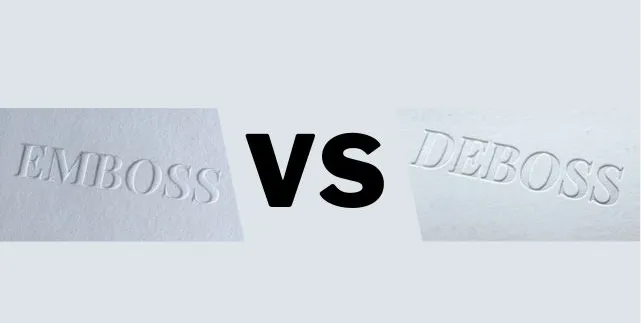
Emboss vs Deboss
| Factor | Debossing | Embossing |
|---|---|---|
| Stability | ⭐⭐⭐⭐⭐ | ⭐⭐⭐ |
| Visual Impact | ⭐⭐⭐⭐ | ⭐⭐⭐⭐⭐ |
| Detail Accuracy | ⭐⭐⭐⭐ | ⭐⭐⭐ |
| Production Risk | Low | Medium |
Engineering Conclusion:
- Debossing = scalable, engineering-safe system
- Embossing = expressive but structurally sensitive system
Most OEM failures occur when embossing is used on unstable leather structures.
7. Material × Logo Engineering Risk Matrix
| Material | Deboss | Emboss | Laser | Metal | |
|---|---|---|---|---|---|
| PU Leather | Best | Good | Good | Good | Good |
| Full Grain Leather | Best | Risky | Risky | Good | Best |
| Top Grain Leather | Best | Good | Medium | Good | Best |
| Microfiber Leather | Best | Good | Good | Best | Good |
| Vegan Leather | Good | Medium | Best | Good | Good |
Engineering Principle:
Smooth surface = high precision
Natural grain = high variability but premium texture
8. Common OEM Logo Failures
Mistake 1
Embossing on soft full-grain leather
→ edge collapse due to low structural resistance
Mistake 2
Logo placed over magnetic zone
→ uneven pressure deformation
Mistake 3
Too close to the stitching line
→ post-assembly distortion
Mistake 4
Metal plate on textured leather
→ adhesion failure + visual mismatch
Mistake 5
No artwork engineering review
→ repeated sampling cycles
These account for the majority of OEM production delays.
9. Artwork Engineering Gate
Required Formats:
- AI / EPS / SVG / PDF (vector only)
Engineering Requirements:
- stroke ≥ 0.4 mm
- letter height ≥ 3 mm
- edge distance ≥ 5 mm
- no gradients or raster images
High-Risk Inputs:
- PNG / JPG files
- unoutlined fonts
- ultra-thin strokes
- micro-detail logos
Insight:
Most logo failures originate from artwork, not manufacturing.
10. Experienced OEM Buyer Logic
Experienced buyers do not ask:
“Which logo looks best?”
They ask:
“Which logo survives mass production with zero rework cost?”
Because they prioritize:
- sampling efficiency over aesthetics
- tooling stability over design complexity
- production predictability over visual preference
Logo selection = engineering risk management decision system.
11. Engineering Support System
We provide OEM support, including:
- logo feasibility evaluation before tooling
- material × logo compatibility analysis
- structural interference review
- production risk scoring
Objective: Reduce sampling cycles and achieve first-sample accuracy closer to final production.
12. OEM Workflow
- Send logo artwork
- Provide leather selection
- Share product structure (if available)
- Engineering evaluation (24h)
- Receive risk + method recommendation
Output:
- reduced sampling cycles
- improved production yield
- faster time-to-market
13. Conclusion
If you are developing a leather iPad case and want to ensure your logo method is production-safe, our engineering team can evaluate it before tooling begins.
Please send:
- logo file
- leather type
- product structure
You will receive:
- feasibility analysis
- risk assessment
- optimized logo recommendation
- expected production outcome
This reduces tooling risk, avoids unnecessary sampling cycles, and accelerates OEM development timelines.
FAQ
1. Which logo method is most durable for leather iPad cases?
Blind debossing and metal logo plates are the most durable options due to structural integration and mechanical resistance.
2. Can embossing be used on full-grain leather?
It is not recommended for soft full-grain leather, as its surface elasticity can cause edge collapse and distortion.
3. Does logo customization increase MOQ?
In most OEM projects, the logo method does not affect the MOQ. However, metal logo plates may require additional setup conditions.
4. Which file format is required for OEM logo production?
Vector formats only: AI, EPS, SVG, or PDF. Raster files (JPG/PNG) are not suitable.
5. Can I change the logo after tooling is completed?
Yes, but it requires new tooling and additional cost due to fixed mold production.
6. Which logo method is best for premium branding?
Blind debossing is the most widely used for premium minimalist positioning, while metal plates are used for luxury retail.
7. How long does logo tooling take?
Typically 5–10 working days, depending on complexity and factory workload.
8. Can multiple logo methods be combined?
Yes, but it depends on structure design and cost constraints. Engineering review is required.