
Quick Answer
Card retention is one of the key performance factors of a MagSafe wallet.
It determines whether cards:
- Stay securely inside the wallet during daily use
- Can be removed smoothly when needed
- Maintain consistent performance after repeated use
Cards may fall out or become difficult to access due to:
- Incorrect card slot dimensions
- Improper capacity planning
- Material deformation
- Unbalanced friction
- Insufficient reinforcement
- Poor access design
For brands developing custom leather MagSafe wallets, card retention should be considered during the early design stage.
A successful design is not the tightest card slot.
It is a structure that balances:
Security + Accessibility + Long-term durability
Why Card Retention Matters for MagSafe Wallet Brands
MagSafe wallets are designed for users who want a slim and convenient alternative to traditional wallets.
Typical usage includes carrying:
- Bank cards
- ID cards
- Access cards
- Essential daily cards
However, a slim wallet has limited structural space.
Increasing card capacity may affect:
- Overall thickness
- Card removal experience
- Pocket comfort
- Long-term slot stability
For brands, poor card retention can directly affect customer satisfaction and product reviews.
Common user complaints include:
- Cards sliding out during movement
- Difficulty removing cards at checkout
- Loose card slots after extended use
- Excessive tightness when carrying multiple cards
These problems are usually caused by design balance issues rather than a single material problem.
Card Retention Is Different From Magnetic Attachment
A MagSafe wallet contains two independent functional systems.
Magnetic Attachment
Controls:
Card Retention
Controls:
- How securely cards stay inside the wallet
These functions require different design considerations.
A wallet can have strong magnetic attachment but still have poor card retention.
Likewise, a well-designed card slot does not depend on magnetic performance.
This article focuses only on the card holding performance inside the wallet.
1. MagSafe Wallet Card Slot Design: The Foundation of Retention
The card slot is the main structure controlling retention performance.
Small changes in slot design can significantly affect user experience.
Slot Depth
Slot depth determines how much of the card is supported inside the wallet.
Too shallow:
- Reduced card support
- Higher risk of cards sliding out
Too deep:
- Difficult card access
- Poor user experience
The ideal slot depth depends on:
- Target card capacity
- Material thickness
- Internal reinforcement
- Opening structure
Slot Pressure
Retention depends on controlled pressure.
Insufficient pressure:
- Cards move too easily
- Retention becomes unreliable
Excessive pressure:
- Cards become difficult to remove
- Users feel the wallet is inconvenient
A well-designed card slot should provide enough holding force while maintaining smooth operation.
Card Access Design
Card access design affects both usability and appearance.
Common solutions include:
- Thumb push slot
- Finger groove
- Front cutout
- Side opening
The design should allow users to remove cards naturally without reducing retention.
2. How Many Cards Should a MagSafe Wallet Hold?
Card capacity is one of the most important decisions during product development.
A common mistake is designing for maximum capacity without considering daily usage.
A slim wallet cannot increase storage indefinitely without affecting comfort.
| Capacity | Advantage | Design Consideration |
|---|---|---|
| 1 Card | Slimmest profile | Requires precise retention control |
| 2 Cards | Best daily balance | Suitable for most users |
| 3 Cards | Higher storage | Requires stronger structural control |
| 4+ Cards | Maximum capacity | Usually affects slim design |
For premium leather MagSafe wallets, a 2-card or 2-3 card structure usually provides the best balance.
Before development, brands should define the intended user scenario:
- Minimalist wallet
- Everyday wallet
- Travel wallet
- Higher-capacity replacement wallet
Different positioning requires different slot structures.
3. What Causes Cards to Fall Out of MagSafe Wallets?
Cards usually fall out because the wallet cannot maintain the correct balance between structure and flexibility.
Common causes include:
1. Incorrect Slot Dimension
A slot designed too loose cannot provide enough holding force.
A slot designed too tight creates poor usability.
2. Material Stretching
Flexible materials may change after repeated card insertion.
Without proper structural support, the slot may gradually loosen.
3. Improper Capacity Design
A wallet designed for three cards may perform poorly when users carry only one card.
Capacity should match the intended usage.
4. Poor Friction Control
The inner surface needs suitable friction.
Too smooth:
- Cards may move easily
Too rough:
- Cards become difficult to remove
4. How Material Structure Affects Long-Term Card Retention
The outer leather material shapes the product’s appearance, but the internal construction determines durability.
During daily use, the card slot experiences:
- Repeated insertion
- Compression
- Stretching
- Shape changes
Important structural factors include:
Leather Thickness
Thicker leather:
- Provides stronger structure
- May increase product thickness
Thinner leather:
- Creates a slimmer profile
- Requires better reinforcement control
Reinforcement Layer
A reinforcement layer helps maintain the slot shape during repeated use.
Typical structure:
Outer Leather
↓
Reinforcement Layer
↓
Adhesive Layer
↓
Inner Lining
↓
Card Contact Surface
The correct structure helps prevent:
- Slot deformation
- Excessive stretching
- Reduced retention performance
Inner Lining Material
The lining directly affects:
- Friction
- Card movement
- Removal experience
A smooth surface may improve accessibility.
A higher-friction surface may improve holding performance.
The best choice depends on the product positioning and target capacity.
5. Friction Control: Balancing Security and Accessibility
Friction is a critical factor in card retention.
A premium MagSafe wallet should keep cards secure while allowing comfortable removal.
Friction is affected by:
- Inner lining texture
- Surface treatment
- Slot pressure
- Card thickness
- Edge finishing
- Material aging
A good design does not rely only on tight compression.
It combines:
- Correct slot geometry
- Suitable lining material
- Stable reinforcement
- Controlled pressure
6. MagSafe Wallet Card Retention Testing Before Production
A visually attractive sample does not always guarantee reliable performance.
Before mass production, brands should evaluate both function and durability.
Card Capacity Testing
Test different scenarios:
- 1 card
- 2 cards
- 3 cards (if advertised)
Different card quantities may create different retention performance.
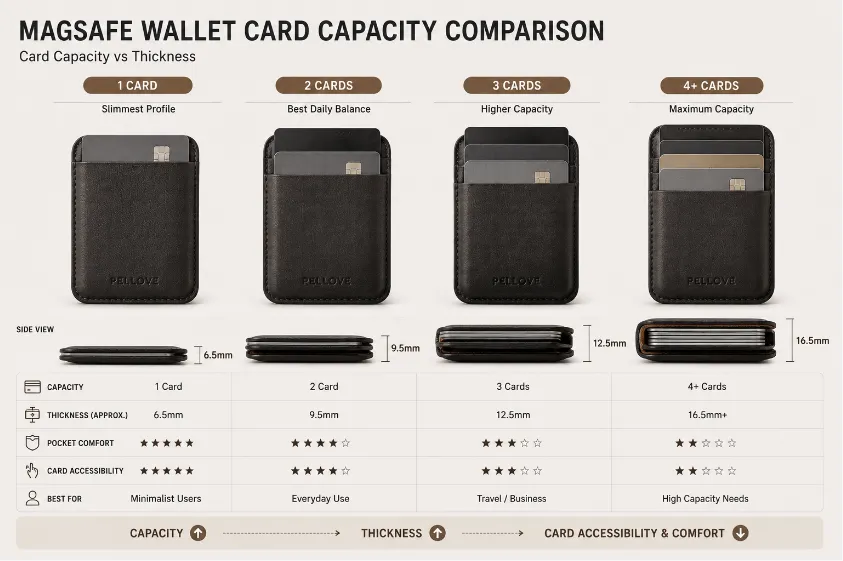
MagSafe wallet card capacity comparison
Card Removal Testing
Evaluate:
- Card insertion experience
- Card removal force
- One-hand operation
- Daily usability
Testing with real cards is recommended because different cards have different thickness and surface conditions.
Durability Testing
Recommended evaluations:
| Test | Purpose |
|---|---|
| Card insertion cycles | Evaluate long-term slot durability |
| Pull-out test | Check retention performance |
| Loaded thickness test | Evaluate comfort |
| Shape retention test | Check structural stability |
The purpose is to confirm consistent performance after extended use.
Common OEM Development Challenges
Challenge 1: Designing for Maximum Capacity
A brand may request a 3-card wallet to increase selling points.
However, excessive capacity may affect:
- Thickness
- Card accessibility
- Long-term retention
The solution is balancing capacity with real user behavior.
Challenge 2: Premium Materials Need Structural Control
Soft leather creates a premium touch but may require additional reinforcement.
Material selection and construction must work together.
Challenge 3: Appearance Does Not Guarantee Performance
A beautiful prototype may still have usability problems.
Functional testing should be completed before mass production.
How Pellove Supports MagSafe Wallet Development
Pellove helps brands develop custom leather MagSafe wallets with a focus on both appearance and performance.
Our development support includes:
- Card slot structure evaluation
- Capacity optimization
- Material and lining recommendation
- Reinforcement structure review
- Card access improvement
- Prototype performance testing
From prototype development to mass production, Pellove helps brands optimize product structure before launch.
A successful MagSafe wallet is not only visually premium.
It should also provide reliable everyday performance.
FAQ
Why do cards fall out of MagSafe wallets?
Cards usually fall out because of incorrect slot dimensions, insufficient friction, material stretching, or improper capacity design.
How many cards should a MagSafe wallet hold?
For most slim leather MagSafe wallets, 2 cards provide the best balance between thickness, security and usability.
Why are cards difficult to remove from MagSafe wallets?
Common reasons include excessive slot pressure, unsuitable lining friction, or poor access design.
Can leather MagSafe wallets become loose over time?
Yes. Flexible materials may change after repeated use. Proper reinforcement and structural design help maintain retention performance.
What should brands test before launching a MagSafe wallet?
Brands should evaluate:
- Card retention
- Card removal experience
- Different card capacities
- Slot durability
- Long-term usability
Conclusion
A successful leather MagSafe wallet is not defined by how many cards it can store.
The best design balances:
- Secure card retention
- Easy card access
- Slim profile
- Premium appearance
- Long-term durability
For OEM brands, card retention should be considered from the beginning of product development through proper slot design, material selection and prototype testing.
A well-engineered MagSafe wallet does not simply hold more cards.
It delivers a better everyday experience for the end user.