
How many cards should a leather MagSafe wallet hold?
The best answer depends less on the number printed on the product page and more on the internal structure.
A 2-card wallet may use two card slots or one spring-plate pocket. A 3-card wallet can use one spring-plate structure that securely holds one, two, or three cards. A 4/5-card wallet is often built by keeping the 3-card spring-plate section and adding a second card area, especially in kickstand designs. A 7/8-card wallet usually switches to an elastic pocket or pouch-style structure.
For brands, that distinction matters.
Card capacity affects:
- thickness
- magnetic retention
- leather stretch
- card security
- kickstand space
- Find My space
- pocket comfort
- product positioning
- OEM difficulty
At Pellove, we evaluate MagSafe wallet card capacity together with the spring plate, elastic pocket, leather thickness, magnetic layout, lining, edge finishing, and final use scenario. The goal is not to make the wallet hold the most cards. The goal is to match the internal structure to the real user need.
If you are still comparing suppliers, this MagSafe wallet manufacturer guide explains how to evaluate factory capability, material control, QC standards, and private label support.
Quick Answer: Which Capacity Is Right?
| Capacity | Typical Structure | Best Product Positioning | Main Risk |
|---|---|---|---|
| 2 cards | Two slots or spring-plate pocket | Slim minimalist wallet | Limited storage |
| 3 cards | One spring-plate pocket | Everyday slim wallet | Spring tension |
| 4/5 cards | Spring plate + extra card section | Kickstand / multifunctional wallet | More thickness |
| 7/8 cards | Elastic pocket | Travel / high-capacity wallet | Bulk and stretch |
A 2-card wallet is not always the best minimalist design.
In many cases, a well-made 3-card leather MagSafe wallet gives buyers more flexibility without requiring a larger structure.
The real question is not:
How many cards can fit?
It is:
How many cards can the structure hold securely, comfortably, and consistently after repeated use?
Why Card Capacity Depends on Internal Structure
A MagSafe wallet is not an empty pouch. Its card capacity is controlled by how the cards are held inside.
Three structures dominate the market:
- Spring-plate card pocket
- Multi-section card structure
- Elastic pocket or pouch-style structure
Each one creates a different user experience.
A spring-plate wallet can keep cards secure even when the pocket is not fully loaded. An elastic pocket can hold more cards, but it usually needs a fuller load to maintain tension. A multi-section structure adds capacity, but also adds thickness and assembly complexity.
That is why two wallets advertised as “4 cards” may behave very differently in daily use.
A standard ID-1 card is about 0.76 mm thick. Source: ISO/IEC 7810 overview. Once you stack several cards, thickness rises quickly, which is why the internal structure matters so much.
2-Card MagSafe Wallet: Two Common Structures
A 2-card MagSafe wallet usually follows one of two designs.
Structure A: Two Separate Card Slots
The wallet has two individual card pockets. Each card has its own position, so the user can identify and remove a card more easily.
This structure works well for:
- one ID card and one payment card
- one bank card and one transit card
- premium leather card holders
- slim business-style wallets
Its biggest advantage is organization.
The user does not need to remove the first card to reach the second one.
The tradeoff is that two separate slots usually need more leather, more stitching, and more internal space than a single spring-plate pocket.
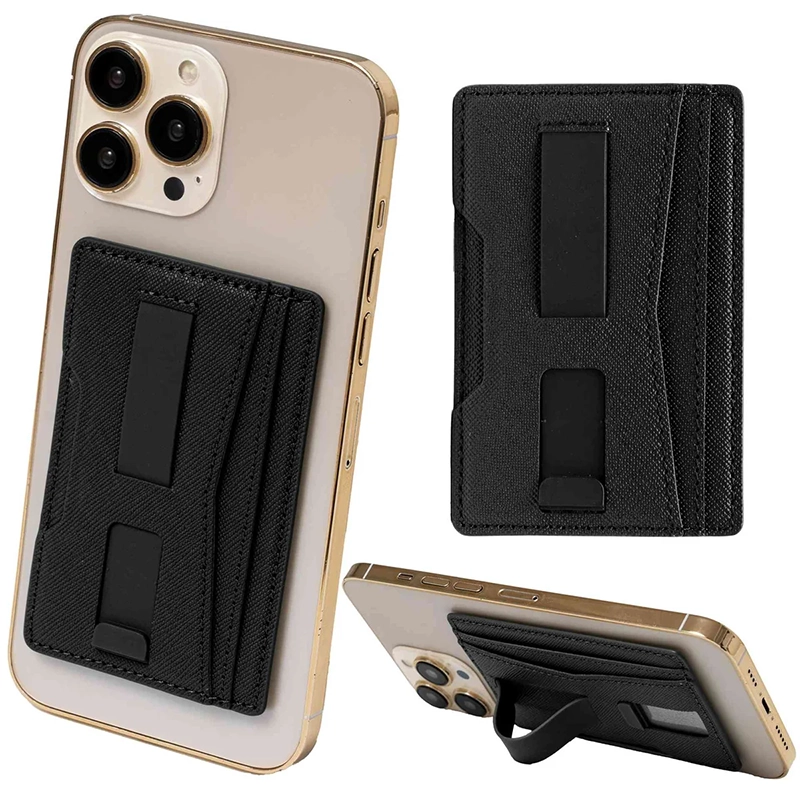
2-Card MagSafe Wallet
Structure B: One Spring-Plate Pocket for Two Cards
A single pocket with a spring plate can hold two cards against the front surface. The spring plate provides continuous pressure and keeps the cards from sliding out even when the pocket is not fully filled.
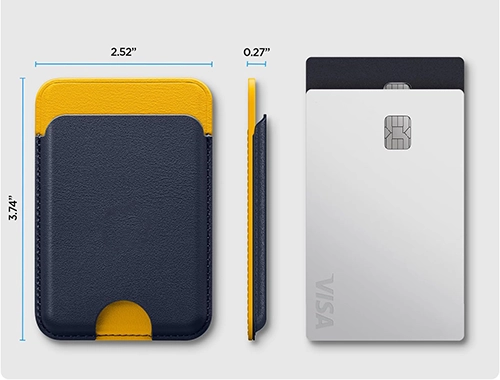
One Spring-Plate Pocket for Two Cards
This structure is usually:
- thinner than two separate card slots
- easier to combine with a minimalist back plate
- suitable for slim MagSafe wallets
- easier to combine with a simple logo and packaging system
The spring plate must be controlled carefully. If it is too weak, cards may fall out. If it is too strong, card removal becomes frustrating and the leather may show pressure marks.
A 2-card structure is also the most practical base for a Find My MagSafe wallet, because it leaves more room for tracking hardware without creating excess bulk.
3-Card MagSafe Wallet: The Spring-Plate Structure
The 3-card MagSafe wallet is one of the most practical structures for daily use.
This is where the market becomes interesting.
A 3-card spring-plate pocket can usually hold one, two, or three cards securely. That makes it more flexible than a simple 2-card structure, but still thin enough to stay comfortable on the back of a phone.
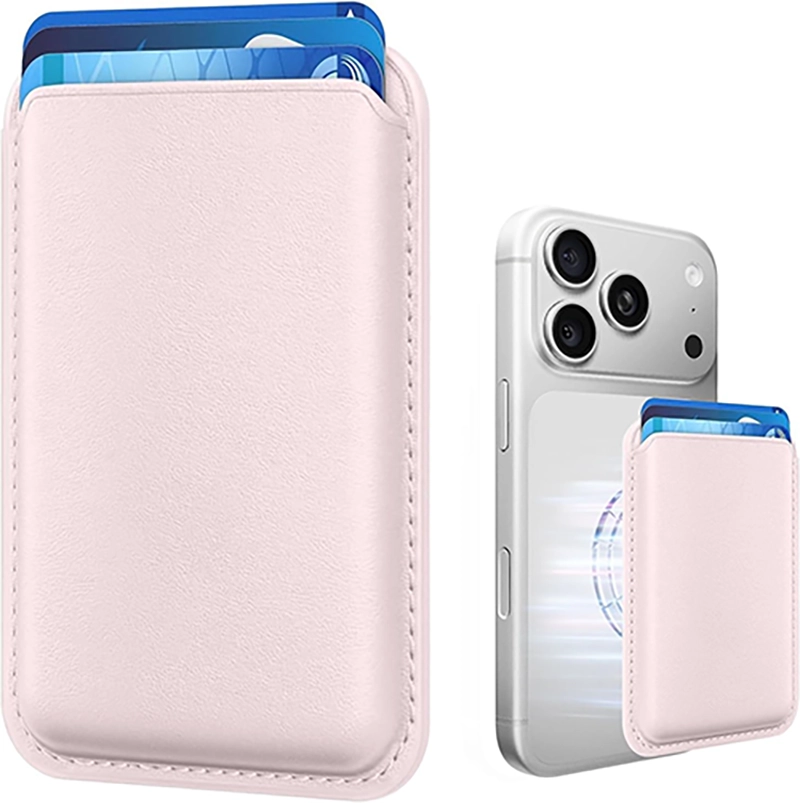
3-Card MagSafe Wallet
Why Brands Should Care About the 3-Card Structure
The 3-card format offers a useful middle ground:
- more flexible than a 2-card wallet
- thinner than a 4/5-card multifunctional wallet
- easier to use with one, two, or three cards
- suitable for premium leather positioning
- strong fit for daily users
A customer may use one card on Monday, two cards on Wednesday, and three cards while traveling. The wallet still works without feeling empty or insecure.
For many brands, the 3-card leather MagSafe wallet is the most practical starting point because it balances slimness, retention, and everyday usability.
OEM Design Considerations
The spring plate must be calibrated for the advertised capacity.
The factory should evaluate:
- spring force
- pocket depth
- plate position
- leather thickness
- lining friction
- removal force
- surface pressure on the leather
A 3-card MagSafe wallet manufacturer should not treat the spring plate as a hidden metal part that can be added at the end. It is a core part of the user experience.
If your brand wants one mainstream SKU that feels balanced and premium, the custom 3-card MagSafe wallet is often the structure worth validating first.
4/5-Card MagSafe Wallet: Spring Plate Plus Extra Card Section
A 4/5-card MagSafe wallet is usually not a simple larger version of the 3-card wallet.
In many designs, the front section keeps the same 3-card spring-plate structure. An additional section is then added behind or beside it for one or two more cards.
This structure is especially common in:
- kickstand MagSafe wallets
- multifunctional magnetic wallets
- fold-over card-holder designs
- premium business wallets
Typical Structure
The front area:
- uses a spring plate
- holds up to three cards
- keeps cards secure even when the section is not full
The additional area:
- uses a separate card slot
- may hold one or two cards
- can be placed behind the front section
- may be integrated into the kickstand or flap structure
This is more practical than forcing every card into one oversized pocket.
For example:
- front spring-plate section: frequently used ID or payment cards
- additional slot: access card, transit card, or backup card
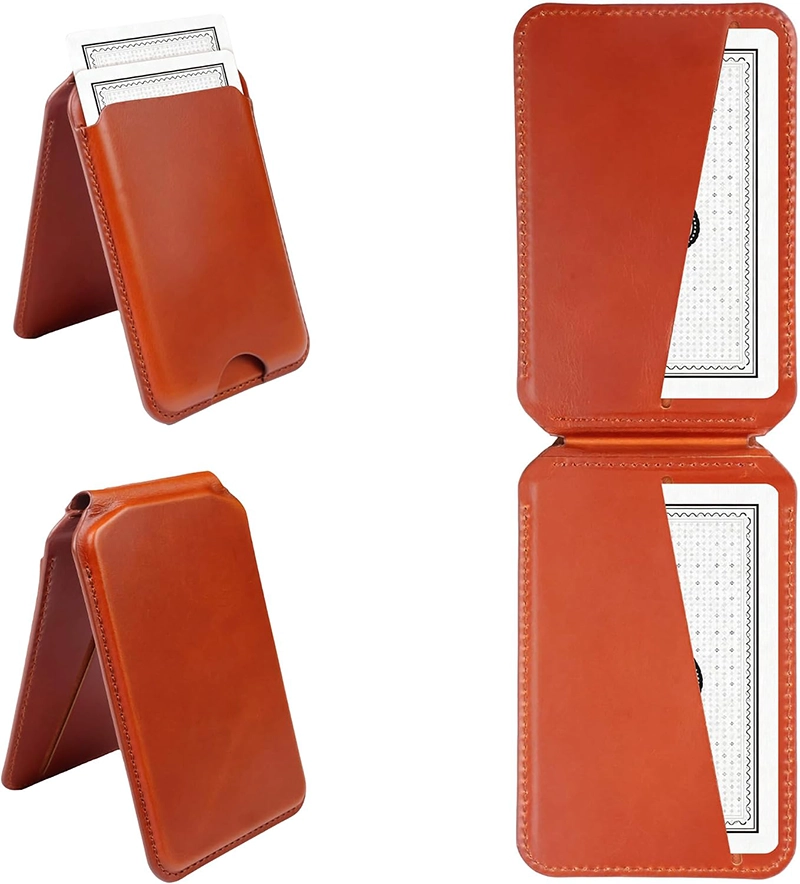
4/5-Card MagSafe Wallet
Why This Structure Is Harder
The extra card section adds:
- more leather layers
- more internal pressure
- more weight
- more distance between the magnet and the phone
- more difficulty keeping the wallet flat
The structure also needs to stay balanced when the wallet is used as a stand.
A 4/5-card wallet that works well as a card holder may become unstable when used as a kickstand. The card load changes the center of gravity, while the added layers can affect folding and magnetic attachment.
That is why brands developing a kickstand MagSafe wallet should define the card capacity and stand structure together instead of adding the stand after the wallet is already designed.
7/8-Card MagSafe Wallet: Elastic Pocket Structure
When the capacity reaches 7 or 8 cards, the internal structure usually changes completely.
At this level, a spring-plate design is often no longer practical. The wallet needs to expand and contract, so manufacturers usually move to an elastic pocket, elastic band, or pouch-style structure.
The elastic material holds cards through continuous tension.
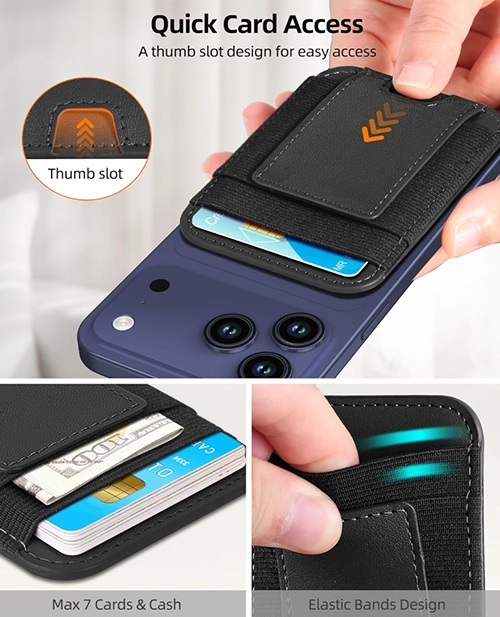
7/8-Card MagSafe Wallet
Best For
- frequent travelers
- business users carrying multiple cards
- customers replacing a traditional wallet
- buyers who need higher capacity
- users who prioritize storage over slimness
Main Advantages
- holds more cards
- accommodates different card combinations
- can sometimes hold folded cash
- clearly differentiates the product from basic slim wallets
Main Limitations
The problem is not whether an elastic pocket can physically hold eight cards.
The problem is what happens when users actually carry eight cards every day.
The wallet becomes:
- thicker
- heavier
- more back-heavy
- less comfortable in pockets
- harder to keep securely attached
- more likely to stretch over time
A 7/8-card wallet also needs careful elastic tension. If the elastic is too loose, cards move inside the pocket. If it is too tight, loading and unloading become annoying.
That means brands should define the recommended capacity clearly. A wallet may physically fit eight cards, but that does not mean eight cards is the best everyday user experience.
Magnetic Strength and Card Capacity
As the wallet becomes thicker, the magnetic system has to work across a greater distance.
That can lead to:
- weaker attachment
- movement during walking
- detachment when pulling the phone from a pocket
- instability when the wallet is used as a stand
- uneven contact with MagSafe accessories
The problem becomes more serious in 4/5-card and 7/8-card designs, where more leather layers and cards sit between the magnet and the phone.
For a more detailed explanation of why wallets fall off under load, see MagSafe wallet magnet strength.
A proper magnetic test should be completed:
- with the wallet empty
- with the recommended card load
- with the maximum advertised load
- on a bare phone
- on a MagSafe-compatible phone case
- during normal movement
An empty-wallet test is not enough.
How OEM Brands Should Validate a MagSafe Wallet Before Production
Choosing the card capacity is only the first step. Before mass production, brands should validate the wallet in real use.
1. Card Loading Test
Test the wallet with:
- one card
- the recommended capacity
- the maximum advertised capacity
Check whether cards stay secure and whether users can remove them without excessive force.
For a spring-plate wallet, test whether one card stays secure.
For an elastic pocket, test whether the pocket still holds cards properly at lower and higher loads.
2. Spring-Plate Retention Test
For 2-card and 3-card structures, inspect:
- spring force
- card movement
- card edge damage
- removal effort
- pressure marks on leather
- performance after repeated loading
A spring plate that works well in a new sample may perform differently after repeated use.
3. Multi-Section Test for 4/5-Card Wallets
For a kickstand or multifunctional wallet, test each card area separately.
Check:
- front spring-plate section
- additional card slot
- wallet flatness
- card interference
- closing behavior
- stand stability
- magnetic hold under full load
The extra card section should not make the front section loose or difficult to use.
4. Elastic Pocket Test for 7/8-Card Wallets
Elastic structures should be tested at different loads:
- minimum recommended load
- normal daily load
- maximum advertised load
Inspect:
- elastic recovery
- pocket looseness
- card movement
- stitching stress
- leather deformation
- edge wear
5. Magnetic Retention Test
Test the wallet during:
- walking
- pocket removal
- phone handling
- light vibration
- stand use
- repeated attachment and removal
The test should reflect the product’s advertised capacity, not just the empty state.
6. Leather Stretch and Daily Use Test
Repeatedly load and unload the wallet to check:
- slot expansion
- leather stretching
- lining separation
- spring plate movement
- elastic fatigue
- edge cracking
- stitching stability
This is where a leather wallet shows whether the material and structure were chosen correctly.
Product Line Strategy for Brands
A brand does not need to launch every capacity under one product. A better approach is to assign each structure a clear role.
| Product Line | Structure | Recommended Role |
|---|---|---|
| Slim Wallet | 2-card slot or spring plate | Premium minimalist SKU |
| Everyday Wallet | 3-card spring plate | Main compact daily-use SKU |
| Kickstand Wallet | 3-card spring plate plus 1/2-card section | Main multifunctional SKU |
| High-Capacity Wallet | 7/8-card elastic pocket | Travel and niche extension |
The 3-card spring-plate wallet deserves special attention. It may be the most balanced daily structure because it can hold one, two, or three cards without requiring a separate expandable pouch.
The 4/5-card structure is better when the brand wants to add a stand or a second card area.
The 7/8-card structure should remain a niche option. It can attract customers who genuinely need more storage, but it should not be marketed as a slim wallet.
For foldable phones or other thicker devices, 2-card and 3-card structures are usually safer because the phone already has more inherent bulk.
How Pellove Helps Develop Leather MagSafe Wallets
Pellove supports brands developing:
- 2-card leather MagSafe wallets
- 3-card spring-plate wallets
- 4/5-card kickstand wallets
- 7/8-card elastic-pocket wallets
- Find My MagSafe wallets
- matching leather phone cases
- private label accessory collections
During product development, Pellove evaluates:
- card capacity
- spring-plate structure
- elastic pocket structure
- leather thickness
- slot tension
- magnetic layout
- lining friction
- card insertion and removal
- kickstand space
- Find My module space
- edge finishing
- packaging instructions
- OEM / ODM production feasibility
The aim is not to put the largest possible number of cards into the smallest possible wallet. The aim is to match the internal structure to the real customer use case.
For brands already developing custom leather phone cases, a matching leather MagSafe wallet can create a more complete accessory collection. If you are developing a custom product from an existing design, sketch, or reference sample, Pellove’s OEM / ODM custom project service can help evaluate the structure and production path.
FAQ
What is the best card capacity for a MagSafe wallet?
For most users, 2 to 4 cards is the most practical range. Two cards are best for slim premium designs, three cards are often the best balance, and four cards offer more daily flexibility.
Why is the 3-card MagSafe wallet important?
The 3-card leather MagSafe wallet is often the most balanced structure. It can usually hold one, two, or three cards securely while staying thinner than 4/5-card multifunctional designs.
Can a leather MagSafe wallet hold 8 cards?
Yes, but an 8-card design will be thicker and heavier. It should be positioned as a travel or full-wallet replacement product rather than an ultra-slim wallet.
Does card capacity affect magnetic strength?
Yes. More cards add thickness and weight, increasing the distance between the magnetic structure and the phone. This can reduce stability and increase the risk of shifting or detachment.
Is a 2-card MagSafe wallet too small?
Not necessarily. It is suitable for customers carrying only an ID card and one payment or transit card. It is also the most practical structure for kickstand and Find My versions.
Is 4/5 cards the best capacity for an OEM product?
For many brands, yes. A 4/5-card MagSafe wallet can combine a spring-plate section with an extra card area, which makes it suitable for multifunctional or kickstand products.
Why do leather MagSafe wallet slots become loose?
Leather can stretch with repeated card insertion and removal. Loose card slots may also result from poor pocket depth, weak lining friction, insufficient reinforcement, or incorrect material selection.
Should brands test a wallet empty or fully loaded?
Both tests are useful, but the wallet must be tested at its recommended and maximum advertised capacity. A fully loaded wallet behaves differently from an empty sample.
Can Pellove customize MagSafe wallet capacity?
Yes. Pellove can develop 2-card, 3-card, 4/5-card, and 7/8-card leather MagSafe wallets with custom leather, logo craft, magnetic layout, lining, packaging, and OEM / ODM production support.