
Apple has officially introduced iPhone Duo, its first foldable iPhone. For brands looking to develop a custom leather case, the development conversation has now changed significantly.
Before the launch, manufacturers had to work around rumors, estimated dimensions and incomplete information. Now, OEM and ODM buyers can work from Apple’s confirmed device specifications and official accessories.
For leather case manufacturers, however, iPhone Duo is still very different from a conventional iPhone. Its folding architecture, precision hinge, two separate sides, magnetic charging system and repeated opening and closing movement all affect how a leather case should be designed.
This guide explains the key considerations for developing a custom iPhone Duo leather case, including structure, leather selection, hinge protection, MagSafe compatibility, testing, MOQ and the OEM/ODM development process.
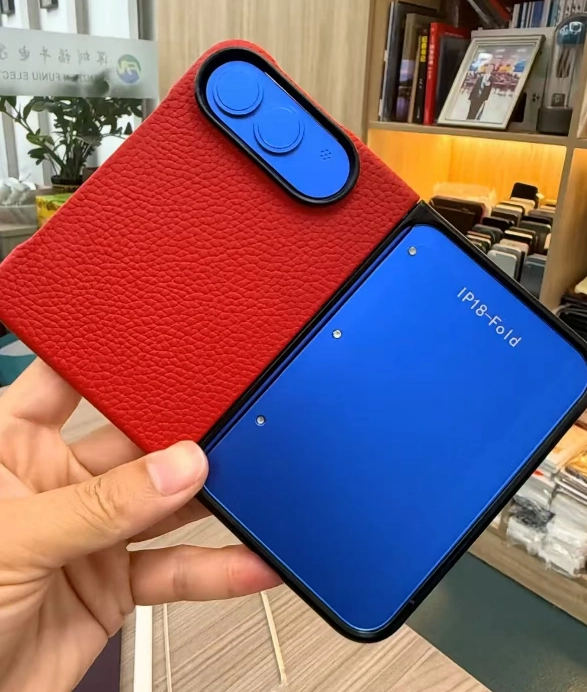
iPhone DUO leather phone case
iPhone Duo Specifications for Case Development
Apple’s official technical specifications provide manufacturers with a reliable starting point for case development.
| Specification | iPhone Duo |
|---|---|
| Open dimensions | 164.6 × 117.8 × 5.2 mm |
| Folded dimensions | 84.1 × 117.8 × 11.3 mm |
| Weight | 254 g |
| Inner display | 7.6-inch |
| Outer display | 5.4-inch |
| Frame | Grade 5 titanium |
| Hinge | Precision hinge |
| Wireless charging | MagSafe and Qi2 |
| MagSafe / Qi2 | Up to 25W |
| Apple Pencil | Apple Pencil (USB-C) supported |
| Case architecture | Two-part design available from Apple |
Apple confirms that iPhone Duo uses a titanium foldable design, a precision hinge and two displays. The phone measures 5.2 mm thick when open and 11.3 mm thick when folded.
These specifications are more useful for OEM development than the pre-launch estimates that manufacturers previously had to rely on.
For a factory, the most important change is simple: the device geometry is now confirmed, so case development can move from prediction to validation.
What Apple’s Official iPhone Duo Case Tells OEM Buyers
One of the most useful references for manufacturers is not only the phone itself, but also Apple’s own case design.
Apple’s official iPhone Duo Case uses a thin, lightweight two-part construction that wraps around both sides of the device. Apple also confirms compatibility with MagSafe, Qi2 25W and Qi-certified chargers.
This gives leather case manufacturers an important reference point.
A two-part case is not simply a smaller version of a traditional iPhone case. The two sections have to work together while the phone opens and closes.
For OEM/ODM development, the main design questions become:
- How should the two leather-covered sections connect?
- How much leather thickness can be used without affecting folding?
- How should the hinge area be protected?
- How should the leather be bonded to the shell?
- How can the case remain slim when the phone is folded?
- How should magnets be positioned for reliable attachment and charging?
- How can the case maintain alignment after repeated opening and closing?
These questions should be resolved during prototype development rather than after mass production begins.
Why iPhone Duo Leather Cases Are More Difficult Than Standard iPhone Cases
A conventional iPhone case is essentially a single rigid structure surrounding one device.
A foldable phone introduces movement.
The case has to accommodate two device sections connected by a central hinge. When the phone opens, the distance and angle between the two sections change. When it closes, the two sections come together again.
Leather makes this even more interesting.
Leather is flexible, but it is not dimensionally identical to plastic or metal. Its thickness, softness, grain structure, stretch and adhesive behavior can vary depending on the leather type and finishing process.
A leather case therefore has to balance four things:
Protection + flexibility + appearance + dimensional control
If the leather is too thick, the case can become bulky.
If the leather is too stiff, it may interfere with movement around the folding area.
If the leather is too soft, it may stretch or deform during repeated use.
If the adhesive system is not suitable, the leather may lift from the shell over time.
For this reason, a successful iPhone Duo leather case is not simply a leather-wrapped plastic case. It requires coordinated development between the leather, shell, adhesive, magnets and hinge area.
The Hinge Is the Most Important Area to Validate
The hinge is one of the defining components of iPhone Duo.
Apple describes the device as using a precision hinge designed to support the center of the display and provide smooth opening and closing.
For case manufacturers, this means the hinge should be treated as a functional area, not simply another surface to cover.
A leather case around the hinge needs enough freedom for the device to open and close naturally.
At the same time, the case should provide enough protection to prevent the exposed areas around the hinge from becoming vulnerable during everyday use.
During prototype development, manufacturers should check:
1. Opening and closing movement
The case should not create resistance that changes the normal movement of the phone.
2. Hinge clearance
The case structure and leather thickness should not interfere with the hinge or folding area.
3. Edge movement
Leather edges should remain stable rather than curling, lifting or rubbing against the device during repeated movement.
4. Adhesive durability
The adhesive system should be validated for the combination of leather, plastic and repeated movement.
5. Folded thickness
The case should still feel practical when the phone is closed.
This is especially important for premium leather cases because leather adds visual and tactile value, but also adds material thickness.
Three Practical iPhone Duo Case Structures for OEM/ODM Development
There are several possible approaches to developing a leather case for iPhone Duo. For most B2B projects, they can be grouped into three main categories.
1. Two-Piece Slim Leather Case
This structure uses two separate case sections corresponding to the two sides of the phone.
Each section can use a PC, TPU or hybrid shell with leather laminated or wrapped around the exterior.
This is the most straightforward approach for brands looking for a premium leather version of a slim protective case.
Advantages include:
- Slim overall construction
- Independent movement of the two case sections
- Easier hinge clearance
- Good compatibility with a foldable design
- Suitable for custom leather colors and branding
For a premium leather accessory brand, this structure also provides a relatively clean surface for embossing, debossing or hot stamping.
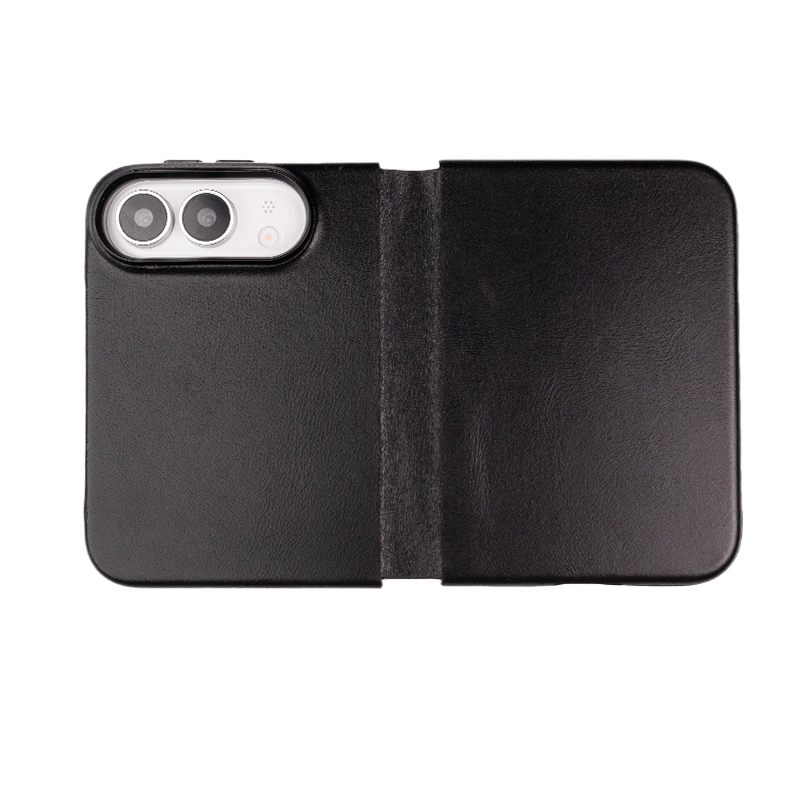
two piece iphone duo leather phone case
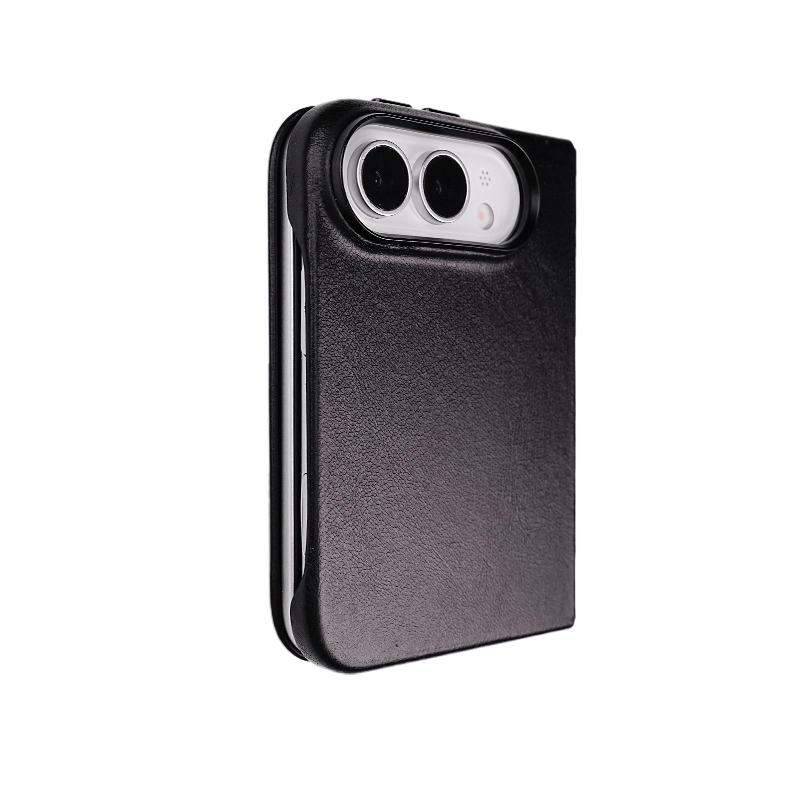
two piece iphone duo phone case
2. Leather Case With Enhanced Hinge Protection
A second approach is to add additional protection around the hinge area.
The exact structure can vary depending on how much hinge coverage the brand wants.
This can provide a stronger protective appearance, but it also increases the engineering requirements.
The manufacturer must make sure that additional material does not interfere with folding.
This is where leather thickness, edge treatment and flexible transition areas become especially important.
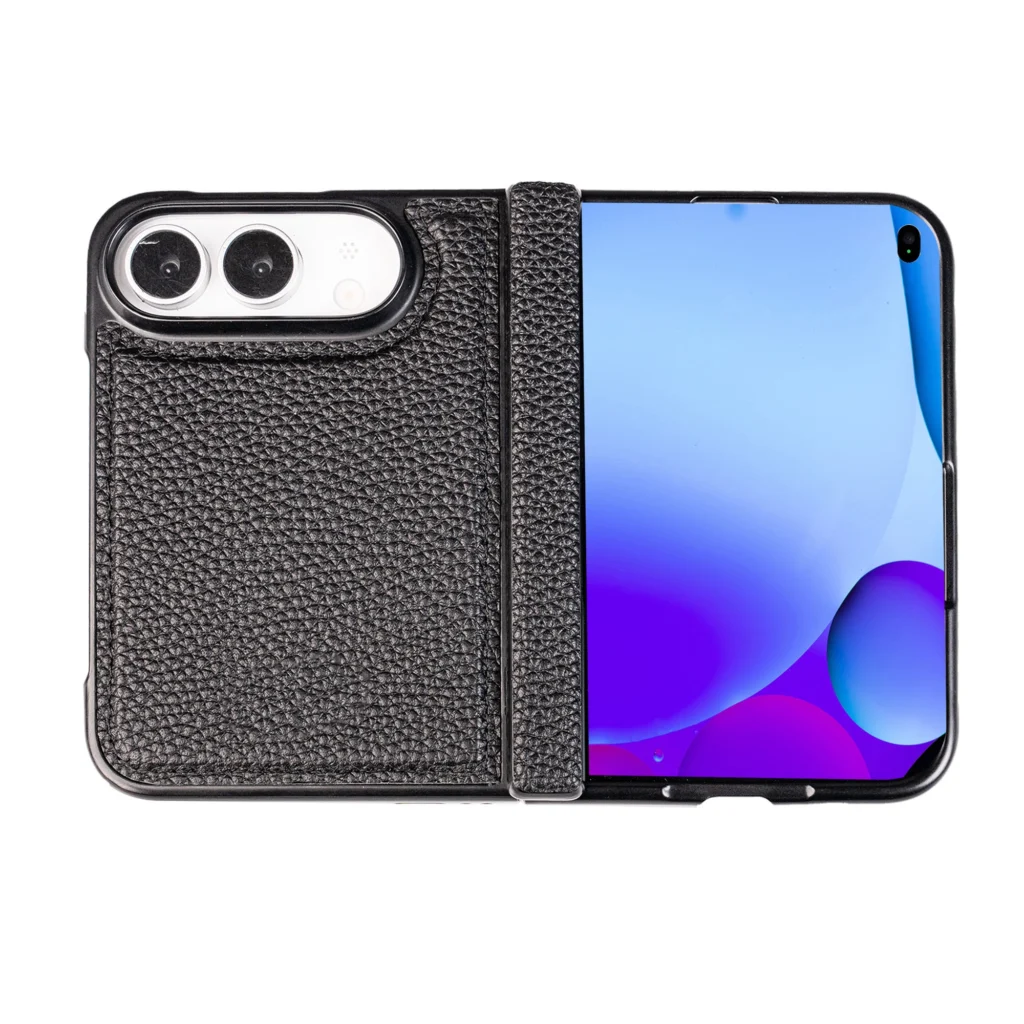
iphone Duo case with hinge
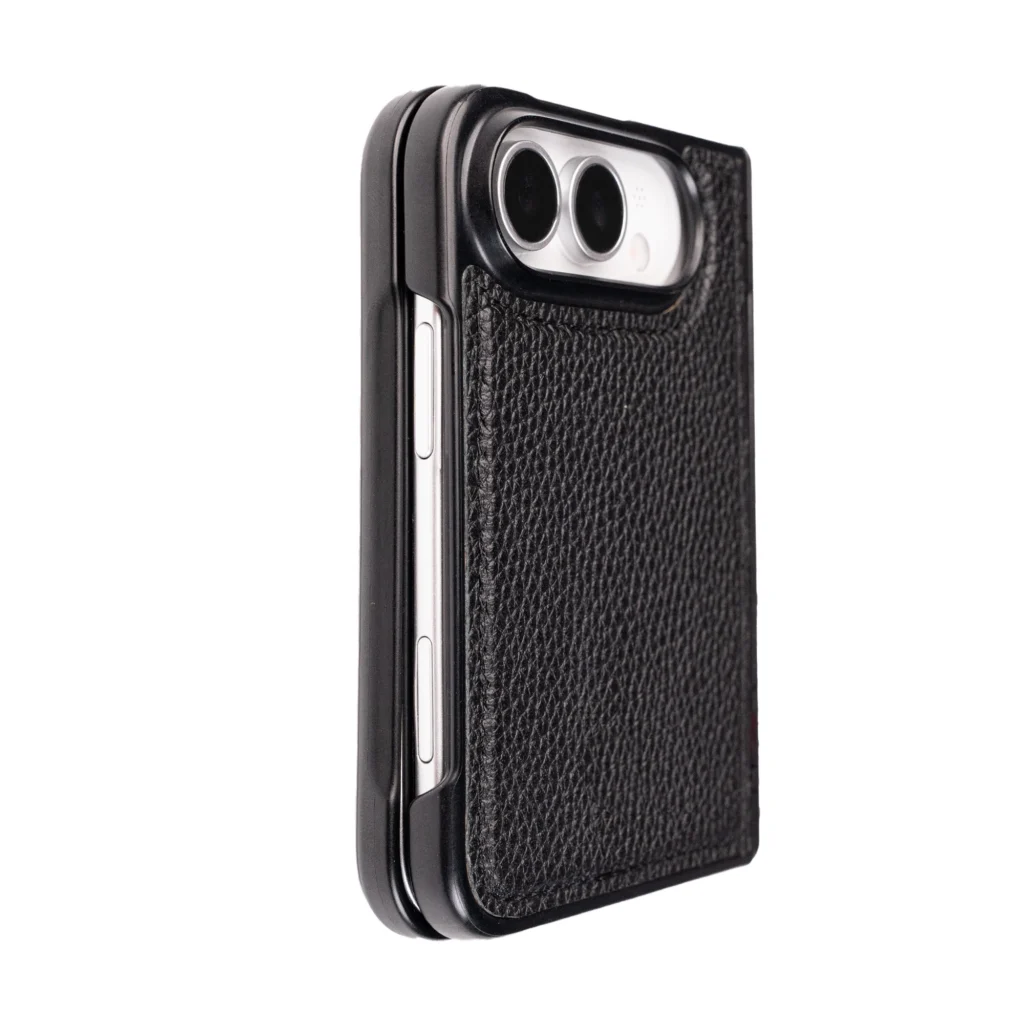
iphone Duo leather case with hinge
3. Leather Folio or Wallet Case
A third option is a folio-style design.
Apple itself offers an iPhone Duo Folio with an integrated kickstand, demonstrating that a larger-format protective accessory is also part of the official accessory ecosystem.
For OEM brands, a leather folio can provide additional space for:
- Card slots
- Cash compartments
- Kickstand functions
- Branding
- Premium lining
- Magnetic closure systems
However, a folio should be developed around the actual folding geometry rather than simply adapting a traditional iPhone wallet case.
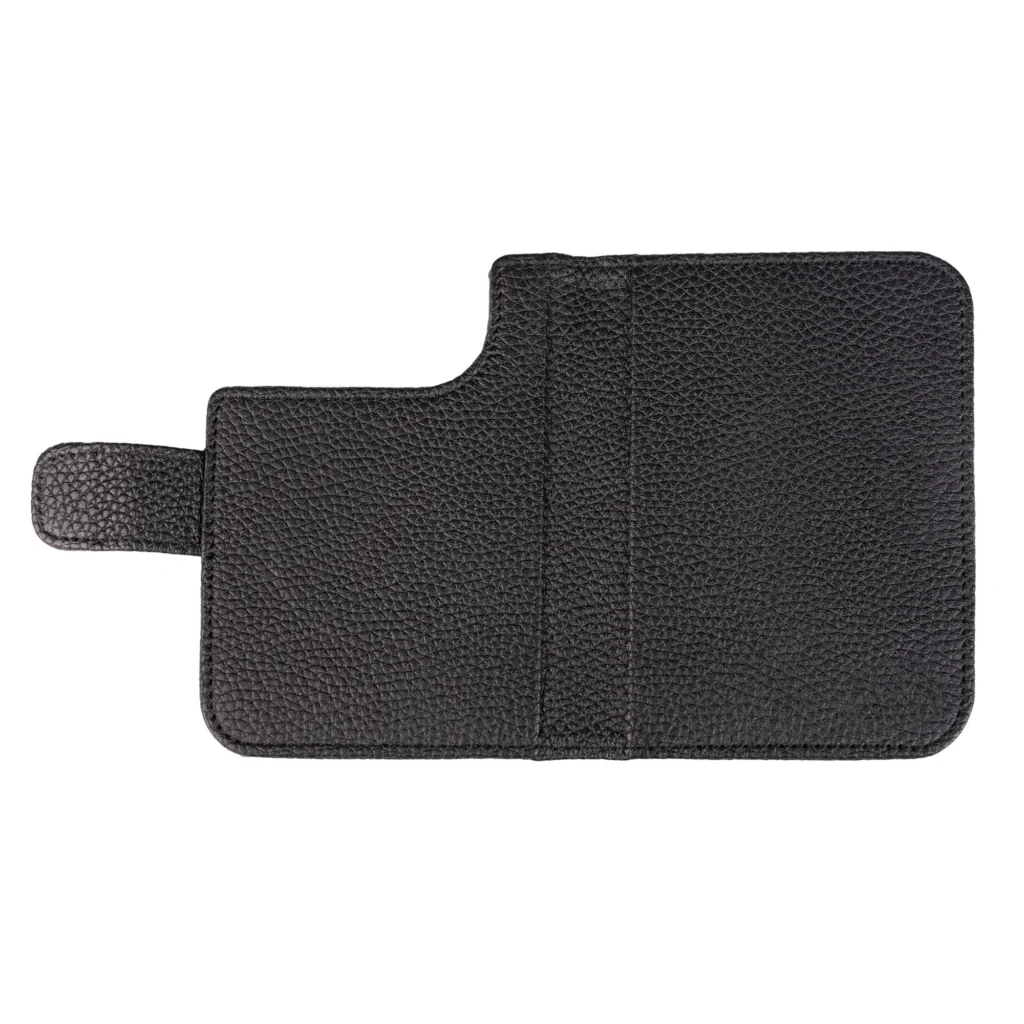
wallet iphone duo case
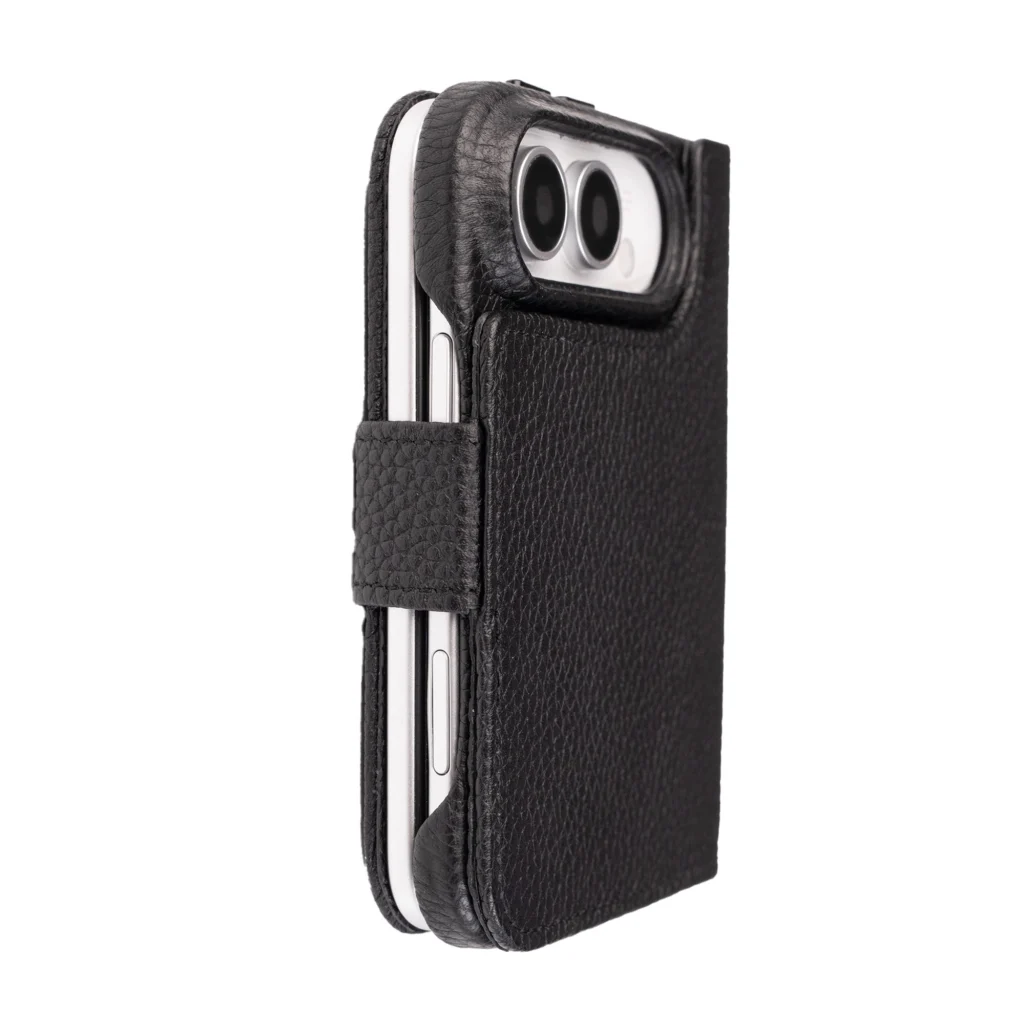
Folio wallet iphone duo case
What Samsung and Huawei Foldables Teach Us
Because final iPhone DUO engineering details still need confirmation, existing foldable phones offer useful reference points.
Samsung lists the Galaxy Z Fold7 at about 4.2 mm thick when unfolded and 8.9 mm when folded on its official specifications page. Huawei lists the Mate X6 at about 4.6 mm thick when unfolded and around 9.85 mm to 9.9 mm when folded, depending on the material version, on its official specifications page.
These numbers explain a major design problem.
Modern foldables are already thin when unfolded, but they become noticeably thicker when folded. Once a case adds leather, shell material, adhesive, lining, magnets, and hinge protection, the final product can easily feel bulky.
For leather cases, this creates a positioning decision:
Should the case feel slim and premium, or should it feel protective and engineered?
Trying to maximize both can create trouble. A very slim leather case cannot honestly offer rugged hinge protection. A full-hinge protective case cannot feel as thin as a minimalist back-plate case.
This is not just a design choice. It affects unit price, MOQ, tooling cost, customer expectations, and after-sales complaints.
For brands developing custom leather phone cases, the most practical strategy is to define the product promise before sampling begins.
Choosing the Right Leather for an iPhone Duo Case
Leather selection should be based on both appearance and mechanical requirements.
Full-Grain Leather
Full-grain leather is suitable for premium brands that want natural grain and a high-end tactile experience.
It can work particularly well for:
- Luxury phone accessories
- Premium private-label products
- Minimalist leather cases
- Executive accessories
However, leather thickness must be controlled carefully.
For a foldable phone, a premium leather does not necessarily mean thicker leather is better.
A thinner, properly skived leather can provide a more refined result than a thick leather that makes the case bulky.
Top-Grain Leather
Top-grain leather can offer a good balance between appearance, consistency and production control.
It is often a practical choice for brands that need multiple colors or repeat production.
For OEM projects, the leather should be evaluated together with:
- Thickness
- Grain
- Flexibility
- Surface finish
- Color consistency
- Edge behavior
- Adhesion performance
Oil-Wax and Pull-Up Leather
Oil-wax and pull-up leathers can create a distinctive vintage appearance.
However, the higher oil or wax content can influence edge finishing and adhesive behavior.
This is particularly important when the leather case includes painted edges or bonded components.
For this reason, a manufacturer should test the actual leather before finalizing the production process.
Microfiber and Vegan Leather
For brands looking for a lower-cost or animal-free option, microfiber and other synthetic leather materials can also be considered.
They can offer more consistent color and thickness, which can be useful for larger production runs.
The material choice should ultimately be based on the brand’s target price, appearance, durability requirements and production quantity.
MagSafe and Wireless Charging Considerations
iPhone Duo supports MagSafe and Qi2 wireless charging. Apple states that its official iPhone Duo Case supports MagSafe, Qi2 25W and Qi-certified chargers.
This makes magnetic alignment an important part of OEM case development.
A leather case may look simple from the outside, but the internal magnetic structure can affect:
- Magnetic attachment
- Wireless charging
- Alignment
- Case thickness
- Leather deformation
- Internal component placement
For custom cases, manufacturers should test the actual production structure rather than assuming that a standard magnetic ring will perform identically on every leather construction.
The testing should include both:
Magnetic attachment testing
and
Wireless charging testing
The manufacturer should also test the case after the leather, adhesive and shell have been assembled into the final production configuration.
Apple Pencil Compatibility Should Also Be Considered
Apple confirms that iPhone Duo supports Apple Pencil (USB-C).
For certain premium or productivity-oriented brands, this creates another accessory-design opportunity.
If a case is intended to be used with Apple Pencil, the manufacturer should evaluate whether the case:
- Blocks the Pencil’s usable area
- Changes the way the device is held
- Interferes with attachment or storage
- Adds excessive thickness around the display
- Creates conflicts with other accessories
This does not mean every iPhone Duo leather case needs an Apple Pencil holder.
Instead, it gives OEM buyers another possible product direction when designing a broader accessory collection.
Common Failure Problems in iPhone Duo Leather Case Development
Many problems can be prevented if the prototype stage is taken seriously.
Problem 1: The case is too thick
A leather case can become noticeably thicker when leather, adhesive, shell and magnetic components are combined.
Solution: Control leather thickness and evaluate the complete assembly rather than the leather alone.
Problem 2: The hinge area interferes with folding
This can happen when leather or structural material extends too far into the movement area.
Solution: Validate the hinge area on a real device or accurate development tooling.
Problem 3: Leather lifts from the shell
Repeated movement can place additional stress on bonded areas.
Solution: Select the adhesive system according to the actual leather and substrate.
Problem 4: Edges become uneven
Leather wrapping around complex shapes can create inconsistent edges.
Solution: Control skiving, folding, cutting and edge finishing during sampling.
Problem 5: Magnetic performance is weaker than expected
Additional leather and internal layers can affect the overall magnetic experience.
Solution: Test the final assembled case with actual MagSafe and Qi2 accessories.
Problem 6: The two case sections are not aligned
A small dimensional difference can become more noticeable when the phone is opened and closed.
Solution: Control shell tooling, leather cutting and assembly tolerances.
Cost Factors for a Custom iPhone Duo Leather Case
The final OEM price depends on much more than the leather itself.
The main cost factors include:
| Cost Factor | Impact on Price |
|---|---|
| Leather type | Low to high |
| Leather thickness | Material and processing impact |
| Case structure | Tooling and assembly |
| Hinge design | Engineering complexity |
| Magnetic system | Component and assembly cost |
| Logo process | Setup and unit cost |
| Edge finishing | Processing cost |
| Packaging | Packaging material and assembly |
| MOQ | Strong effect on unit price |
| Testing requirements | Development cost |
A simple two-piece leather case can have a very different cost structure from a leather folio with card slots and a kickstand.
For this reason, OEM buyers should provide as much information as possible before requesting a final quotation.
MOQ and Customization for OEM/ODM Buyers
MOQ depends on the construction and customization requirements.
A manufacturer may need to consider:
- Leather purchasing quantity
- Custom leather color
- Tooling
- Magnetic components
- Packaging
- Logo setup
- Production efficiency
For brands launching a new product, it is often useful to discuss the target quantity before finalizing the structure.
A design that requires many custom components may not be commercially practical at a very low MOQ.
An experienced manufacturer can help simplify the structure while maintaining the intended premium appearance.
How to Choose an iPhone Duo Leather Case Manufacturer
When comparing suppliers, do not evaluate them only by the leather samples they show.
For a foldable product, ask whether the manufacturer can manage the complete development process.
Useful questions include:
- Have you developed foldable phone cases before?
- Can you provide iPhone Duo development tooling?
- Can you produce a two-piece leather case?
- Can you integrate MagSafe-compatible magnetic components?
- Can you test the case on a real device?
- Can you customize leather colors?
- Can you support embossing or debossing?
- Can you provide custom packaging?
- What is the MOQ?
- What is the sample lead time?
- What is the expected bulk production lead time?
- Can you support OEM/ODM design modifications?
For B2B brands, the manufacturer’s engineering and production capability can be just as important as the appearance of the leather.
Why Work With Pellove for iPhone Duo Leather Case OEM/ODM?
Pellove is a leather accessories manufacturer specializing in OEM and ODM development for brands, wholesalers and distributors.
For iPhone Duo projects, Pellove can support customization across multiple stages of development, including:
- Leather selection
- Custom leather colors
- Two-piece case construction
- Leather wrapping
- Logo embossing and debossing
- Magnetic components
- Custom packaging
- Sample development
- Bulk production
Pellove has already prepared iPhone Duo development tooling and can support brands moving from concept to sample and trial production.
For buyers who already have a design, Pellove can evaluate the existing structure and discuss material, tooling and production requirements.
For brands that only have a concept, the factory can also work through the structure and material options during the OEM/ODM development process.
Final Thoughts: Developing an iPhone Duo Leather Case in 2026
The iPhone Duo case market is no longer based on speculation.
Apple has officially introduced its first foldable iPhone, confirmed the device dimensions, described its precision hinge and launched an official two-part case compatible with MagSafe and Qi2.
For leather case manufacturers, the focus should therefore move away from predicting what the device might look like.
The real challenge is now engineering a leather case that works with the actual device.
The most important areas are:
- Two-part case construction
- Hinge clearance
- Leather thickness
- Adhesive durability
- Magnetic alignment
- Wireless charging
- Edge finishing
- Repeated folding
- Production consistency
For OEM/ODM buyers, the best time to develop a custom iPhone Duo leather case is when the product requirements, structure and target market are clearly defined.
With the official device specifications now available, manufacturers can move from concept development to real-device testing, sampling and production with much less uncertainty.
If you are looking for an iPhone Duo leather case manufacturer for a private-label, OEM or ODM project, Pellove can discuss your required structure, leather, logo, packaging, MOQ and development schedule.