
Quick Answer
The most common leather AirPods case defects include loose upper lids, blocked charging ports, unstable wireless charging, poor retention, leather surface damage, edge peeling, hardware failure, logo defects, packaging damage and sample-to-bulk inconsistency.
For OEM/ODM buyers, most quality issues come from small variations during product development and manufacturing, including:
- AirPods model fitting
- Leather and lining thickness
- Cutting accuracy
- Adhesive application
- Lid structure design
- Hardware reinforcement
- Logo processing
- Packaging protection
The best way to prevent defects is to validate physical samples with real AirPods devices before mass production and establish clear quality standards for materials, assembly and inspection.
This guide explains common custom AirPods case defects, their root causes and how OEM buyers can reduce production risks. If you’re still evaluating suppliers, you can refer to our Leather AirPods Case Manufacturer Guide.
Why Leather AirPods Case Defects Happen
A leather AirPods case is a small accessory, but it requires high manufacturing precision.
Compared with larger leather products, AirPods cases have limited tolerance because the product must fit a compact charging case while maintaining:
- Smooth lid opening and closing
- Easy cable charging access
- Stable wireless charging
- Secure product retention
- Premium appearance
A small change in leather thickness, cutting position, or assembly accuracy can affect the final user experience. Proper fit testing and charging compatibility validation are essential to ensure every case performs reliably with real AirPods devices.
Common defect sources include:
- Incorrect AirPods model reference
- Excessive material thickness
- Poor cutting alignment
- Uneven adhesive application
- Incorrect inner dimensions
- Weak reinforcement structure
- Improper logo positioning
- Insufficient packaging protection
For OEM/ODM production, defect prevention should start during product development, not after bulk production.
Common Leather AirPods Case Defects Overview
| Defect | Symptom | Main Cause | Prevention |
|---|---|---|---|
| Loose upper lid | Cap falls off or shifts | Poor fit, weak bonding | Real-device lid test |
| Blocked charging port | Cable cannot insert fully | Opening deviation or excess thickness | Charging test |
| Wireless charging issue | Charging unstable | Thick structure or poor alignment | Wireless charging test |
| Loose case fit | AirPods case moves inside | Incorrect inner size | Retention test |
| Tight fit | Difficult removal | Excess material buildup | Removal test |
| Leather defects | Scratches, wrinkles, peeling | Material handling issues | Material inspection |
| Logo defects | Uneven or unclear logo | Incorrect process | Logo approval |
| Hardware failure | Hook or ring loosens | Weak reinforcement | Pull test |
| Packaging damage | Pressure marks or deformation | Poor packaging design | Packing validation |
1. Lid Fit Problems
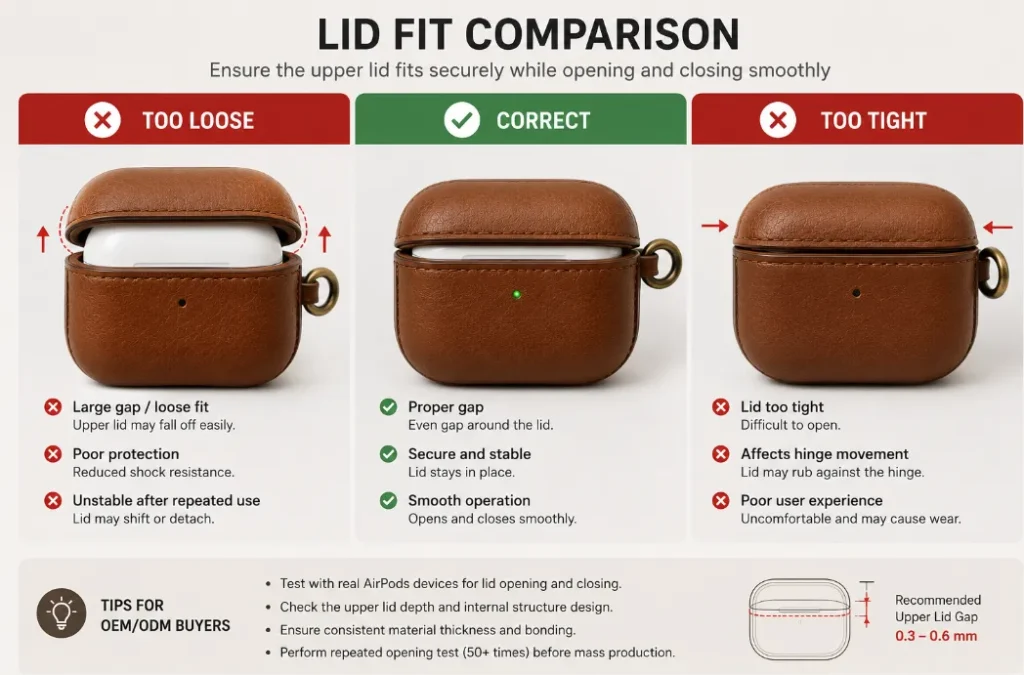
The upper lid is one of the most sensitive areas in the manufacturing of leather AirPods cases.
Common Defects
- Upper cap falling off
- Uneven lid gap
- Lid blocked during opening
- Leather rubbing against the hinge
- Loose feeling after repeated use
Main Causes
Incorrect Upper Cap Depth
The leather cap must match the AirPods charging case precisely.
If the cap is too shallow:
- The lid may detach easily
- Protection performance decreases
If the cap is too deep:
- Lid movement may become restricted
- Opening may feel tight
Weak Adhesive Bonding
Insufficient adhesive coverage or inconsistent bonding pressure can cause the upper cap to separate after repeated opening.
Excessive Material Thickness
A leather AirPods case usually contains multiple layers:
- Outer leather
- Adhesive
- Reinforcement
- Microfiber lining
Excess thickness can reduce hinge clearance and affect lid movement.
Prevention
Before mass production, buyers should test:
- Real AirPods device fitting
- Repeated lid opening and closing
- Hinge movement
- Upper cap stability
A good leather AirPods case should keep the lid secure while maintaining smooth operation.
2. Charging Port and Wireless Charging Problems
Charging compatibility is one of the most important quality requirements for AirPods accessories.
Defects
Common symptoms:
- Charging cable cannot fully insert
- Opening is misaligned
- Leather blocks the connector
- AirPods charging case sits too high inside the cover
Root Causes
- Incorrect bottom opening size
- Cutting deviation
- Excess leather thickness
- Thick adhesive layer
- Incorrect internal positioning
For small accessories, even a small cutting error can affect charging performance.
Wireless Charging Problems
Wireless charging may become unstable when the case structure is too thick or uneven.
Possible causes:
- Thick leather layers
- Excess microfiber lining
- Uneven back structure
- Incorrect hardware placement
- Poor internal fitting
Metal hooks or rings may also affect charging if positioned too close to the charging area.
Prevention
Always test the fully assembled case with:
- Original AirPods charging case
- Charging cable
- Wireless charger
Testing individual materials is not enough. The finished product must be tested under real usage conditions.
3. AirPods Case Fit Problems
A quality leather AirPods case should hold the charging case securely while allowing easy removal.
Too Loose
Symptoms:
- AirPods case slides out
- Upper lid separates
- Product feels low quality
Causes:
- Incorrect inner dimensions
- Weak retention force
- Material stretching
Too Tight
Symptoms:
- Difficult removal
- Leather deformation
- Lining damage
Causes:
- Excess material thickness
- Incorrect internal size
- Adhesive buildup

Lid fit comparison
Prevention
OEM buyers should check:
- Shake resistance
- Installation and removal force
- Repeated insertion and removal
- Long-term retention
The ideal fit is secure but comfortable.
4. Leather Surface and Edge Defects
Leather appearance directly affects premium product perception.
Common defects include:
- Scratches
- Glue marks
- Wrinkles
- Color inconsistency
- Edge peeling
- Uneven edge finishing
Causes
- Poor material handling
- Incorrect wrapping process
- Unstable adhesive
- Improper edge finishing
- Unsuitable leather thickness
For genuine leather products, natural grain variation is normal.
Acceptable characteristics may include:
- Different grain patterns
- Slight color differences
- Natural texture variation
However, production defects include:
- Glue contamination
- Edge separation
- Visible scratches
- Uneven finishing
Prevention
Approve physical leather samples and inspect:
- Curved areas
- Corners
- Bottom openings
- High-contact areas
5. Material Thickness and Layer Structure Problems
Material thickness plays an important role in leather AirPods case performance. A leather AirPods case usually contains multiple layers. Choosing the right leather and lining combination is equally important for durability and functionality, as explained in our Leather AirPods Case Material Guide.
A typical structure includes:
- Outer leather layer
- Adhesive layer
- Reinforcement layer
- Microfiber lining
Small thickness changes can influence:
- Lid fitting
- Charging access
- Wireless charging distance
- Overall product feeling
Common defects:
- Lid cannot close smoothly
- Charging opening becomes restricted
- Case feels bulky
- Wireless charging performance decreases
Prevention
Before production, buyers should confirm:
- Leather thickness
- Lining thickness
- Adhesive standard
- Reinforcement material
- Final assembled thickness
Material approval should always be based on physical samples.
6. Manufacturing Process Related Defects
Leather AirPods case quality depends on every production stage.
| Process | Possible Defects | Control Method |
|---|---|---|
| Leather cutting | Misaligned openings, uneven edges | Cutting template check |
| Skiving | Uneven thickness | Thickness measurement |
| Lamination | Bubbles, weak bonding | Bonding inspection |
| Assembly | Loose lid, poor fitting | Real-device test |
| Logo processing | Uneven embossing | Logo sample approval |
| Hardware installation | Loose hooks or rings | Pull test |
| Packaging | Pressure marks | Packaging validation |
A reliable manufacturer should control quality through:
- Incoming material inspection
- Process inspection
- Sample approval
- Production monitoring
- Final inspection
7. Hook, Ring and Hardware Defects
Many custom AirPods cases include hooks, rings or straps.
Common hardware problems:
- Loose hardware
- Torn leather around attachment points
- Metal scratches
- Hardware affecting lid movement
- Damage during packaging
Causes
- Weak reinforcement
- Incorrect rivet position
- Poor hardware quality
- Sharp metal edges
- Poor packaging protection
Prevention
Suppliers should perform:
- Pull strength testing
- Carry simulation
- Hardware movement checks
8. Logo and Branding Defects
For private label AirPods cases, logo quality directly affects brand image.
Common problems:
- Logo off-center
- Uneven embossing depth
- Blurry edges
- Incorrect size
- Logo peeling
- Color mismatch
Prevention
Before bulk production, buyers should approve:
- Logo size
- Position
- Processing method
- Color requirements
- Acceptable tolerance
The logo sample should be produced on the actual production material.
9. Packaging-Related Defects
Defects can occur during packing and shipping after production.
Common problems:
- Leather pressure marks
- Hardware scratches
- Deformed upper caps
- Damaged gift boxes
- Wrong SKU labels
Causes
- Tight packaging structure
- Poor inserts
- Hardware touching leather
- Insufficient carton protection
Prevention
Packaging approval should include the finished product inside the box.
Metal hooks and rings should be protected to avoid scratching the leather surface.
10. Sample-to-Bulk Consistency Issues
A common OEM complaint is:
“The approved sample looks good, but the bulk production is different.”
Common differences:
- Leather feels different
- Lid fit changes
- Logo position shifts
- Hardware becomes weaker
- Color varies
Causes
- Different material batches
- Handmade sample adjustment
- Unclear production standards
- Assembly variation
Prevention
Use an approved PP sample as the production reference.
Confirm:
- Material standard
- Hardware specification
- Logo position
- Assembly method
- Packaging requirements
Leather AirPods Case Quality Inspection Checklist
Before bulk production approval, OEM buyers should check:
| Inspection Item | Recommended Test |
|---|---|
| Lid fitting | Open and close test |
| Charging port | Cable insertion test |
| Wireless charging | Charger compatibility test |
| Retention | Shake and removal test |
| Leather surface | Appearance inspection |
| Logo | Position and quality check |
| Hardware | Pull strength test |
| Packaging | Protection validation |
How OEM Buyers Can Reduce Leather AirPods Case Defects
Before production, buyers should confirm:
Exact AirPods model
Approved physical sample
Leather and lining thickness
Lid movement
Charging compatibility
Wireless charging performance
Retention strength
Hardware structure
Logo standard
Packaging design
During inspection, check:
- Real-device fitting
- Charging test
- Wireless charging test
- Logo appearance
- Hardware strength
- Packaging condition
How Pellove Helps Prevent AirPods Case Quality Issues
Pellove supports OEM/ODM buyers by controlling quality risks from product development to final inspection.
Our process includes:
- Material thickness confirmation
- Real-device fit testing
- Lid and hinge clearance checking
- Charging compatibility testing
- Wireless charging validation
- Logo approval
- Hardware reinforcement review
- Packaging inspection
- Final quality control before shipment
During development, Pellove helps brands evaluate:
- Material selection
- Structure design
- Functional compatibility
- Branding details
- Production standards
With proper engineering validation and quality control, brands can reduce production risks and create reliable custom leather AirPods cases.
FAQ
What are the most common leather AirPods case defects?
The most common defects include loose lids, charging issues, wireless charging problems, poor retention, leather damage, logo defects, hardware failure and packaging damage.
Why does an AirPods case lid become loose?
Loose lids are usually caused by incorrect cap fitting, weak adhesive bonding, material thickness variation or poor tolerance control.
Can a leather AirPods case affect charging?
Yes. Incorrect charging openings, excessive thickness or poor internal positioning can affect cable charging and wireless charging performance.
Why does a leather AirPods case differ between sample and bulk production?
Common reasons include different material batches, unclear production standards, manual sample adjustment and assembly variation.
What quality checks should OEM buyers perform before production?
Buyers should test real-device fitting, charging performance, lid movement, logo quality, hardware strength and packaging protection before approving bulk production.
Conclusion
Leather AirPods case defects usually come from small but important variations in fit, material thickness, assembly accuracy and quality control.
For OEM/ODM buyers, the best prevention method is validating physical samples with real AirPods devices before production and establishing clear standards for materials, logo, hardware and packaging.
A high-quality leather AirPods case should not only look premium. It should fit securely, open smoothly, charge reliably and maintain consistent quality throughout mass production.
By working with an experienced OEM partner and implementing proper quality control, brands can reduce production risks and deliver reliable custom leather AirPods cases to customers.