
MOQ for custom leather goods is not only about how many pieces a buyer wants to order. It is about whether the factory can buy materials, set up production, control cost, and finish the order without creating unnecessary waste or losing efficiency.
Many buyers are surprised when a factory says the MOQ is 100, 300, or even 500 pieces. From the buyer’s side, the question sounds simple: “Why can’t I just make 50 pieces?” But from the factory’s side, even a small custom order may require leather purchasing, logo molds, cutting dies, packaging setup, worker training, QC inspection, and separate production scheduling.
That is why MOQ is one of the most misunderstood parts of custom leather goods sourcing. It affects unit price, inventory risk, sample planning, packaging cost, and whether the project is worth starting at all.
This matters because the leather goods market is still large and competitive. Grand View Research estimated the global leather goods market at USD 266.82 billion in 2024 and projected it to reach USD 538.23 billion by 2033, with a CAGR of 8.4% from 2025 to 2033. Source: Grand View Research
That growth creates opportunity, but it also creates pressure. Buyers who understand MOQ can plan better products, avoid overstock, and negotiate with factories more realistically.
Quick Answer: What Affects MOQ for Custom Leather Goods?
MOQ for custom leather goods is mainly affected by raw material minimums, tooling costs, labor setup time, production efficiency, craftsmanship complexity, packaging requirements, QC standards, and customization level.
The more customized the product is, the higher the MOQ usually becomes.
| Factor | Why It Affects MOQ |
|---|---|
| Raw material minimums | Leather, lining, magnets, hardware, and packaging suppliers often have their own MOQ |
| Tooling costs | Cutting dies, logo molds, fixtures, and hardware molds are fixed costs |
| Labor efficiency | Small batches still require setup, training, adjustment, and QC time |
| Craftsmanship complexity | More steps create more labor, waste, and defect risk |
| Customization level | New materials, colors, structures, and packaging increase factory risk |
| Packaging requirements | Gift boxes, insert cards, EVA, magnetic boxes, and custom cartons may have separate MOQ |
| QC standard | Higher inspection standards increase labor time and rejection rate |
In simple terms: MOQ exists because factories need enough quantity to spread out fixed costs and reduce production risk.
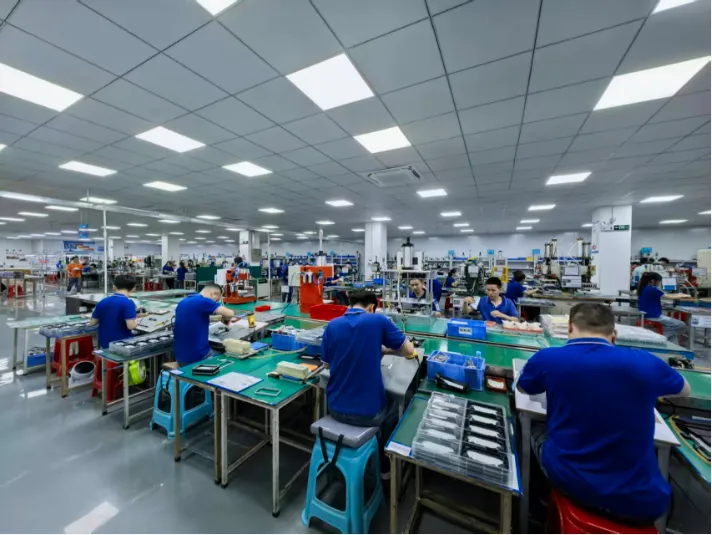
One of our workshops
Why MOQ Matters More in Leather Goods
Leather goods are not like simple plastic items where every piece comes from the same mold and looks almost identical. Leather has natural variation. Cutting, folding, stitching, edge painting, lining, hardware assembly, and packaging often require skilled manual work.
That makes small-batch customization more complicated.
A leather phone case, wallet, passport holder, iPad case, AirPods case, MagSafe wallet, or watch band may look small, but the production process can involve many separate steps. If the order quantity is too low, the preparation time may be almost the same as a larger order, but the cost has fewer units to spread across.
This is why Pellove’s FAQ explains that MOQ depends on product type, material, customization complexity, packaging requirements, and whether special development or tooling is needed.
For buyers, MOQ is not just a factory rule. It is a signal of the project’s real production logic.
1. Raw Material MOQ: The Hidden Starting Point
Many MOQ problems begin before the factory starts production.
Raw material suppliers often have their own minimum order requirements. A leather goods factory may want to help a buyer make 50 pieces, but the material supplier may not sell enough material for only 50 pieces.
Common materials with supplier MOQ include:
- Genuine leather
- Special color leather
- Vegan leather
- Microfiber leather
- Alcantara-style lining
- Custom hardware
- Custom magnets
- Special velvet lining
- Branded packaging
- Gift boxes
- Insert cards
Some materials may need to be ordered by:
- One whole hide
- One full roll
- 100 meters
- 500 sets
- One color batch
- One hardware batch
This is why a very small order can become difficult. The buyer only wants 50 finished products, but the factory may need to purchase enough material for 100, 200, or 500 pieces.
Example: Purple Genuine Leather Phone Case
Imagine a buyer wants to customize a purple genuine leather phone case.
The leather supplier requires at least 1 whole hide. One hide can make around 30 phone cases. If the buyer only wants 20 pieces, the remaining leather becomes unused stock.
If the buyer wants 50 pieces, the factory may need to buy 2 hides, but 2 hides may make around 60 pieces, leaving leftover material again.
The factory then has three choices:
- Raise the MOQ
- Increase the unit price
- Accept leftover material risk
Most factories will not choose option three unless the buyer is a long-term customer or the material can be reused for other orders.
This is why custom colors often raise MOQ. The issue is not only production. It is material purchasing and leftover risk.
A general MOQ guide from User Solutions also notes that suppliers often have their own raw material MOQs and fixed costs such as setup, tooling, shipping, and administrative processing. Source: User Solutions MOQ Guide
2. Tooling and Setup Costs
Many custom leather goods require some form of tooling or setup before production.
This may include:
- Cutting die
- Mold
- Hardware mold
- Embossing mold
- Debossing mold
- LOGO mold
- Positioning fixture
- Magnetic alignment fixture
- Sample template
- Packaging die line
These costs are usually fixed. They do not become cheaper just because the buyer orders fewer pieces.
Example: LOGO Mold Cost
If a debossed LOGO mold costs $30, the cost per product changes dramatically depending on quantity:
| Quantity | Mold Cost Per Unit |
|---|---|
| 100 pcs | $0.30 per unit |
| 500 pcs | $0.06 per unit |
| 1,000 pcs | $0.03 per unit |
This is why small orders often have higher unit prices. The tooling cost is the same, but fewer pieces share that cost.
For buyers, this is important. A factory may offer a lower MOQ, but the unit price may increase because tooling, sample setup, and production preparation still need to be covered.

logo mould
3. Labor Efficiency: Why Factories Avoid Small Batches with Many Styles
Factories usually dislike “small quantity, many styles” orders.
The reason is simple: preparation time does not shrink in proportion to quantity.
A 50-piece order may still require:
- Material checking
- Cutting setup
- Machine adjustment
- Worker instruction
- Logo testing
- Edge paint testing
- Sample confirmation
- Production scheduling
- QC inspection
- Packaging setup
In some cases, making 50 pieces and making 500 pieces may require similar preparation work at the beginning.
The difference is that 500 pieces allow the factory to spread the setup time across more units.
This is why small-batch multi-SKU orders are often expensive. A buyer may think, “I only need 20 pieces per color.” But the factory sees separate materials, separate color matching, separate cutting plans, separate QC records, and higher risk of mistakes.
4. Craftsmanship Complexity
The more complex the craftsmanship, the higher the MOQ and price usually become.
Leather goods with simple flat structures are easier to produce in small quantities. Products with multiple layers, special edges, magnetic functions, or precise device fitting usually require more testing and tighter QC.
Complex processes may include:
- Hand folding
- Real stitching
- Multi-layer structure
- Special edge painting
- Raised LOGO
- Metal LOGO
- Magnetic closure
- MagSafe structure
- Genuine leather lamination
- Alcantara-style lining
- RFID-blocking layer
- Custom card slots
- Camera protection structure
Each added process can increase:
- Labor time
- Material waste
- Defect rate
- Sample revision
- QC pressure
For example, a standard leather wallet may be easier to produce than a MagSafe leather phone case with magnetic alignment, camera protection, card slot function, microfiber lining, and gift packaging.
This is why buyers developing custom leather phone cases should prepare clear requirements before asking for MOQ and price. The structure, material, phone model list, logo method, and packaging can all change the final quotation.
5. Customization Level
Standard products usually have lower MOQ. Fully customized products usually have higher MOQ.
Low MOQ is easier when the buyer uses:
- Existing structure
- Existing mold
- Available leather color
- Standard lining
- Standard hardware
- Simple LOGO method
- Existing packaging
Higher MOQ is more likely when the buyer requests:
- New structure
- New leather material
- Custom color
- Custom hardware
- Custom magnet
- Custom packaging
- New mold
- Multi-color production
- Multiple product sizes
- Special QC standard
This is the difference between light customization and real product development.
For example, Pellove’s Wallet Phone Case page lists MOQ as typically from 100 pcs per design, but also explains that MOQ changes with model list, material, color, structure, logo process, packaging, and whether the project uses an existing structure or needs a new sample.
For more customized leather phone cases, Pellove’s Crazy Horse Leather Phone Case page states that typical MOQ starts from 300 pcs per design, depending on phone model, case structure, leather option, logo method, packaging setup, and additional functions such as MagSafe or bundled accessories.
These examples show why there is no universal MOQ for leather goods. The number depends on what the buyer wants to change.
What Affects the Price of Custom Leather Goods?
MOQ and price are connected, but they are not the same thing.
MOQ tells you the minimum production quantity. Price tells you what each unit costs after material, labor, tooling, packaging, QC, and profit are calculated.
The main pricing factors are:
- Material cost
- Craftsmanship complexity
- Order quantity
- Packaging requirement
- Quality standard
- Order stability
1. Material Cost
Material is usually one of the biggest cost drivers in custom leather goods.
Common material options include:
- PU leather
- Vegan leather
- Microfiber leather
- Genuine leather
- Split leather
- Top grain leather
- Full grain leather
- Alcantara-style material
- Metal hardware
- Magnets
- Velvet lining
- Microfiber lining
Even within “genuine leather,” prices can vary widely.
For example:
| Leather Type | General Positioning |
|---|---|
| Split leather | Lower cost, more price-sensitive products |
| Top grain leather | Better surface quality and stronger premium positioning |
| Full grain leather | Higher-end natural grain and stronger material story |
A buyer asking for “genuine leather” may receive very different quotations depending on leather grade, thickness, finish, color, and supplier availability.
This is why material selection should match the target market. A premium gift product, an Amazon test SKU, and a luxury private label line should not automatically use the same leather.
2. Craftsmanship Complexity
Craftsmanship affects both cost and MOQ.
More complex craftsmanship usually means:
- More skilled labor
- More production time
- More quality inspection
- More waste
- Higher defect risk
Examples:
| Lower Cost Option | Higher Cost Option |
|---|---|
| Simple edge finish | Hand-folded edge |
| Standard stitching | Hand stitching |
| Debossed LOGO | Metal LOGO |
| Single-layer structure | Multi-layer structure |
| Standard lining | Alcantara-style lining |
| Standard closure | Magnetic closure |
| Simple phone case | MagSafe leather phone case |
This does not mean buyers should always choose the cheaper option. It means buyers should understand what each upgrade is doing for the product.
If a metal LOGO, magnetic closure, or premium lining helps the product command a higher price, the extra cost may be worth it. If the customer cannot see or value the upgrade, it may only reduce margin.
3. Order Quantity
Order quantity has a direct effect on price.
When quantity increases:
- Material purchasing becomes more efficient
- Labor efficiency improves
- Cutting waste can be reduced
- Fixed costs are spread across more units
- Production scheduling becomes easier
- Unit price usually goes down
This is why 100 pcs and 1,000 pcs can have very different unit prices.
But buyers should be careful. Ordering more only helps if the products can actually sell. A lower unit price is not a real saving if it creates dead inventory.
A smarter approach is often tiered pricing:
| Quantity | Buyer Use Case |
|---|---|
| 100 pcs | Market test or sample launch |
| 300 pcs | More practical first production run |
| 500 pcs | Better cost balance |
| 1,000 pcs | Stronger price advantage for proven products |
Buyers should ask factories for price breaks at different quantities instead of asking only for one MOQ and one price.
4. Packaging Requirements
Many buyers underestimate packaging cost.
Custom packaging may include:
- Gift box
- EVA insert
- Magnetic box
- Color box
- Blister pack
- Custom card
- Thank-you card
- Barcode label
- Retail sleeve
- Shipping carton
Packaging can strongly affect price, especially for small orders.
Cubit Packaging’s 2026 pricing guide gives an example that a standard 8 x 6 x 3 inch magnetic closure rigid box with soft-touch lamination and 1-color foil logo costs about $4.00-$5.50 per unit at 1,000 units. Source: Cubit Packaging
That number matters for leather goods buyers because some accessories are small. If a product costs only a few dollars to make, premium packaging can become a major part of the total landed cost.
For gift sets, luxury retail, and corporate gifting, packaging may be worth the investment. For low-price trial orders, simple packaging may be more practical.
5. Quality Standards
Different buyers have different QC expectations.
A low-cost ecommerce product, a premium boutique product, and a corporate gift order may all require different inspection standards.
Higher quality standards may require:
- More strict leather surface selection
- More consistent color matching
- Tighter stitching tolerance
- Cleaner edge paint
- Better hardware inspection
- Lower defect acceptance
- More packaging inspection
- More rework
This increases cost because the factory spends more time checking, rejecting, and correcting products.
A buyer may say, “I want Apple-level quality.” But if the target price is very low, the project may not be realistic. High standards need enough budget, time, and quantity to support them.
6. Order Stability
Long-term customers often receive better pricing than one-time small-order buyers.
Factories consider:
- Repeat order potential
- Stable production schedule
- Lower communication cost
- Better material planning
- Lower development risk
- Long-term cooperation value
A single small order is usually priced more conservatively because the factory cannot assume future business. A repeat order program gives the factory more reason to support better pricing, lower MOQ flexibility, or shared development cost.
This is why buyers should explain their long-term plan when asking for a quote. A factory will treat a one-time 100-piece order differently from a brand planning repeat orders across several styles.
Why Do Some Factories Offer Very Low MOQ?
Some factories offer very low MOQ, but buyers should understand why.
Low MOQ is usually possible when:
- The factory uses existing stock materials.
- The product uses a standard mold or existing structure.
- The customization is limited to a simple logo.
- Packaging remains standard.
- The factory simplifies craftsmanship.
- The factory is willing to develop a new buyer.
- The buyer accepts a higher unit price.
Low MOQ is not always bad. It can be useful for testing the market.
But very low MOQ can also mean tradeoffs:
- Fewer material choices
- Less customization
- Higher unit price
- Simpler packaging
- Standard structure
- Limited color options
- No exclusivity
A buyer should not only ask, “Can you do low MOQ?”
A better question is: “What do I need to simplify to make low MOQ possible?”
Common Buyer Mistake: “I Only Want to Add a Logo”
One of the most common misunderstandings in custom leather goods sourcing is this sentence:
“I only want to add a logo. Why is the MOQ still high?”
From the buyer’s side, adding a logo sounds simple. From the factory’s side, it may still involve:
- LOGO mold
- Logo position testing
- Heat or pressure testing
- Leather surface testing
- Packaging adjustment
- Separate production record
- Separate QC standard
- Separate material preparation
Once a logo is added, the product is no longer pure stock. It becomes a small custom project.
For example, embossing a logo on smooth leather may be easy. But embossing the same logo on pebbled leather, Crazy Horse leather, or soft vegan leather may produce different results. The factory may need to test temperature, pressure, logo depth, and position before production.
This is why “only adding a logo” can still affect MOQ, price, and lead time.
Buyer Scenario: The 50-Piece Order That Became Too Expensive
A typical small-brand buyer may start with this plan:
- 50 leather phone cases
- Custom purple leather
- Debossed logo
- Magnetic packaging
- 5 phone models
- 2 colors
- Fast delivery
On paper, the order looks small. In production, it is complicated.
The factory may need to purchase special leather, open a logo mold, split production by phone model, prepare different cutouts, test packaging, and inspect several small batches separately.
The result is predictable: MOQ goes up, unit price goes up, and the buyer feels the factory is being difficult.
But the real issue is not the factory refusing small orders. The project contains too many custom variables for a 50-piece run.
A better first order might be:
- 100-300 pieces
- 1-2 phone models
- Available leather color
- Existing structure
- Simple logo
- Standard packaging
This gives the buyer a more realistic market test without forcing the factory to absorb material and setup risk.
How Buyers Can Reduce MOQ and Control Price
Buyers can often reduce MOQ if they simplify the project strategically.
1. Use Existing Materials
Available leather colors and standard linings are easier to source than custom colors or rare materials.
Instead of custom purple leather, the buyer may start with black, brown, tan, navy, or another available stock color.
2. Use Existing Structures
Existing molds and tested structures reduce development cost.
For example, a buyer testing leather phone cases can start with an existing wallet case or slim back case structure, then customize logo, color, and packaging.
3. Reduce SKU Complexity
Avoid too many colors, sizes, and models in the first order.
Instead of 5 colors and 6 models, start with:
- 1-2 colors
- 1-3 best-selling models
- 1 logo method
- 1 packaging direction
This helps the factory control material waste and production setup.
4. Choose Simple Packaging First
Premium packaging can be added later.
For early-stage testing, buyers may use a pouch, paper box, or branded insert card instead of a magnetic rigid gift box.
5. Ask for Tiered Pricing
Instead of asking only for the lowest MOQ, ask for pricing at:
- 100 pcs
- 300 pcs
- 500 pcs
- 1,000 pcs
This helps buyers see the cost curve clearly and choose the best balance between inventory risk and unit price.
6. Separate Sample Development from Bulk Order
For complex projects, it may be better to pay for a sample first before negotiating the final MOQ.
A sample helps confirm:
- Structure
- Leather texture
- Logo effect
- Packaging
- Function
- QC standard
Pellove’s leather phone case manufacturer page explains that buyers should provide phone models, target material, structure requirements, logo artwork, packaging idea, quantity, and reference sample if available. These details make quotation and MOQ evaluation much more accurate.
7. Explain Your Long-Term Plan
If the first order is small but the buyer has a real repeat-order plan, tell the factory.
Factories are more likely to support flexible MOQ when they see:
- Repeat order potential
- Clear product direction
- Stable communication
- Serious sampling process
- Long-term category development
What Information Should Buyers Provide for a More Accurate MOQ?
A factory cannot give an accurate MOQ or price if the project details are too vague.
Before asking for quotation, prepare:
- Product type
- Target quantity
- Material preference
- Color requirement
- Logo artwork
- Logo method
- Product structure
- Size or device model
- Hardware requirement
- Lining requirement
- Packaging idea
- Target price
- Target market
- Sample deadline
- Expected launch date
The more specific the request, the more realistic the MOQ and price will be.
For example, “I need a custom leather phone case” is too broad.
A better request is:
“We need 300 pieces of genuine leather MagSafe phone cases for iPhone models, with debossed logo, microfiber lining, black and brown color options, and simple branded packaging.”
That kind of request allows the factory to evaluate material, tooling, production, packaging, and QC more accurately.
Conclusion: MOQ Is a Production Logic, Not Just a Sales Rule
MOQ for custom leather goods is not random. It is shaped by raw material purchasing, tooling cost, labor efficiency, craftsmanship complexity, packaging, QC standards, customization level, and order stability.
Low MOQ is possible, but it usually requires tradeoffs. Buyers may need to use existing materials, standard structures, simple logo methods, or basic packaging. If the project needs custom leather, special hardware, new structure, magnetic functions, premium packaging, or strict QC standards, MOQ and unit price will naturally rise.
The smartest buyers do not only ask, “What is your lowest MOQ?”
They ask a better question:
“What can we simplify now, and what should we customize later after the product proves demand?”
For custom leather goods, that mindset can save money, reduce inventory risk, and create a smoother path from first sample to repeat order.
If you are planning custom leather phone cases, wallets, passport holders, iPad cases, AirPods cases, watch bands, MagSafe wallets, or other leather accessories, Pellove can help evaluate material options, MOQ, logo method, packaging, sample development, and production planning based on your project details.
FAQ
What does MOQ mean in custom leather goods?
MOQ means Minimum Order Quantity. It is the smallest quantity a factory can accept for a custom production order while still covering material purchasing, setup, labor, QC, and production costs.
Why is MOQ higher for custom leather goods?
MOQ is higher when the product requires custom leather, special colors, new molds, logo molds, custom hardware, special packaging, complex craftsmanship, or strict QC standards.
Can I order only 50 custom leather products?
Sometimes, but it depends on the product. A 50-piece order is easier if the factory uses existing materials, existing structures, standard colors, simple logo methods, and basic packaging. Fully customized projects usually require higher MOQ.
Why does custom color increase MOQ?
Custom color increases MOQ because leather suppliers may require a whole hide, full roll, or minimum dyeing batch. If the order is too small, leftover material becomes inventory risk for the factory.
Why does adding a logo affect MOQ?
Adding a logo may require a logo mold, logo position testing, heat or pressure testing, separate QC, and separate production setup. Even simple logo customization can turn a stock product into a custom order.
Why is the unit price higher for small orders?
Small orders have fewer units to share fixed costs such as tooling, sample setup, logo molds, machine adjustment, worker setup, and QC. This makes the cost per unit higher.
What is a reasonable MOQ for leather phone cases?
It depends on the structure and customization. Some existing wallet phone case structures may start from around 100 pcs per design, while more customized leather phone cases may start around 300 pcs per design depending on material, phone model, logo method, packaging, and function.
How can buyers reduce MOQ?
Buyers can reduce MOQ by using existing materials, existing molds, standard colors, simple logo methods, basic packaging, fewer colors, fewer models, and clearer project requirements.
Does packaging affect MOQ?
Yes. Custom packaging such as gift boxes, magnetic boxes, insert cards, EVA inserts, and retail boxes may have separate supplier MOQs and setup costs, which can increase the total project MOQ and price.
Should buyers choose the lowest MOQ factory?
Not always. Very low MOQ may mean limited customization, standard materials, simple packaging, higher unit price, or weaker quality control. Buyers should compare MOQ together with material, quality, packaging, and long-term production stability.
MOQ decisions should also match the manufacturing model, product structure, and inspection level. If the project is still early, compare OEM vs ODM leather goods manufacturing first, then use a leather goods quality checklist to define what must be checked before bulk production. For category-specific planning, review the leather phone case manufacturer guide, the leather iPad case manufacturer guide, and the leather iPad case category.