
Choosing between OEM and ODM leather goods manufacturing is not just a factory decision. It is often the point where a leather goods project either becomes a real brand asset or turns into another generic product in the market.
Many buyers only start asking about OEM and ODM after something has already gone wrong: the sample takes too long, the MOQ is higher than expected, the logo does not look right on the leather, or a competitor launches a similar product using the same factory design.
For leather goods buyers, the difference between OEM and ODM affects five things immediately: product uniqueness, development cost, lead time, MOQ, and design ownership.
This matters because the leather goods market is still large, but buyers are becoming more selective. The global leather goods market was estimated at USD 266.82 billion in 2024 and is expected to grow at a CAGR of 8.4% from 2025 to 2033, according to Grand View Research. At the same time, Bain & Company reported that luxury leather goods declined by 3% to 5% in 2024, reaching around EUR 78 billion. Source: Bain & Company
That contrast tells buyers something important: the market is not disappearing, but weak products are easier to ignore. A leather wallet, phone case, passport holder, iPad case, or AirPods case now needs a clearer reason to exist. Choosing the right manufacturing model is one of the first steps toward building that reason.
Quick Answer: What Is the Difference Between OEM and ODM?
OEM means the buyer leads the product design and asks the factory to manufacture according to specific requirements. ODM means the factory already has existing or semi-developed designs, and the buyer customizes them with brand details such as logo, color, leather type, hardware, or packaging.
| Model | Best For | Main Advantage | Main Risk |
|---|---|---|---|
| OEM | Brands with their own design direction | Higher uniqueness and stronger control | Higher cost and longer development time |
| ODM | Startups, wholesalers, retailers, fast launches | Faster launch and lower development risk | Less product uniqueness |
| Hybrid | Growing brands | Balance between speed and differentiation | Requires clear product planning |
OEM gives buyers more control. ODM gives buyers more speed. Many mature brands use both.
Why the OEM vs ODM Decision Matters More Now
The leather goods market is not simply growing in a straight line. On one side, global demand for leather goods remains strong. On the other side, premium buyers are more cautious about what they consider worth paying for.
This is why the Bain & Company data is important. A 3% to 5% decline in luxury leather goods does not mean people stopped buying leather products. It means buyers are questioning value. A product that looks similar to everything else has less room to command a premium price.
For brands, this creates a clear manufacturing lesson:
- If the product needs a strong brand identity, OEM may be worth the extra development time.
- If the product is mainly for testing demand, ODM can reduce risk.
- If the brand wants both speed and differentiation, a hybrid strategy may be better.
In a softer luxury market, the wrong model becomes more expensive. ODM may save money at the beginning but create a differentiation problem later. OEM may create a stronger product but waste budget if the buyer has not tested demand.
What Is OEM Leather Goods Manufacturing?
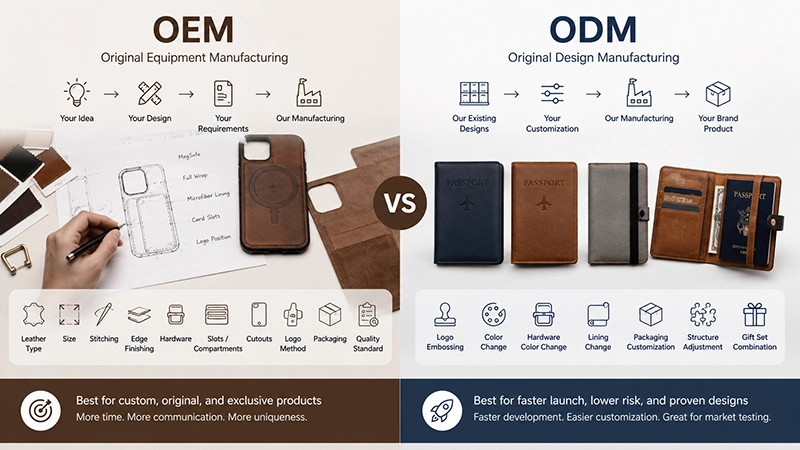
OEM stands for Original Equipment Manufacturing. In leather goods, OEM usually means the buyer provides the product idea, design requirements, technical details, or reference samples, and the factory manufactures the product according to those requirements.
An OEM project may include custom decisions about:
- Leather type
- Product size
- Stitching style
- Edge finishing
- Hardware
- Card slots or compartments
- Camera or button cutouts
- Logo method
- Packaging
- Quality inspection standard
For example, a brand developing custom leather phone cases may want a specific MagSafe layout, a full-wrap leather structure, a custom microfiber lining, and gift-box packaging. That kind of product usually needs OEM development because the details are part of the brand’s value.
OEM is best when the product itself needs to feel original. If your customer is paying for a unique structure, better material combination, or exclusive design language, OEM gives you more room to build that difference.
The tradeoff is time. OEM usually requires more sampling, more communication, more adjustment, and clearer quality standards before bulk production.
What Is ODM Leather Goods Manufacturing?
ODM stands for Original Design Manufacturing. In leather goods, ODM means the factory already has existing product designs or mature product structures. The buyer chooses a base design and customizes it for their brand.
ODM customization may include:
- Logo embossing or printing
- Leather color change
- Hardware color change
- Lining material change
- Packaging customization
- Small structure adjustments
- Gift set combination
For example, a buyer may choose an existing passport holder structure and customize the color, logo, packaging, and RFID-blocking lining. A product such as a leather passport holder can often be developed faster through ODM if the buyer does not need a completely new structure.
ODM is useful when buyers want to launch quickly, test demand, or reduce first-order risk. It is especially practical for startups, gift suppliers, Amazon sellers, retailers, and wholesalers testing a new leather goods category.
The limitation is that the base design may not be exclusive. Other buyers may be able to use a similar structure unless exclusivity is negotiated in advance.
OEM vs ODM: Key Differences for Buyers
| Factor | OEM | ODM |
|---|---|---|
| Product design | Buyer-led | Factory-led |
| Customization level | High | Medium or limited |
| Development cost | Higher | Lower |
| MOQ | Usually higher | Usually lower |
| Lead time | Longer | Shorter |
| Product uniqueness | Stronger | Weaker |
| IP control | Stronger if contract is clear | Limited unless exclusivity is negotiated |
| Best use case | Signature products and premium lines | Fast launch and market testing |
The easiest way to choose is to ask one question:
Are you trying to create something unique, or are you trying to launch something quickly?
If uniqueness matters more, OEM usually fits better. If speed and market testing matter more, ODM is often the better first step.
OEM vs ODM leather goods manufacturing
Common Buyer Scenario: The Cheap ODM Product That Became Expensive
A common sourcing mistake happens when a buyer chooses ODM only because the first quotation looks cheaper.
At the beginning, the project looks simple. The factory already has a wallet design. The buyer adds a logo, changes the leather color, and places a small first order. The product launches quickly.
Then the problems appear.
Another seller uses a very similar base design. The buyer’s product photos start looking interchangeable with competitors. Customers compare only price. The brand has no strong design feature to defend its margin.
At that point, the buyer may need to redesign the product anyway: new pocket layout, better leather, different hardware, improved packaging, or a more recognizable logo position. The project that started as a low-cost ODM order slowly turns into an OEM upgrade.
This does not mean ODM was wrong. It means ODM should be used with a clear purpose. It is excellent for testing demand, but it should not be confused with long-term product differentiation.
Cost, MOQ and Lead Time
OEM often costs more because the factory needs to spend more time on development. New patterns, tooling, sample revisions, material testing, structure adjustment, and packaging development can all increase cost.
ODM usually has a lower starting cost because the structure already exists. Buyers can focus on logo, material, color, packaging, and smaller details instead of building the whole product from zero.
For leather goods, MOQ and lead time depend on:
- Product type
- Leather material
- Color availability
- Logo method
- Hardware
- Packaging
- Tooling requirements
- Whether the design is OEM or ODM
- Order quantity
- Production season
Buyers who are still comparing MOQ, sampling, and customization options can review the Pellove FAQ before sending project details.
A simple planning guide:
| Buyer Situation | Better Starting Point |
|---|---|
| First time testing leather goods | ODM |
| Need a unique hero product | OEM |
| Small trial order | ODM |
| Long-term private label line | OEM |
| Seasonal gift product | ODM |
| Premium flagship collection | OEM |
| Unsure about demand | ODM first, OEM later |
IP and Exclusivity: Do Not Leave This Vague
IP is one of the easiest areas to misunderstand.
In OEM, buyers often expect that the design belongs to them. That can be true when the buyer provides the design and the agreement clearly defines ownership. But it should not be assumed silently.
In ODM, the factory usually owns the base product structure. The buyer may own the logo, packaging design, and brand assets, but not necessarily the product design itself.
Before confirming an order, buyers should ask:
- Who owns the design?
- Can the factory sell the same structure to other buyers?
- Is the mold, pattern, or tooling exclusive?
- Can the buyer request temporary exclusivity?
- What happens to samples and drawings after the project?
- Are confidentiality or NNN terms included?
- Can the factory use product photos for promotion?
A simple rule: if exclusivity matters to your brand, write it into the agreement.
Quality Control: OEM and ODM Have Different Risks
OEM and ODM both need quality control, but the risks are different.
OEM quality risk often comes from new development. Since the product may be built from scratch, the first samples may need several rounds of revision. The factory and buyer need to align on leather thickness, structure, stitching tension, edge paint, logo position, hardware, and packaging.
ODM quality risk is usually more about customization. The base product may already be stable, but changing the leather, logo method, lining, or packaging can still create new problems.
For example, changing from smooth cowhide to pebbled leather may affect logo clarity. Switching hardware color may affect lead time. Changing packaging may affect shipping protection. Adding RFID lining may affect thickness and folding comfort.
This is why buyers should always review physical samples, not only photos. Leather goods depend heavily on touch, smell, flexibility, edge finishing, stitching, and hardware feel.
Pellove was founded in 2011 and supports OEM/ODM leather accessories for global brands, retailers, and distributors. For buyers, that factory experience matters because leather goods quality is often decided in small details rather than big claims.
A Typical Mistake: Treating a Brand Product Like a Catalog Item
One of the easiest mistakes in leather goods sourcing is choosing a catalog design for a product that is supposed to represent the brand.
This often happens with premium accessories. A buyer wants a product that feels exclusive, but chooses a standard ODM design because it is faster and cheaper. The sample looks good enough. The logo is added. The packaging is changed. The product launches.
But once it reaches the market, it feels familiar. The shape is familiar. The pocket layout is familiar. The stitching is familiar. The only real difference is the logo.
For low-risk market testing, that may be acceptable. For a flagship product, it is dangerous.
A flagship product should carry something the customer can remember: a better hand feel, a smarter structure, a more thoughtful gift experience, or a material combination that fits the brand story. That is usually where OEM becomes more valuable.
When Should You Choose OEM?
Choose OEM when your product needs to be different enough that customers can recognize the difference.
OEM is usually better for:
- Established brands
- Premium leather goods lines
- Unique phone case structures
- Custom iPad cases
- Signature wallets
- Corporate gift sets
- Private label collections
- Long-term product development
For example, a brand developing a premium full grain leather phone case may want specific leather thickness, camera opening, MagSafe compatibility, logo placement, and packaging. These details are not just decoration. They shape how the product feels and how the brand is perceived.
OEM is also better when the buyer wants to build long-term product assets. A custom product may take longer to develop, but it gives the brand more control over future improvements.
When Should You Choose ODM?
Choose ODM when speed, lower starting cost, and market testing are more important than full originality.
ODM is usually better for:
- Startup brands
- Amazon sellers
- Gift companies
- Wholesalers
- Retailers
- Promotional product buyers
- Seasonal product launches
- First-time leather goods buyers
ODM works well when the buyer wants to test demand before investing heavily. A brand can start with an existing wallet, card holder, passport holder, phone case, or AirPods case structure, then customize logo, material, and packaging.
If the product sells well, the buyer can later upgrade it through OEM development.
This path is often more practical than trying to design every product from scratch from day one.
The Hybrid Strategy: Start Fast, Then Build Differentiation
Many smart leather goods brands use both OEM and ODM.
They use ODM to test the market. Then they use OEM to build stronger products after they understand what customers actually want.
A practical path can look like this:
- Launch an ODM product to test demand.
- Collect sales data, reviews, return reasons, and buyer feedback.
- Keep the best-performing product direction.
- Upgrade the structure, material, and packaging through OEM.
- Build a more exclusive version for long-term sales.
This reduces risk because the buyer does not invest too much before seeing market response.
For example, a brand may start with an ODM passport holder for a travel gift collection. If it sells well, the next version can become an OEM product with a custom pocket layout, RFID-blocking layer, better lining, unique leather, and premium packaging.
That is a smarter way to grow: test quickly, then customize deeply.
What a Good Leather Goods Manufacturer Should Help You See
A good leather goods manufacturer should not only ask, “How many pieces do you want?”
For OEM and ODM projects, the more useful question is usually: “What are you trying to test or protect?”
If a buyer is testing a new travel accessory line, a factory may suggest starting with an ODM passport holder structure and customizing the logo, leather color, and packaging first. If the product performs well, the next version can move toward OEM with a custom pocket layout, RFID lining, exclusive stitching details, or a more premium gift box.
If a buyer is developing custom leather phone cases, the decision may be different. Camera openings, MagSafe alignment, button feel, leather wrapping, and inner lining can all affect the final user experience. In that case, OEM development may be more suitable because small structural details are part of the product value.
This is where factory experience matters. Pellove works with leather phone cases, iPad cases, AirPods cases, watch bands, MagSafe wallets, passport holders, wallets, laptop sleeves, and other custom leather accessories. Instead of treating OEM and ODM as fixed labels, buyers can use Pellove’s sampling process to decide which parts should stay factory-standard and which parts should be customized.
For example, a buyer may keep an existing wallet structure to control cost, but customize the leather, logo method, stitching color, and packaging. Another buyer may need a fully custom leather phone case because the case structure itself is the selling point.
That is the practical difference: ODM helps buyers move faster, while OEM helps buyers own more of the product experience.
Conclusion: Do Not Choose OEM or ODM by Price Alone
OEM is better when your brand needs uniqueness, control, and long-term product differentiation.
ODM is better when your brand needs speed, lower development risk, and faster market testing.
But the real decision should not be based only on price. It should be based on what the product is supposed to do for your business.
If the product is only testing a new category, ODM may be the smarter first step. If the product is meant to become a signature item, OEM gives you more room to build something defensible. If the brand is still learning the market, a hybrid path may be the most practical choice.
Leather goods buyers should prepare their product type, target price, order quantity, material preference, logo method, packaging needs, and launch timeline before contacting a factory. With those details, Pellove can help evaluate whether OEM, ODM, or a staged development plan is the better fit.
The strongest leather goods projects usually do not start with the question, “Which model is cheaper?”
They start with a better question:
What kind of product are we trying to build, and how much of that product do we need to own?
FAQ
What is OEM in leather goods manufacturing?
OEM means the buyer provides the design direction, product requirements, or technical details, and the leather goods factory manufactures according to those requirements. It is suitable for brands that want stronger customization and product uniqueness.
What is ODM in leather goods manufacturing?
ODM means the factory provides an existing or semi-developed product design, and the buyer customizes it with logo, color, material, hardware, or packaging. It is suitable for faster launches and market testing.
Is OEM more expensive than ODM?
Usually, yes. OEM often requires more development work, sample revisions, pattern adjustment, material testing, and production setup. ODM usually has a lower starting cost because the base design already exists.
Is ODM good for startup brands?
Yes. ODM is often a practical choice for startup brands because it allows faster product launch, lower development risk, and easier market testing.
Which model gives better product uniqueness?
OEM usually gives better product uniqueness because the buyer can control the product structure, material, function, and design details. ODM products may be less unique unless exclusivity is negotiated.
Can ODM products be exclusive?
Sometimes. Buyers can negotiate exclusive sales rights, exclusive material combinations, or temporary market exclusivity. However, the base design usually still belongs to the factory unless the contract says otherwise.
Should I choose OEM or ODM for leather phone cases?
Choose OEM if you need a unique leather phone case structure, special MagSafe design, exclusive materials, or original packaging. Choose ODM if you want to launch quickly using an existing phone case design with custom branding.
What should buyers prepare before contacting a leather goods manufacturer?
Buyers should prepare product type, target market, material preference, logo method, packaging needs, estimated order quantity, target price, and whether they need OEM, ODM, or both.
After choosing OEM or ODM, buyers still need to align cost, MOQ, and inspection standards. The MOQ for custom leather goods guide explains quantity and price drivers, while the leather goods quality checklist helps define sample approval and production QC points.