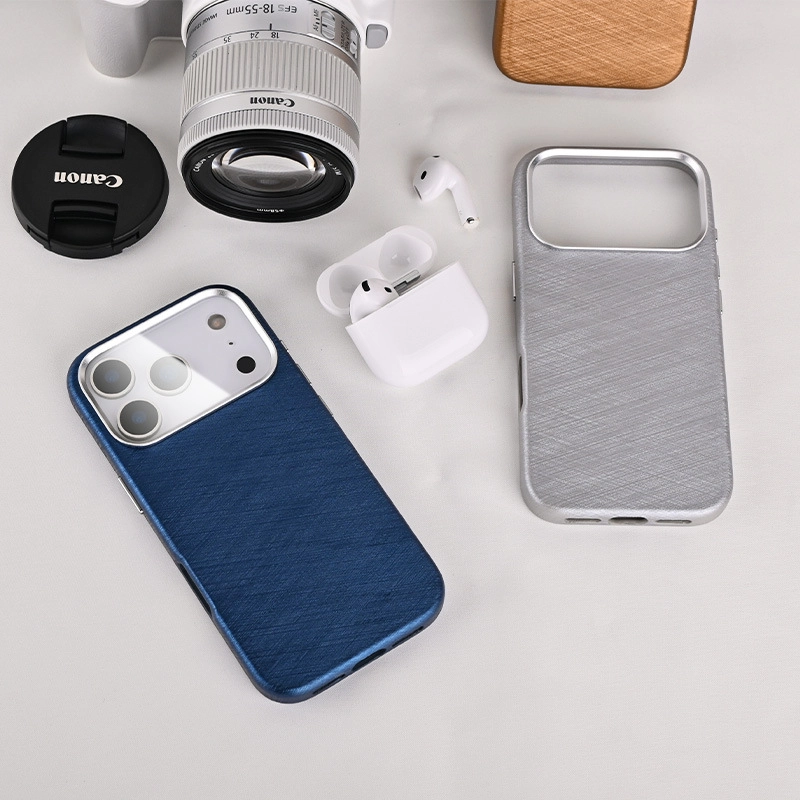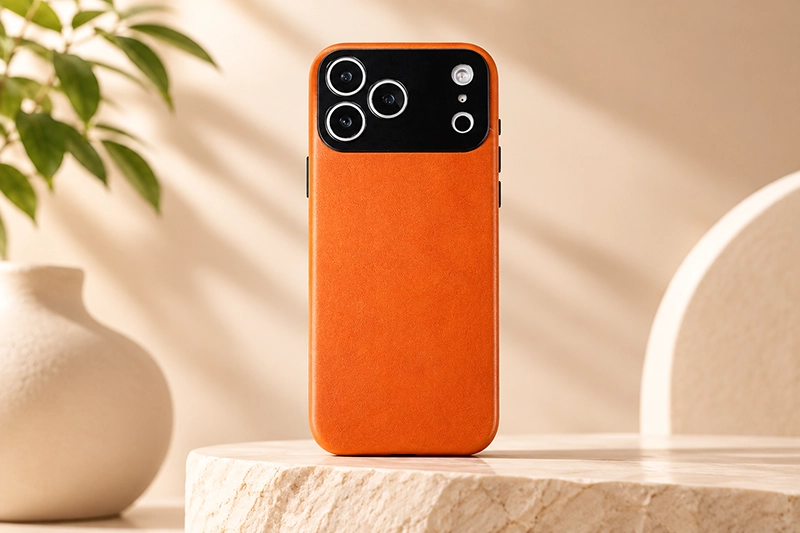

A thin leather phone case can provide useful everyday protection without turning the phone into a thick block, but it should not be sold as a rugged case. Thin leather usually protects against scratches, pocket and desk friction, minor bumps and hand slips. Drop performance depends on the inner shell, corners, raised edges, fit and the test standard behind the claim.
A slim phone case should be measured as the finished assembly, not only as the leather’s thickness before or after skiving. Outer leather, adhesive, PC or TPU shell, lining and optional magnets all add to the final profile. A lower leather number does not automatically make the product better or worse.
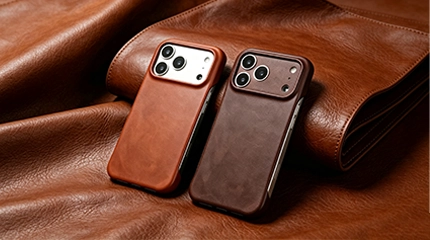
What a Thin Leather Case Can Protect
The leather surface shields the back from keys, dust, pockets and ordinary desk contact, while the inner shell holds the phone and stabilizes the shape. A softer lining reduces direct rubbing between the device and the case.
Small raised edges around the camera and screen can keep those surfaces away from a flat table. Low-profile designs do not need a large lip, but the lip should be deliberate. It should not disappear after leather wrapping or push against the camera module.
Leather can also improve grip when the finish is not too smooth or heavily coated. The material does not make the phone unbreakable, and a visible mark in the leather does not prove impact protection. Product claims should separate surface protection from drop protection.
Where Slimness Becomes a Tradeoff
| Tradeoff | Thin leather case | What to verify |
|---|---|---|
| Leather hand feel | Slim wrapping usually requires thinner leather, which can feel less substantial. | Approve the exact leather after skiving, not only a full-thickness swatch. |
| Camera and screen | Protection relies on a small but effective lip and accurate opening. | Measure the finished lip, lens clearance and table contact on the assembled case. |
| Impact protection | Less overall material usually means less shock absorption than a rugged case. | Do not claim rugged protection without a defined test and result. |
| Fit stability | A soft or oversized shell may loosen, warp or lift at the corners. | Test insertion, removal, button alignment and sidewall hold after repeated use. |
| MagSafe | The magnet, shell, lining, adhesive and leather all add to the stack. | Test charging, wallet grip, heat and alignment on the final case. |
How Thin Cases Keep Their Shape
A useful slim case is not one thin layer of leather. It usually combines an outer leather surface, an adhesive or bonding layer, a structured PC or TPU shell, a soft lining and a magnet assembly when MagSafe is required. Each layer should serve a clear purpose.
An ultra thin phone case can still carry a PC shell, lining and edge support, but each component must remain thin enough to preserve the profile. Removing an internal layer to hit a number can make the case feel weak or fit poorly.
The leather needs enough thickness to wrap, resist tearing at corners and hold its finish. Too thin a material may wrinkle, expose the backing or feel closer to a film than leather. The shell needs enough rigidity to hold the phone but enough flexibility to install without cracking.
That balance changes with model size and structure. A large Pro Max case may feel different from a compact model using the same leather because wraps, corners and internal dimensions differ. A foldable device adds hinge coverage and separate folded and open states.
What “Thin” Should Mean in a Specification
The product brief should define finished thickness at the back panel, sidewall and camera surround. It should also state leather thickness after skiving, shell material, lining and magnet stack where relevant. One overall number can hide a bulky camera area or an unstable sidewall.
There is no universal “best” leather thickness. Around 0.5 mm may work for one full-wrap construction, but it is not a production rule for every model, hide or finish. Thickness should be chosen with the leather temper, bonding method, corner radius and intended hand feel.
Measure a physical sample at multiple points. Check the center panel, corners, buttons, camera lip and lower edge. The finished tolerance should be written down so it can be repeated in bulk production and treated consistently during inspection.
MagSafe and Device Fit Need Separate Approval
A slim leather case can support MagSafe, but the finished stack must be tested. Check charger alignment, magnetic grip, wallet attachment, car-mount stability, surface flatness and heat during charging. Magnet position must remain accurate after leather wrapping.
Device fit is equally important. Confirm camera opening, button travel, port clearance, speaker access and corner coverage with the intended phone model or a verified dummy. Repeat the check after leather is applied because bonding and wrapping change the internal clearance.
For foldables, do not assume that a flat phone case structure will scale. Hinge clearance, folded thickness and case movement need a separate platform and physical sample.
How to Judge Leather Feel in a Slim Case
Customers often compare a slim leather phone case with a thicker leather wallet or folio and then assume the thin version is synthetic. That conclusion may be wrong. A genuine hide can feel smoother and lighter after skiving and bonding.
The product page should explain the construction honestly. “Slim full-wrap leather case” does not promise the same hand feel as a thick natural leather case. If the leather is backed, laminated or combined with a microfiber lining, state that too.
Surface finish matters as much as thickness. Oil-wax, pebbled and coated leathers feel different and age differently. Approve the final finish for grip, color, scratch visibility and care expectations instead of choosing thickness alone.
What Brands Should Approve Before Production
Review a finished sample with the actual phone inside. Check the camera lip, screen edge, buttons, installed-case thickness, weight, corner hold, lining, stitching, edge paint and logo. The sample must feel stable without being too difficult to install.
Define a production standard for the leather surface, color range, acceptable wrinkles, camera gap, button force, corner fit, adhesive and edge finish. If impact resistance is claimed, agree the test method and acceptance result rather than relying on a generic “protective” description.
For a private-label program, connect the slim product to packaging, model labels, care instructions and replacement planning. Packaging pressure can mark leather, and a model label mismatch can create a return even when the case itself passes inspection.
Pellove can review custom leather phone case development, skiving, shell fit and sample approval across current device models. Compare structures in the leather phone case collection, use the leather goods quality checklist for inspection, or contact Pellove with the target model, finished thickness and MagSafe requirement.
Best positioning: A thin leather case is an everyday protection product for people who value a slimmer hand feel, leather touch and business styling. It is not a rugged case, and it should not be marketed as one without evidence.
Questions Buyers Ask
Are thin leather phone cases protective?
They can provide everyday scratch, friction, camera-contact and minor-bump protection. A high-drop claim needs a defined structure and test result; thinness alone does not prove it.
Can a thin leather case replace a rugged case?
No. Rugged cases usually add thicker corners, air pockets or multi-layer impact structures. A slim leather case is positioned for daily urban use, not extreme protection.
Why does a thin leather case feel less like thick leather?
Slim construction often requires thinner leather after skiving. The outer leather, backing, shell and lining also change the final hand feel, so a genuine hide can feel lighter than a thick leather product.
Is 0.5 mm leather too thin?
It can work in some full-wrap constructions, but there is no universal answer. Leather type, shell, corners, finish and target hand feel should decide the approved thickness.
What is the best thickness for a thin leather phone case?
The right specification is the finished assembled thickness, measured at the back, sidewall and camera area. It should be set with the physical sample rather than copied from another phone model.
Can a thin leather case support MagSafe?
Yes, if the magnet ring, shell, lining and leather stack are designed and tested together. Confirm charging alignment, grip and accessory stability on the finished case.
Do thin leather phone cases develop patina?
They can, depending on the leather and finish, but a thin bonded construction may age differently from a thick full-grain case. Explain the actual material and care expectation.