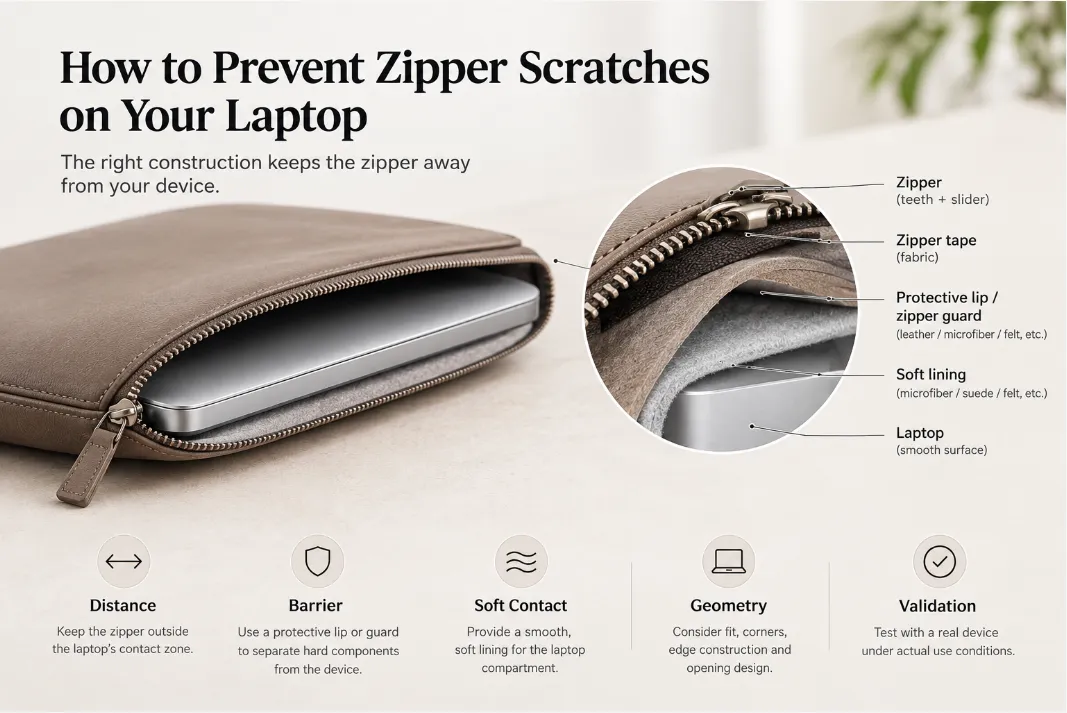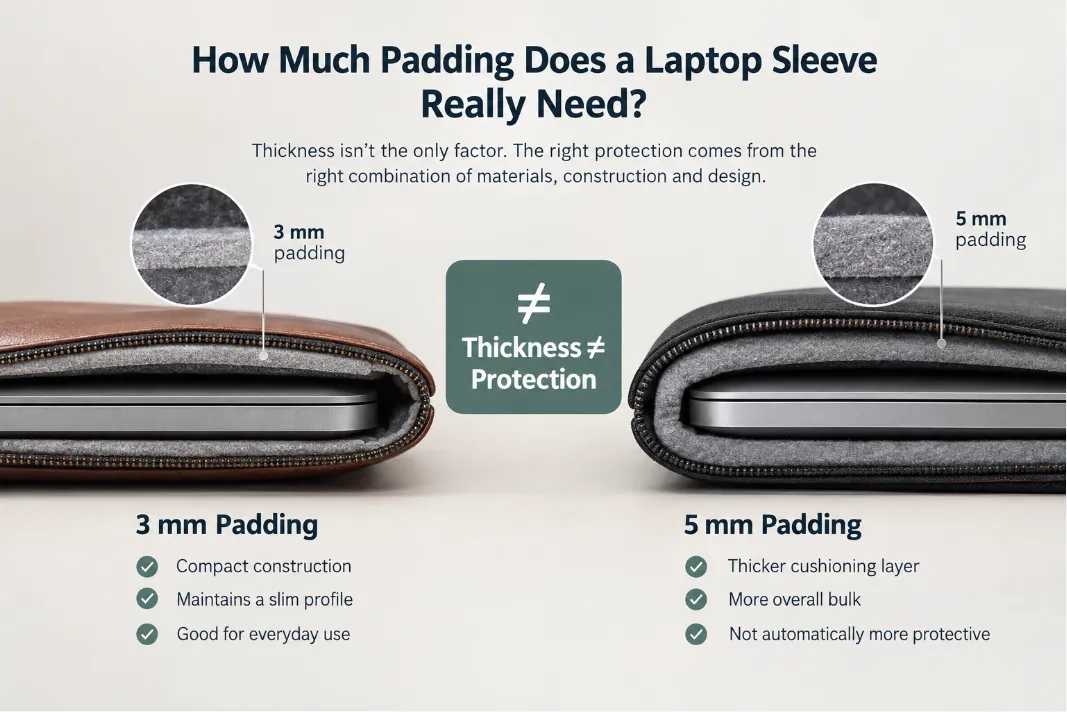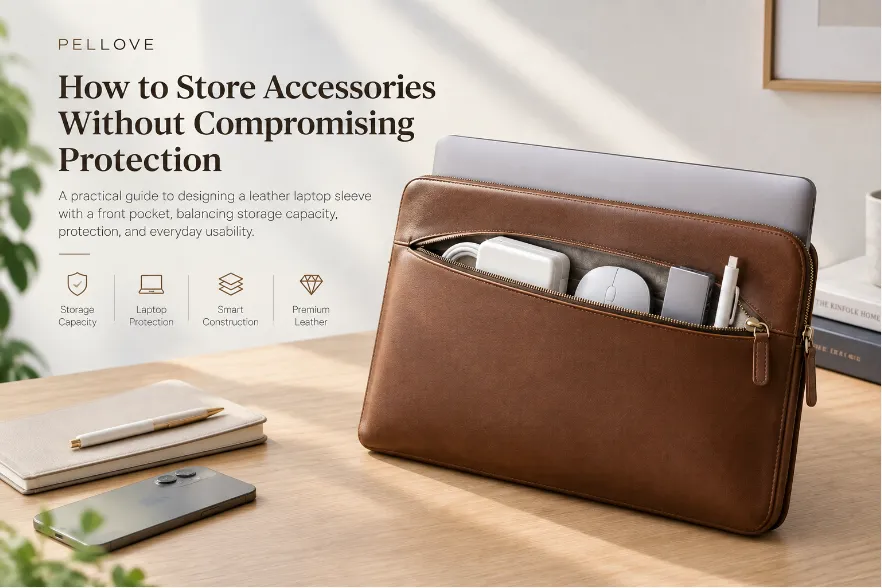

The edges of a leather laptop sleeve face constant handling, bending, friction, and movement. Over time, a poorly designed edge may develop fine cracks, start peeling, open at folded sections, or show exposed leather fibers.
For a custom leather laptop sleeve, edge durability is built into the product’s construction. Leather selection, skiving, edge construction, bonding, reinforcement, and finishing all affect how the edge performs during repeated use. Testing and production quality control are equally important when moving from a prototype to mass production.
Understanding these factors can help brands identify potential edge problems earlier and develop a more reliable laptop sleeve construction. For a full understanding of the leather laptop sleeve, please refer to our Custom Leather Laptop Sleeve Guide.
What Causes Leather Laptop Sleeve Edges to Crack or Peel?
Edge failure can result from several factors, and different failure patterns may have different causes.
1. Repeated Bending and Flexing
Laptop sleeves are handled frequently. The opening, corners, and folded edges may flex every time you insert or remove the laptop.
If the edge construction cannot accommodate this movement, repeated stress can cause the surface finish to crack or bonded layers to separate gradually.
2. Rigid or Excessive Edge Paint
Painted edges can create a clean, precise appearance, but the edge coating needs to remain compatible with the flexibility of the leather underneath.
If the coating is too rigid or applied too heavily, repeated bending may cause fine cracks to appear. Excessive coating can also reduce the flexibility of the edge.
3. Poor Adhesion Between Materials
Peeling often occurs when two layers do not bond adequately.
A leather laptop sleeve may contain several material interfaces, including:
- Leather and reinforcement
- Leather and lining
- Folded leather layers
- Leather and zipper components
- Leather and edge-finishing materials
Adhesive compatibility, coverage, bonding pressure, surface condition, and curing conditions can all affect the final bond.
4. Inappropriate Leather Selection
Leather properties vary considerably between materials.
Different leathers can have different levels of flexibility, surface strength, fiber structure, and coating behavior. A leather that performs well on a relatively rigid product may not behave the same way when repeatedly folded or flexed.
For premium laptop sleeves, leather selection should therefore consider not only appearance and hand feel, but also flexibility and expected edge behavior.
5. Poor Edge Geometry
Sharp transitions, insufficient folding allowance, uneven thickness, or poorly positioned layers can create localized stress.
This is why edge durability should be considered during structural development rather than treated only as a finishing-stage issue.
What Is the Difference Between Edge Cracking and Edge Peeling?
Cracking and peeling can indicate different failure mechanisms, even though both may affect the appearance and durability of the finished edge.
| Edge Problem | What You See | Likely Cause | Corrective Direction |
|---|---|---|---|
| Edge cracking | Fine cracks in the finished edge | Rigid or excessive edge coating combined with repeated flexing | Review edge-finish flexibility and coating thickness |
| Edge peeling | Edge material separates from the leather | Weak or unsuitable bonding | Review adhesive compatibility and bonding process |
| Edge opening | Folded edge starts lifting | Weak folding or insufficient bonding | Review skiving, folding, and bonding |
| Edge fraying | Leather fibers become exposed | Abrasion or insufficient edge treatment | Review edge treatment and abrasion resistance |
Identifying the failure pattern first makes it easier to determine whether the problem is related to the material, construction, bonding, or finishing process.
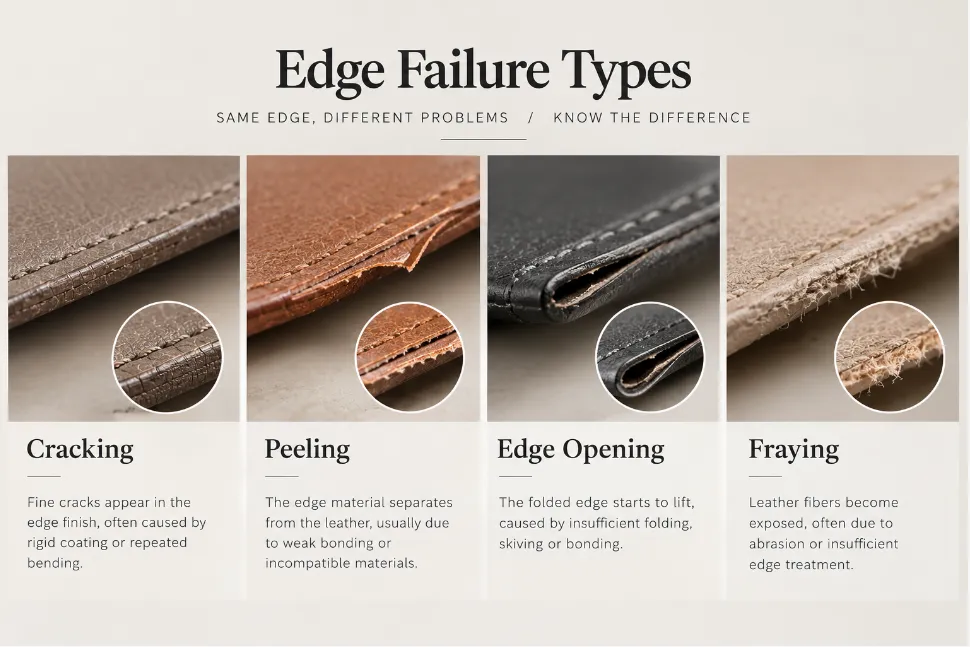
Edge Failure Types
Which Edge Construction Is Suitable for a Leather Laptop Sleeve?
There is no single edge construction that works best for every laptop sleeve. The choice depends on the desired appearance, leather thickness, product structure, flexibility, production requirements, and target cost.
Folded Edge
A folded edge turns the leather back onto itself to create an integrated leather appearance.
Advantages include:
- Premium leather appearance
- No exposed raw leather edge
- Good integration with the overall product structure
Accurate skiving is important because the leather needs enough flexibility to fold cleanly without creating excessive bulk or stress.
Painted Edge
An edge-painted construction uses a coating to create a clean and uniform finish.
Advantages include:
- Precise appearance
- Suitable for modern and minimalist designs
- Consistent edge profile
The flexibility and thickness of the edge finish need to match the leather and the amount of movement expected during use.
Natural and Turned Edges
Some designs use a more natural leather appearance rather than a heavy painted finish.
This can highlight the characteristics of the leather, but exposed leather fibers may be more vulnerable to abrasion and fraying depending on the material and application.
How Should You Choose?
| Edge Construction | Typical Advantage | Main Consideration |
|---|---|---|
| Folded edge | Premium integrated leather appearance | Requires accurate skiving and sufficient folding allowance |
| Painted edge | Clean and precise appearance | Edge finish must remain compatible with leather flexibility |
| Natural/turned edge | More natural leather appearance | Exposed areas may be more vulnerable to abrasion and fraying |
The appropriate construction should be selected based on the complete product design rather than appearance alone.
How Does Skiving Affect Edge Durability?
Skiving reduces leather thickness in selected areas. For laptop sleeves, it is particularly important around folded edges and transitions between different construction zones.
Poor skiving can create two opposite problems:
- Too little skiving: the edge remains bulky and may be difficult to fold.
- Too much skiving: excessive material removal can reduce local leather strength.
| Skiving Condition | Possible Result |
|---|---|
| Too little | Bulky edge and difficult folding |
| Uneven | Inconsistent thickness and localized stress |
| Too much | Reduced leather strength |
| Controlled and consistent | Better balance of thickness, flexibility, and strength |
Why the Skiving Transition Matters
The transition between the normal leather thickness and the skived area should be gradual and controlled.
A sudden thickness change can create a weak point or stress concentration. During repeated bending, this area may experience more movement than the surrounding leather.
For this reason, skiving quality is not only about achieving a target thickness. The transition profile also matters.
Why Do Leather Laptop Sleeve Edges Peel?
Peeling is often related to movement between different materials.
Leather, reinforcement boards, adhesive layers, lining materials, and edge finishes may respond differently to bending and tension. When a bonded interface repeatedly experiences shear stress, a weak bond may gradually separate.
Important factors include:
- Adhesive compatibility
- Adhesive coverage
- Bonding pressure
- Surface condition
- Curing time
- Material compatibility
- Layer alignment
- Local stress during folding
Why Visual Inspection Alone Is Not Enough
An edge may look clean immediately after production while still having insufficient bonding strength.
For OEM/ODM development, edge construction should therefore be evaluated through repeated-use testing and physical inspection, rather than relying only on the appearance of the finished sample.
How to Protect High-Stress Areas
Not every part of a laptop sleeve experiences the same level of stress. Some areas deserve particular attention during structural development.
Sleeve Opening
The opening is repeatedly flexed when the laptop is inserted and removed.
The edge construction should provide enough flexibility to accommodate this movement without allowing the leather or lining to shift excessively.
Corners
Corners change direction and can become areas of concentrated stress.
Consistent skiving, accurate folding, and appropriate reinforcement can help distribute stress more effectively.
Zipper Ends
Zipper ends combine several materials and construction layers within a relatively small area. Because closure construction can affect both stress distribution and overall sleeve performance, brands should also consider the appropriate laptop sleeve closure options during product development.
They should be checked for:
- Layer separation
- Uneven thickness
- Exposed edges
- Stitching or bonding stress
- Local reinforcement
These high-stress areas should be considered during the original construction design rather than reinforced only after a failure occurs.
How Edge Construction Affects Laptop Sleeve Thickness
Edge construction can also affect the overall thickness of a laptop sleeve.
For example, a folded leather edge requires sufficient folding allowance, while reinforcement, adhesive, and lining layers can add thickness around specific areas.
This becomes particularly important when developing a slim laptop sleeve.
A thinner edge does not automatically mean a better construction. The objective is to achieve a controlled balance between thickness, flexibility, strength, protection, and appearance.
For more information, see our guide on How to Design a Slim Leather Laptop Sleeve Without Sacrificing Protection.
For a broader comparison of sleeve and hard-shell protection, see our guide to Leather Laptop Sleeve vs Hard Shell Case: Which Is Better for MacBook Protection?
How to Test Leather Laptop Sleeve Edge Durability
Edge durability should be evaluated during prototype development and checked again during production.
A practical testing approach can include repeated opening, bending, folding, and handling of the sleeve.
During testing, inspect for:
- Fine cracks in the edge finish
- Peeling between material layers
- Opening of folded edges
- Exposed leather fibers
- Corner separation
- Changes in edge thickness
- Changes in appearance after repeated use
The purpose is not simply to determine whether an edge survives one test. It is to identify where the construction begins to fail and what may be causing the failure.
Why Prototype Approval Does Not Guarantee Mass-Production Edge Durability
A prototype may perform well while production samples later show edge problems.
Mass production involves larger quantities of materials, repeated processing steps, operators, and normal process variation. Small differences in the following factors can affect the final edge performance:
- Leather thickness
- Skiving depth
- Adhesive application
- Folding position
- Bonding pressure
- Edge coating
- Curing conditions
This is why production control is just as important as prototype development for OEM/ODM projects.
A construction that works on one carefully controlled prototype still needs to be translated into a repeatable production process.
How to Diagnose Leather Laptop Sleeve Edge Problems
When an edge problem appears, identify the failure pattern before immediately changing the material.
QC Checkpoints
| Production Stage | What to Check |
|---|---|
| Before assembly | Leather thickness, skiving consistency, material defects, reinforcement placement, lining dimensions |
| During bonding and assembly | Adhesive coverage, layer alignment, fold consistency, edge tension, bonding pressure |
| After edge finishing | Edge smoothness, paint adhesion, cracks, peeling, uneven thickness, exposed fibers |
| Final QC | Corner finishing, overall edge appearance, layer separation, functional areas such as zipper ends |
Failure Pattern → Possible Cause
| Observed Problem | Areas to Investigate |
|---|---|
| Uneven edge thickness | Leather thickness and skiving consistency |
| Fine edge cracks | Edge-finish flexibility and coating |
| Peeling between layers | Adhesive compatibility and bonding process |
| Folded edge opening | Skiving, folding, and bonding |
| Exposed leather fibers | Edge treatment and abrasion |
| Corner separation | Corner construction and reinforcement |
This type of failure analysis helps determine whether the issue is primarily related to materials, construction, bonding, finishing, or process control.
Can Cracked or Peeling Leather Laptop Sleeve Edges Be Repaired?
Minor surface problems may sometimes be repaired, depending on the construction and severity of the damage.
However, repair is not always the best solution for a production product. If peeling results from insufficient bonding or cracking results from an unsuitable edge construction, adding another finishing layer may not address the underlying problem.
For OEM projects, identifying the root cause and improving the construction is generally more reliable than relying on post-production repair.
Does Thicker Leather Always Mean a More Durable Edge?
No.
Leather thickness is only one factor in edge durability.
A thicker leather edge can still fail if the skiving, bonding, reinforcement, edge construction, or finishing is poorly controlled.
A more useful way to evaluate edge durability is to consider the complete system:
Leather + skiving + reinforcement + adhesive + edge construction + finishing + QC
The goal is not to make every layer thicker. It is to make the complete construction work together.
Key Takeaways
To reduce cracking, peeling, and edge opening on a leather laptop sleeve:
- Select leather based on appearance, hand feel, flexibility, and expected use.
- Design the edge construction as part of the overall product structure.
- Control skiving for consistent thickness and smooth transitions.
- Match the edge finish to the flexibility of the leather.
- Check bonding conditions when different materials are joined.
- Reinforce high-stress areas such as openings, corners, and zipper ends when required.
- Test prototypes and production samples for repeated-use performance.
- Use production QC to control process variation and maintain consistency.
- Diagnose the failure mechanism before changing materials or construction.
A durable leather laptop sleeve edge is the result of coordinated material, structural, and manufacturing decisions—not a single finishing technique.
Developing a Custom Leather Laptop Sleeve?
If you are developing a custom leather laptop sleeve and need to balance premium appearance, slim construction, edge durability, and production consistency, the edge construction should be considered before mass production.
At Pellove, we support OEM/ODM development for custom leather tech accessories and laptop sleeves, including leather selection, material combinations, structural development, skiving, lining, reinforcement, edge construction, prototyping, and production QC.
You can provide us with a reference sample, technical drawing, target thickness, or an existing product with edge problems, and our team can evaluate the construction and suggest possible improvements for the next prototype.