
Choosing the right material is one of the most important decisions when developing a laptop sleeve.
The material affects far more than the appearance of the finished product. It can influence:
- Protection and structure
- Product durability
- Hand feel and user experience
- Weight and portability
- Brand positioning
- Production cost
- Customization options
Three materials are especially common in the laptop sleeve market:
- Leather laptop sleeves — premium appearance, durability, and craftsmanship
- PU leather laptop sleeves — design flexibility, consistent appearance, and accessible pricing
- Neoprene laptop sleeves — lightweight construction and strong cushioning performance
So, which material is best?
There is no single answer. The right choice depends on your target customer, retail price point, brand positioning, and the type of product experience you want to create.
For brands developing premium technology accessories, material selection is not simply a sourcing decision. It is part of the overall product strategy.
In this guide, we compare leather vs PU vs neoprene laptop sleeves across performance, durability, design, cost, and brand positioning to help brands choose the right material for their collection.
1. Leather vs PU vs Neoprene: Quick Comparison
Before looking at each material in detail, here is a quick overview.
| Feature | Leather | PU Leather | Neoprene |
|---|---|---|---|
| Premium appearance | Excellent | Good to Excellent | Basic to Moderate |
| Long-term durability | Excellent | Moderate to Good | Moderate |
| Shape retention | Excellent | Good | Low |
| Shock absorption | Depends on construction | Depends on construction | Excellent |
| Water resistance | Moderate | Good | Good |
| Natural aging | Excellent | Limited | Limited |
| Color consistency | Moderate | Excellent | Good |
| Customization flexibility | Excellent | Excellent | Moderate |
| Brand value | Excellent | Good | Moderate |
| Typical positioning | Premium / Luxury | Mid-range / Affordable Premium | Entry-level / Functional |
The key takeaway: material alone does not determine whether a laptop sleeve is good. The final product also depends on the lining, padding, reinforcement, closure, and manufacturing quality.
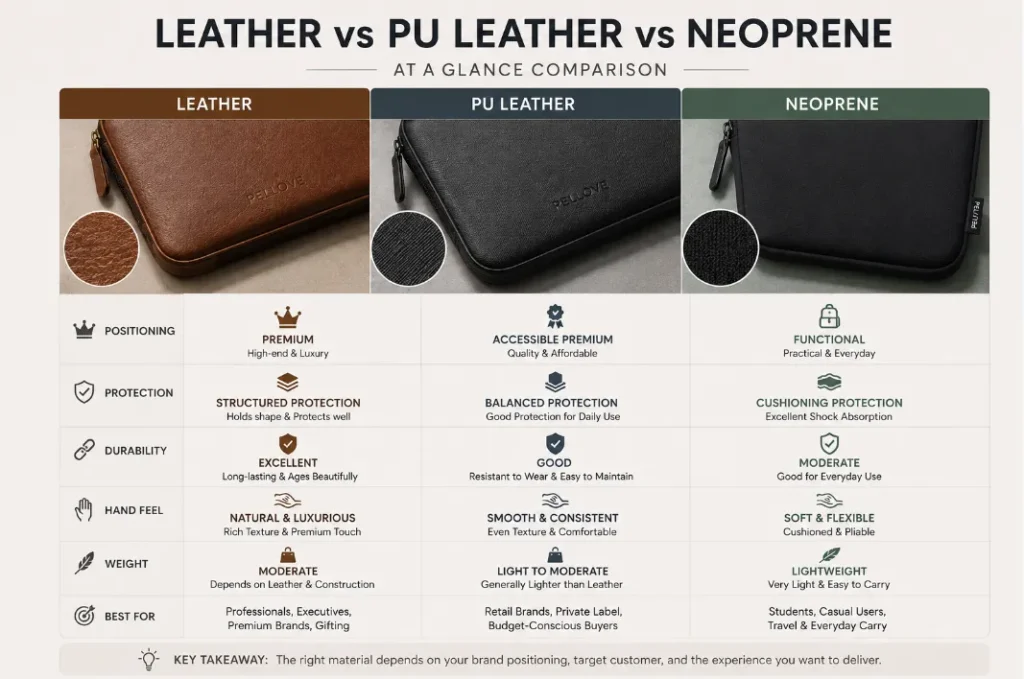
Leather vs PU vs Neoprene Material Comparison
2. Genuine Leather Laptop Sleeves
Leather is the strongest choice for brands that want to position a laptop sleeve as a premium accessory rather than simply a protective cover.
It offers qualities that synthetic materials cannot fully replicate:
- Natural grain and texture
- A premium hand feel
- Strong long-term durability
- Natural variation between pieces
- Patina development over time
A well-designed leather laptop sleeve can become part of the user’s daily professional style, especially for business travelers, executives, designers, and professionals.
However, not all leather is the same.
Full-Grain Leather
Full-grain leather retains the natural grain layer of the hide. It is generally considered the highest-end option for premium leather goods.
Advantages
- Natural and distinctive grain
- Excellent durability
- Strong premium perception
- Develops a unique patina with use
Best suited for
- Luxury laptop accessories
- Executive collections
- Premium leather brands
- High-value corporate gifts
Full-grain leather works particularly well when the brand story focuses on craftsmanship, longevity, and natural materials.
Top-Grain Leather
Top-grain leather is processed to create a more uniform surface while maintaining many of the benefits of genuine leather.
Advantages
- More consistent appearance
- Easier color control
- Refined surface finish
- Suitable for scalable production
Best suited for
- Premium retail collections
- Private label laptop sleeves
- Professional business accessories
- Corporate gifting programs
For many brands, top-grain leather offers a practical balance between premium positioning, appearance consistency, and production requirements.
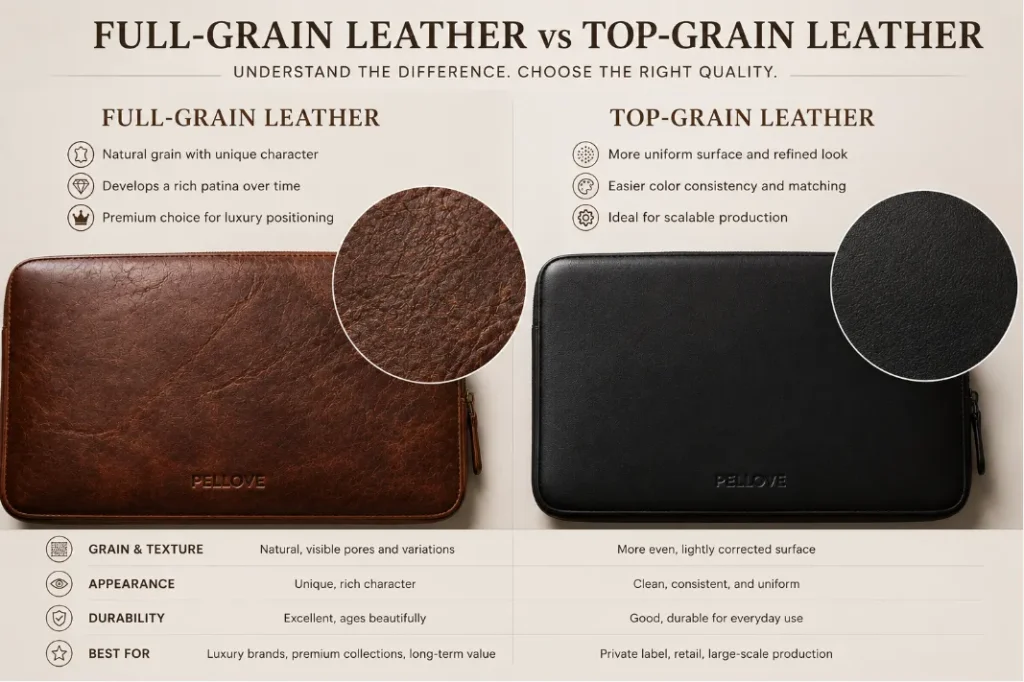
Full grain leather vs Top grain leather
Other Genuine Leather Options
Depending on the target price point and product design, brands may also consider other types of genuine leather.
The final choice should take into account:
- Grain appearance
- Leather thickness
- Softness and flexibility
- Surface coating
- Scratch resistance
- Color consistency
- Expected retail price
For a laptop sleeve, the leather must also work with the construction. A very soft leather may create a different product experience from a firmer leather with better shape retention.
3. PU Leather Laptop Sleeves
PU leather is a synthetic material designed to replicate the appearance and feel of natural leather.
Modern PU materials are available in a wide range of finishes, including:
- Smooth leather textures
- Fine-grain surfaces
- Saffiano-style patterns
- Soft-touch finishes
- Matte finishes
- Glossy finishes
High-quality PU can create a polished and premium-looking product while offering more consistency than natural leather.
Advantages of PU Leather
- Lower material cost
- Consistent surface appearance
- Easier color matching
- Wide range of textures and finishes
- Flexible design options
- Suitable for scalable production
PU can be a strong choice for brands that want to create a refined product while keeping the final retail price more accessible.
Limitations of PU Leather
The quality difference between PU materials can be significant.
Lower-quality PU may eventually experience:
- Surface peeling
- Cracking
- Loss of flexibility
- Surface wear around high-contact areas
For this reason, brands should evaluate PU material based on the actual product structure and intended lifespan rather than choosing based on appearance alone.
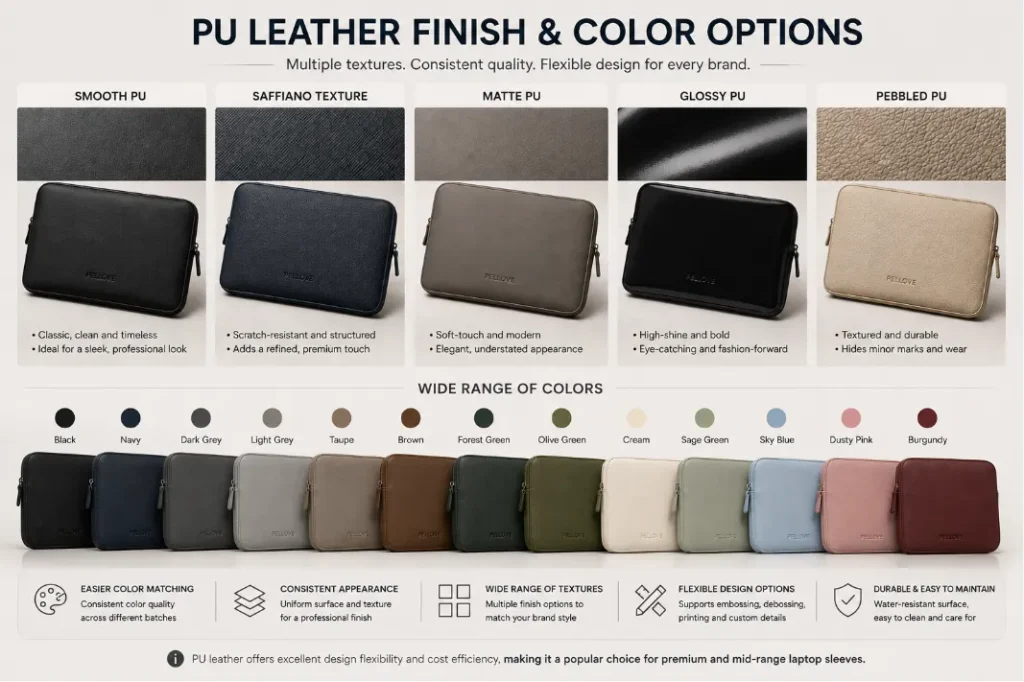
PU leather finish and color options
4. Neoprene Laptop Sleeves
Neoprene is a synthetic rubber-based material widely used in protective and flexible products.
Its main strengths are:
- Lightweight construction
- Flexibility
- Natural cushioning
- Good resistance to moisture
Neoprene laptop sleeves are commonly designed as soft sleeves with zipper closures.
Advantages of Neoprene
- Excellent shock absorption
- Lightweight and easy to carry
- Comfortable, flexible construction
- Competitive production cost
Limitations of Neoprene
Neoprene provides less structural stability than leather or reinforced PU constructions.
Over time, softer sleeves may experience:
- Stretching
- Shape deformation
- Fabric wear
- Reduced visual refinement
Neoprene is therefore best suited to brands focused primarily on practical protection and portability rather than luxury positioning.
5. Protection: Material Is Only One Part of Laptop Sleeve Quality
One of the biggest mistakes when comparing laptop sleeve materials is assuming that the outer material alone determines protection.
It does not.
A premium laptop sleeve is a complete construction system.
The outer material is only one layer of the product.
Exterior Material
The exterior affects:
- Appearance
- Scratch resistance
- Hand feel
- Brand identity
Leather, PU, and neoprene each create a different product experience.
However, the exterior material does not necessarily determine impact protection.
Interior Lining
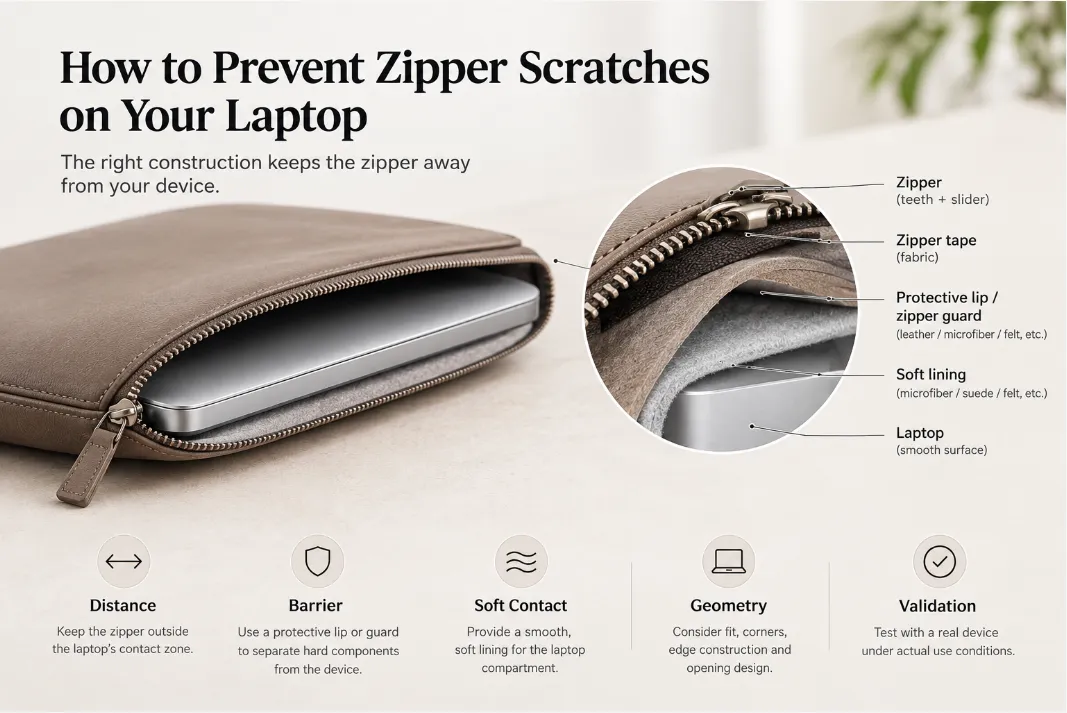
The interior lining directly affects how the laptop surface is protected.
Common options include:
- Microfiber
- Soft textile lining
- Velvet-like fabrics
A good lining helps reduce:
- Surface scratches
- Friction marks
- Contact damage
For premium laptop sleeves, the lining should also support the overall brand experience.
A smooth microfiber interior, for example, creates a very different perception from a basic fabric lining.
Padding and Shock Absorption
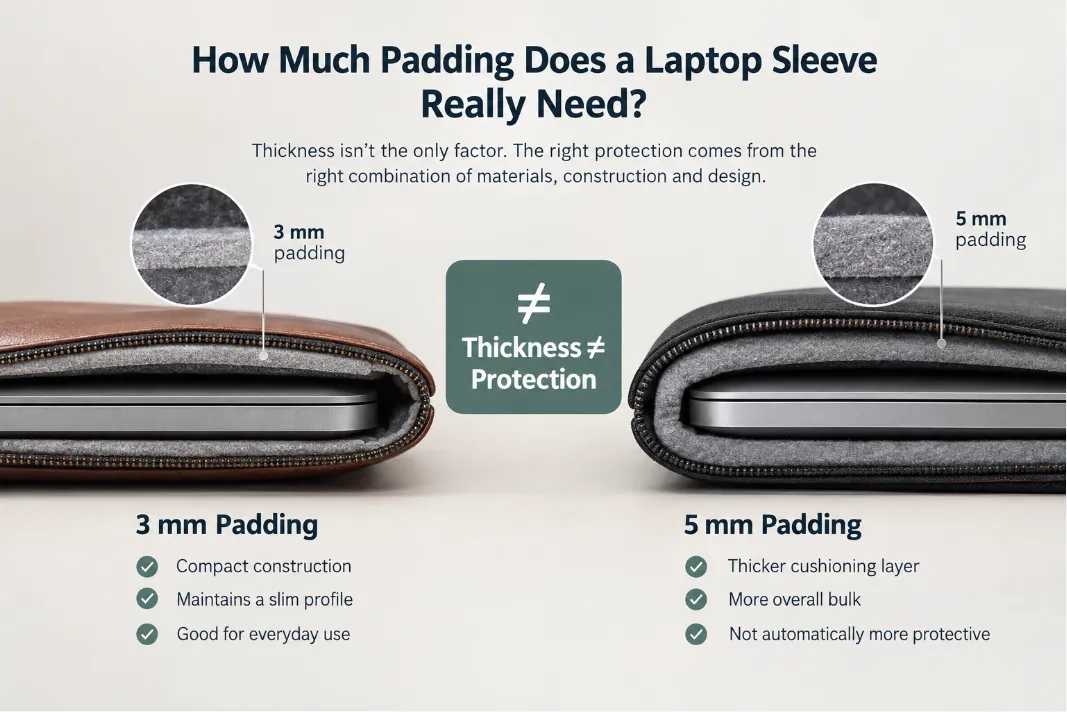
Impact protection usually comes from the internal construction rather than the leather or PU surface itself.
A laptop sleeve may use:
- Foam padding
- EVA padding
- Reinforcement boards
- Semi-rigid panels
- Reinforced corners
This is why two leather laptop sleeves can provide very different levels of protection.
A thin minimalist leather sleeve may prioritize slimness, while a padded leather sleeve may prioritize impact protection.
Structural Design
The overall structure determines how well the sleeve maintains its shape and protects the laptop from pressure.
A more structured sleeve can provide better resistance against:
- Compression inside a backpack
- Everyday impacts
- Pressure from surrounding items
Leather and PU are particularly suitable for structured designs because they can be combined with reinforcement materials while maintaining a refined appearance.
6. Closure Design Should Match the Material and Product Positioning
The closure is another important part of the product design.
Common laptop sleeve closures include:
Different materials work particularly well with different design concepts.
Leather
Leather is highly versatile and can be used with:
- Premium zipper closures
- Magnetic flap designs
- Envelope constructions
- Minimalist open-top sleeves
It is particularly suitable for designs where the closure is part of the visual identity.
PU Leather
PU also offers strong design flexibility.
It can work well with:
- Zippers
- Magnetic flaps
- Fashion-oriented envelope designs
Because PU is available in many finishes and colors, it can be useful for brands developing seasonal or trend-focused collections.
Neoprene
Neoprene sleeves most commonly use zipper closures because the material is soft and flexible.
This combination is practical and functional, although it generally creates a more casual product appearance.
For a more detailed comparison of closure systems, see Zipper vs Magnetic vs Envelope Laptop Sleeve: Which Closure Is Best?
7. Appearance and Brand Positioning
Material choice communicates something about the brand before the customer even uses the product.
Leather: Premium and Professional
Leather creates the strongest association with:
- Craftsmanship
- Professionalism
- Heritage
- Long-term value
A leather laptop sleeve can support a higher perceived product value and is particularly suitable for premium technology accessory brands.
It also works well with understated customization, including:
- Debossed logos
- Embossed branding
- Custom stitching
- Painted edges
- Custom interior linings
For brands building a premium collection, leather provides more opportunities to create a distinctive product identity.
PU Leather: Modern and Accessible
PU leather is often associated with:
- Fashion flexibility
- Modern colors
- Accessible premium positioning
- Consistent visual appearance
It is a practical option for brands that want more design freedom while maintaining controlled costs.
PU can also be useful when exact color matching is important across a larger collection.
Neoprene: Functional and Casual
Neoprene communicates practicality.
It is generally associated with:
- Everyday protection
- Portability
- Casual use
- Affordable products
This makes it suitable for mass-market and functional accessory collections, although it offers less differentiation for brands targeting the premium leather goods market.
8. Durability and Long-Term Value
For laptop sleeves, durability should be evaluated beyond simple wear resistance.
Brands should consider:
- Surface aging
- Shape retention
- Edge durability
- Resistance to repeated opening and closing
- Long-term visual appearance
Leather
High-quality leather can last for many years when properly selected and manufactured.
Its major advantage is aging.
Rather than simply looking worn, quality leather can develop:
- Natural patina
- Softer character
- Individual surface variation
This supports the idea of a long-lasting product rather than a disposable accessory.
However, durability also depends on construction details such as stitching, edge finishing, lining adhesion, and reinforcement.
PU Leather
PU can offer good performance, especially when high-quality material is used.
However, PU does not generally age in the same way as natural leather.
Long-term performance depends heavily on:
- PU formulation
- Surface coating
- Backing material
- Product construction
- Usage conditions
Brands should therefore test PU materials rather than evaluating them only by appearance or hand feel.
Neoprene
Neoprene performs well in everyday protective applications but may lose shape over time.
It is generally better suited for products where:
- Lightweight construction is important
- Shock absorption is the priority
- Premium aging is less important
9. Cost and Production Considerations for Brands
Material selection affects more than the unit cost.
For OEM and private label laptop sleeve development, brands should also consider:
- Material availability
- Color options
- Production consistency
- Customization requirements
- Manufacturing complexity
- Target order quantity
Leather Production Considerations
Leather offers strong premium value but requires careful material selection.
Natural leather may have:
- Grain variation
- Color variation
- Natural markings
These characteristics can add authenticity but also require proper material grading and cutting during production.
Leather products may also involve more craftsmanship, including:
- Skiving
- Edge finishing
- Stitching
- Lining assembly
This can increase product cost but also creates more opportunities for premium customization.
PU Production Considerations
PU generally provides stronger consistency between batches.
Advantages include:
- Easier color matching
- Consistent texture
- Efficient material utilization
This can make PU attractive for brands developing collections with multiple colors or standardized designs.
Neoprene Production Considerations
Neoprene sleeves are generally simpler and more cost-efficient to manufacture.
They can be suitable for larger-volume projects where:
- Cost control is important
- Product construction is relatively simple
- Lightweight protection is the primary goal
However, simpler production also means the material may offer fewer opportunities for premium differentiation.
10. Which Material Should Your Brand Choose?
The best material depends on what you want the product to represent.
Choose Leather If Your Brand Wants:
- Premium positioning
- Higher perceived value
- Long-term product appeal
- Professional or luxury aesthetics
- Extensive customization options
Leather is the strongest choice for brands that want to develop a premium laptop accessory collection.
Choose PU Leather If Your Brand Wants:
- Affordable premium positioning
- Multiple colors and textures
- Consistent product appearance
- Greater cost control
- Fashion-oriented designs
PU is a practical choice for brands balancing design flexibility with accessible pricing.
Choose Neoprene If Your Brand Wants:
- Lightweight protection
- Strong cushioning
- Competitive pricing
- Casual positioning
- Functional everyday products
Neoprene works best when protection and portability are more important than luxury presentation.
11. Final Verdict: Leather vs PU vs Neoprene Laptop Sleeve
There is no universal best material for every laptop sleeve.
The right choice depends on your target customer and brand strategy.
| Your Goal | Recommended Material |
| Luxury technology accessories | Full-grain leather |
| Premium business accessories | Top-grain leather |
| Corporate gifts | Leather |
| Affordable premium products | PU leather |
| Fashion-oriented collections | PU leather |
| Lightweight everyday protection | Neoprene |
| Entry-level mass-market products | Neoprene or PU |
For premium brands, leather remains the strongest choice because it combines:
- High perceived value
- Long-term durability
- Professional appearance
- Natural character
- Extensive customization possibilities
However, material alone does not create a premium laptop sleeve.
The final product should also consider:
- Leather grade or material quality
- Interior lining
- Padding and reinforcement
- Sleeve structure
- Closure system
- Edge finishing
- Logo customization
- Packaging
The best laptop sleeve is the one where all of these elements support the same product positioning.
For example, a premium leather exterior combined with a weak lining or poor edge finishing can undermine the product experience. Likewise, a well-engineered PU or neoprene sleeve can outperform a poorly constructed leather sleeve in specific areas of protection.
For brands developing a new collection, material selection should therefore be the first step in a broader product development process.
FAQ
What is the best material for a premium laptop sleeve?
For premium positioning, genuine leather is generally the strongest choice because it offers natural texture, long-term durability, high perceived value, and extensive customization possibilities.
Is a leather laptop sleeve better than a neoprene sleeve?
They serve different purposes. Leather offers stronger premium appeal, structure, and long-term durability, while neoprene provides lighter weight and better inherent cushioning.
Does PU leather last as long as genuine leather?
Generally, genuine leather has greater long-term durability and ages more naturally. High-quality PU can still provide good performance, but its lifespan depends heavily on material quality and usage conditions.
Is PU leather good for laptop sleeves?
Yes. High-quality PU leather can be a good choice for brands looking for consistent appearance, multiple color options, and more accessible pricing.
What leather is best for laptop sleeves?
Full-grain leather is well suited to luxury products focused on natural character and long-term aging. Top-grain leather can be a strong option for premium collections that require a more consistent appearance and scalable production.
Is neoprene waterproof?
Neoprene is water-resistant and can provide good protection against moisture. However, a finished neoprene laptop sleeve is not automatically waterproof, especially around zippers and seams.
Is a more expensive laptop sleeve always more protective?
No. Protection depends on the complete construction, including padding, reinforcement, lining, closure, and fit. A premium material does not automatically guarantee better impact protection.
Develop a Custom Laptop Sleeve Collection
Choosing the material is only the first step in developing a successful laptop sleeve.
For a custom or private label laptop sleeve, brands should also consider the complete product specification, including:
- Material selection
- Leather thickness and finish
- Custom colors
- Logo embossing or debossing
- Interior lining
- Padding and reinforcement
- Closure design
- Custom packaging
For premium laptop accessories, the strongest products are developed by matching the material, structure, and finishing details to the intended market position.
A well-designed custom leather laptop sleeve can combine protection, craftsmanship, and brand identity in one everyday product.