
Top grain leather is the optimal material for high-volume leather phone case manufacturing. It delivers:
- 30–50% higher material yield vs full-grain leather
- Consistent color and texture across batches
- Lower defect rates in mass production
1. What is Top Grain Leather (OEM Perspective)
Top grain leather refers to the outermost layer of the hide, which has been mechanically corrected (buffed or sanded) to remove natural imperfections.
Why this matters in manufacturing:
- Eliminates scars, stretch marks, insect bites
- Creates a uniform surface for coating and dyeing
- Ensures batch-to-batch consistency
In essence, this grade transforms a natural product into a predictable industrial component. For a detailed breakdown of how this compares to other grades, refer to our guide on Full-Grain vs Top-Grain Leather.
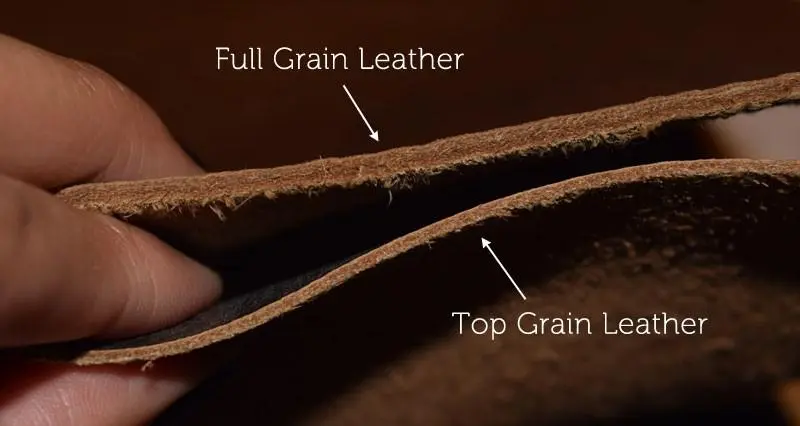
Full grain leather VS Top grain leather
2. Why Top Grain Leather Wins in Mass Production
Key Manufacturing Advantages
| Factor | Impact on Production |
|---|---|
| Material Yield | Higher usable area → lower cost |
| Surface Consistency | Reduced defect rate |
| Color Uniformity | Faster assembly, no sorting |
| Adhesion Stability | Better bonding to PC/TPU shells |
Real-world implication:
- Full-grain leather: high variation → higher returns
- Top grain leather: standardized → scalable
For a 10,000-unit order, this difference directly affects profit margins.
3. OEM Decision Table: Choosing the Right Grade
Selecting the wrong material can lead to production delays or market failure. Use the table below to align your sourcing strategy with your brand’s positioning.
Sourcing Comparison Table
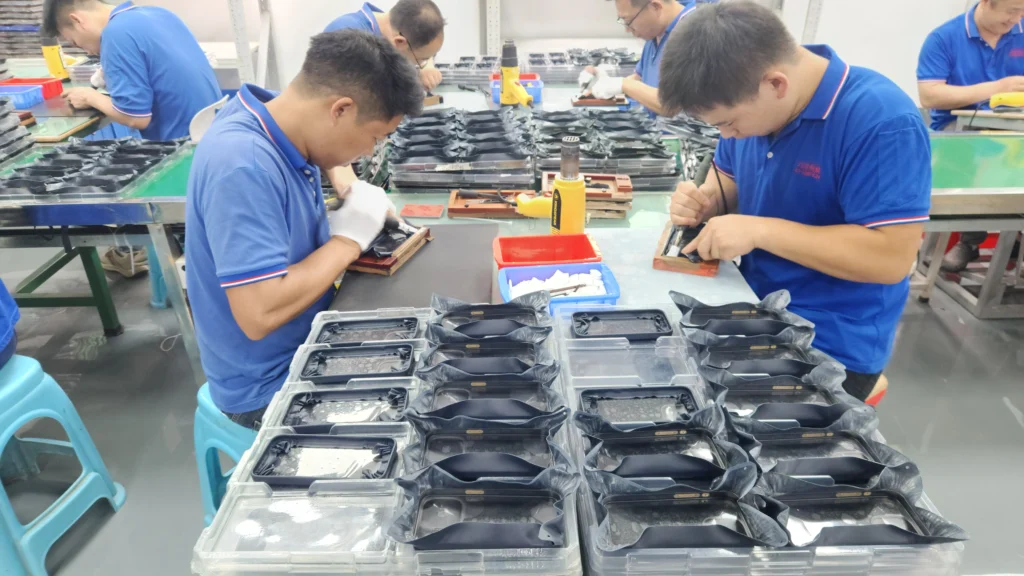
4. Manufacturing Process (Simplified OEM Flow)
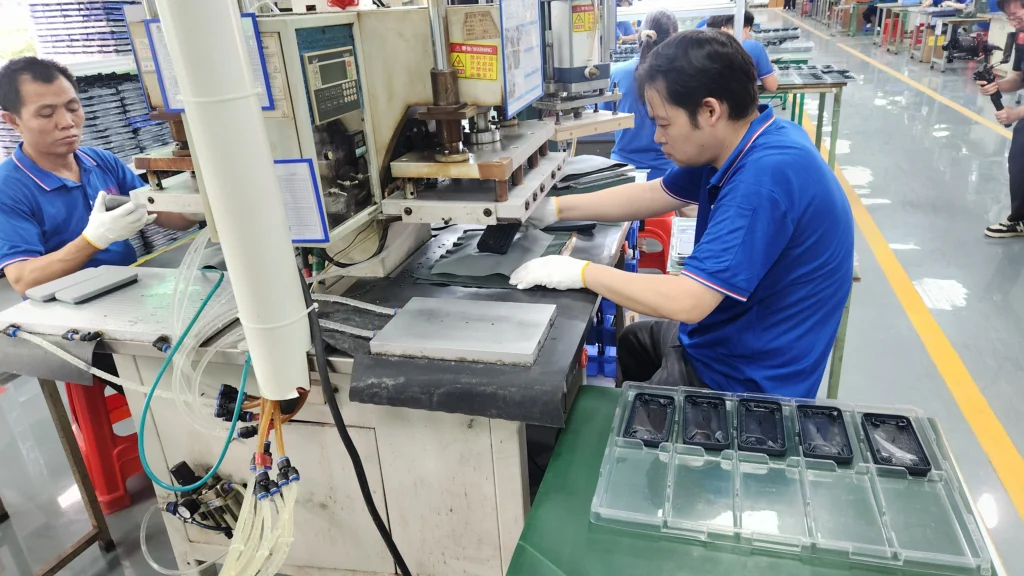
Top grain leather phone case production follows a structured pipeline:
- Hide Selection
- Controlled grain density
- Splitting
- Target thickness: 0.5mm–0.8mm
- Buffing / Correction
- Removes natural defects
- Tanning
- Finishing & Coating
- Semi-aniline / pigmented layers
- Cutting & Lamination
- Bonded to PC/TPU frame
- Assembly & Edge Painting
Each stage is optimized for repeatability and scalability.
Stretching the leather
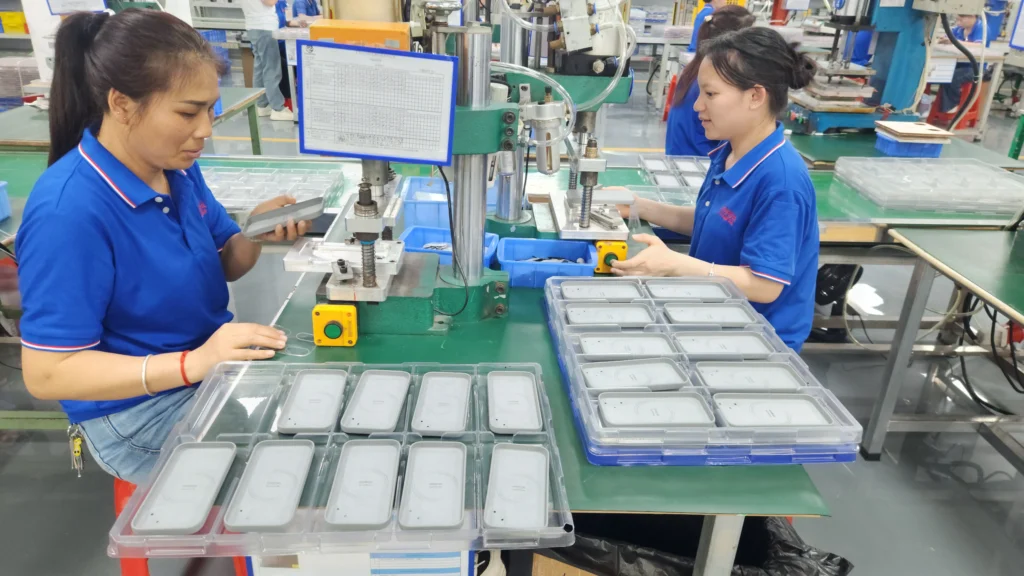
Inner microfiber positioning
5. Cost Structure & MOQ Strategy (Critical for Buyers)
Typical OEM Parameters
| Item | Industry Range |
|---|---|
| MOQ | 100 – 300 pcs/model |
| Unit Price | $3 – $10 (depending on material & structure) |
| Lead Time | 15–30 days |
| Sampling Time | 5–10 days |
Main Cost Drivers
- Leather grade & finish
- Internal structure (PC / TPU / metal frame)
- Logo customization (deboss / foil/metal plate)
- Packaging requirements
Top grain leather reduces waste → stabilizes pricing
6. Finishes & Texture Options (Design Flexibility)
Top grain leather enables high-end texture replication at scale:
Popular Options:
- Pebbled Leather
- Scratch-resistant
- Widely used in retail brands
- Nappa Finish
- Smooth, soft-touch luxury feel
- Saffiano Style
- Cross-hatch texture
- High water resistance
This flexibility allows brands to match premium aesthetics without exotic costs

Saffiano leather
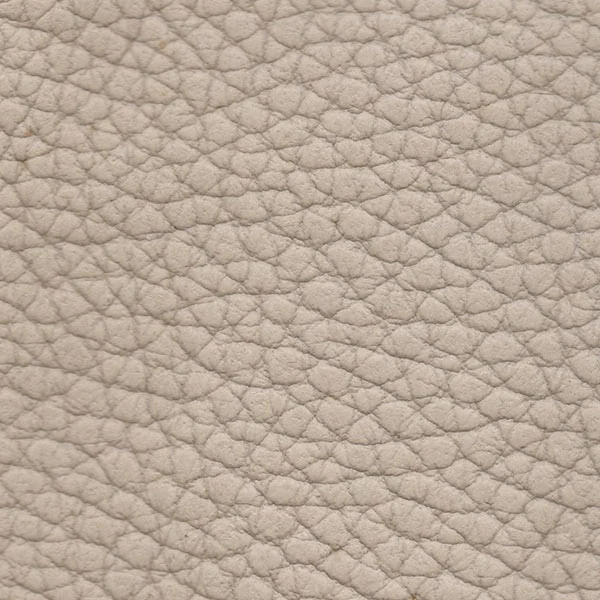
pebbled leather

Nappa Leather
7. Production Challenges & How to Solve Them
1. Color Variation Between Batches
Risk: Slight differences in tanning lots
Solution:
- Spectrophotometer control
- Delta-E ≤ 1.5 tolerance
2. Edge Cracking on Corners
Risk: Poor edge paint durability
Solution:
- Multi-layer heat-sealed edge coating
- Flexible polymer systems
3. Adhesion Failure
Risk: Leather detaching from case
Solution:
- Surface treatment optimization
- Industrial-grade adhesives
8. Sustainability and Global Compliance
For brands selling in the US and EU markets, sustainability is no longer optional. It is a regulatory requirement.
LWG Certification
We work exclusively with tanneries certified by the Leather Working Group (LWG). This ensures:
- Responsible Chemical Management: Compliance with REACH and RoHS standards.
- Energy Efficiency: Reducing the carbon footprint of your supply chain.
- Water Treatment: Ensuring no harmful wastewater is released into the environment.
By choosing a certified top grain leather supplier, you future-proof your brand against tightening environmental regulations.
9. Quality Control (QC) and Testing Standards
To ensure long-term reliability, our products undergo rigorous ISO testing. We recommend that all B2B buyers insist on the following specifications:
- Flex Resistance (ISO 5402): Must withstand ≥ 20,000 cycles without cracking.
- Color Fastness (ISO 11640): No dye transfer even after heavy friction.
- Finish Adhesion (ISO 11644): The coating must be permanently bonded to the hide.
For maintenance tips that you can pass on to your customers, check our guide on How to Clean a Leather Phone Case.
10. How to Choose the Right Manufacturing Partner
Selecting a supplier is often more critical than selecting the material. A true Leather Case Manufacturing Partner should offer more than just a low price; they should offer engineering support and supply chain transparency.
Evaluation Checklist:
Do they have LWG-certified sourcing?
Do they have experience with MagSafe and precision molding?
Can they provide a Delta-E color control report?
Do they have a proven track record with DTC or retail brands?
Conclusion: The Strategic Choice for 2026
Choosing top grain leather for your phone case project is a decision that balances the soul of natural materials with the requirements of modern industry. It is the most practical path to combining luxury aesthetics with the scalability needed to dominate Amazon or global retail channels.
By focusing on consistency, yield, and engineering precision, you build a product line that not only delights customers but also grows profitably.
Start Your OEM Project Today
Ready to develop a scalable leather product line? Our engineering team is standing by to evaluate your project’s feasibility.
B2B Consultation Offer:
- Receive a material recommendation based on your target retail price.
- Get a detailed factory quotation within 24 hours.
- Access our leather swatch library for tactile evaluation.
FAQ
1. Is top grain leather good for phone cases?
Yes. It is widely used for OEM phone cases because it offers durability, consistency, and scalable quality for mass production.
2. What is the difference between top grain and full grain leather?
- Top grain: corrected surface, more uniform, better for mass production
- Full grain: natural surface, more variation, higher luxury positioning
3. Is top grain leather real leather?
Yes. It is 100% genuine leather, only lightly sanded and finished for a more consistent surface.
4. How long does a top grain leather phone case last?
Typically 1.5–3 years, depending on usage and coating quality.
5. Is top grain leather waterproof?
It is water-resistant, not fully waterproof. Protective coatings improve resistance to daily moisture and splashes.
6. Can it support MagSafe or wireless charging?
Yes. With proper structural design, top grain leather cases are fully compatible with MagSafe and wireless charging.
7. What is the MOQ for OEM production?
Usually 100-300 pcs per model, depending on customization level.
8. Why do brands choose top grain leather?
Because it offers:
- Stable quality at scale
- Lower defect rates
- Predictable production cost
- Better suitability for retail and Amazon markets
9. Does it develop patina?
Yes, but more controlled and uniform compared to full grain leather.