
Quick Answer
A well-designed leather AirPods case should protect the original charging case while maintaining full functionality, including smooth lid movement, charging access, wireless charging performance, and daily usability.
For OEM and private label buyers developing custom leather AirPods cases, the most important compatibility factors include:
- Accurate AirPods model fit
- Smooth lid opening and closing
- Proper hinge clearance
- Charging port accessibility
- Wireless charging stability
- Indicator and speaker alignment
- Secure retention without difficult removal
Even small differences in leather thickness, lining structure, adhesive layers, or cutting accuracy can affect the final user experience.
This guide explains how leather AirPods case manufacturers evaluate fit, charging compatibility, and sample performance before mass production. For a detailed manufacturer understanding, pls refer to the Leather AirPods Case Manufacturer Guide
Why Leather AirPods Case Fit Is Critical
Leather AirPods cases are compact accessories, but their functional requirements are highly precise.
Unlike larger products such as tablet cases or phone covers, AirPods cases have limited space around important areas, including:
- Lid connection
- Hinge movement
- Charging port
- Wireless charging zone
- LED indicator
- Speaker openings
A leather AirPods case may look premium but can still prompt customer complaints if the structure is not properly controlled.
Common issues include:
- The lid cannot fully open
- The upper cover separates from the AirPods charging case
- Charging cables cannot connect properly
- Wireless charging becomes unstable
- The indicator light is blocked
- The case is too loose or difficult to remove
For private label brands, these small usability problems can directly impact product reviews and brand reputation.
Therefore, fit testing should be treated as a critical product validation step rather than only a visual inspection.
Confirm the Exact AirPods Model Before Development
Different AirPods generations have different dimensions and structural details.
This is especially important for:
- AirPods
- AirPods Pro
- AirPods Pro 2
- Newer AirPods charging case versions
Before developing a custom leather AirPods case, OEM buyers should confirm:
- Exact AirPods model
- Charging case dimensions
- Lid shape
- Hinge position
- Charging port location
- Speaker opening position
- Indicator light location
- Wireless charging requirements
A leather case designed for one generation may not provide reliable compatibility with another model, even if the overall appearance looks similar.
For OEM projects, samples should always be tested with the actual AirPods charging case instead of relying only on drawings or reference images.
Key Fit Areas of a Leather AirPods Case
A leather AirPods case contains several critical functional zones.
| Fit Area | Function | Common Issues |
|---|---|---|
| Upper lid cover | Holds the AirPods lid securely | Cap falling off, poor alignment |
| Lower body | Keeps the charging case stable | Too loose or too tight |
| Hinge area | Allows smooth opening | Leather blocking movement |
| Charging port opening | Enables cable charging | The connector cannot fully insert |
| Indicator area | Keeps LED visible | Light blocked or shifted |
| Speaker opening | Maintains sound access | Hole position mismatch |
| Wireless charging zone | Supports charging | Unstable charging |
| Hook attachment area | Supports accessories | Leather tearing |
Each area should be checked during sample approval.
Lid Alignment and Hinge Clearance Testing
The upper lid is one of the most sensitive areas of a leather AirPods case.
A properly fitted lid cover should:
- Open and close smoothly
- Stay attached during daily use
- Align correctly with the lower body
- Avoid excessive gaps
- Maintain sufficient hinge clearance
Upper Cap Falling Off
Possible causes:
- Insufficient cap depth
- Weak adhesive bonding
- Incorrect internal dimensions
- Material rebound after forming
Lid Cannot Fully Open
Possible causes:
- Limited hinge clearance
- Excessive leather thickness
- Incorrect cutting position
- Lining interference
During testing, buyers should repeatedly open and close the lid with the AirPods charging case installed.
A sample that looks acceptable in photos may still have functional problems during daily use.
Charging Port Compatibility Testing
The charging opening must match the exact position and size of the original AirPods charging port.
Common charging issues include:
- Opening too small
- Hole position shifted
- Thick leather is blocking the connector
- Lining extending into the charging area
A proper charging test should include:
Insert the charging cable
Remove the cable several times
Confirm stable connection
Test different cable shapes if required
For international markets, brands should consider that customers may use different charging cable designs.
A well-developed leather AirPods case should allow convenient charging without removing the protective cover.
Wireless Charging Compatibility
Leather itself does not prevent wireless charging.
However, the complete material structure can influence charging performance.
Wireless charging problems may occur because of:
- Excessive leather thickness
- Thick inner lining
- Adhesive buildup
- Uneven internal structure
- Metal hardware near the charging area
- AirPods case not sitting flat inside the cover
The correct testing method is not to check individual materials separately.
Instead, manufacturers should test the complete assembled product:
- Finished leather AirPods case
- Actual AirPods charging case installed
- Real wireless charging pad
Recommended validation:
- Place the AirPods case on the charger
- Confirm that charging starts normally
- Test different placement positions
- Repeat after multiple insertions and removals
This helps ensure reliable charging performance in real-world conditions.
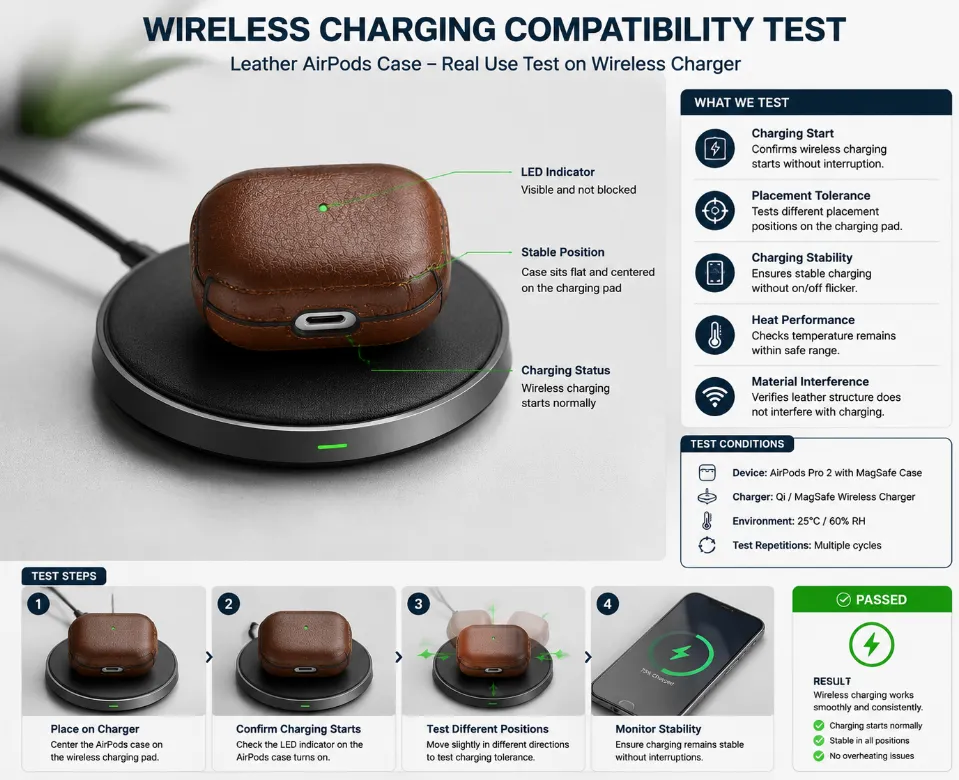
Wireless charging compatibility test
Indicator Light, Speaker and Button Accessibility
Modern AirPods charging cases include multiple functional areas that should remain accessible.
A leather cover should properly support:
- LED indicator visibility
- Speaker openings
- Pairing button access
- Charging port access
Common problems include:
- LED light hidden by leather
- Speaker holes misaligned
- Pairing button difficult to press
- Decorative stitching covering functional areas
For premium accessories, functional details should be considered during development instead of being corrected after production.
Secure Fit vs Easy Removal
A premium leather AirPods case requires the right balance between protection and usability.
The case should be:
Secure enough to prevent accidental movement
while also:
Easy enough for users to remove when needed
If retention is too weak:
- AirPods case may slide out
- Upper cover may detach
- Product may feel low quality
If retention is too strong:
- Users may struggle to remove the charging case
- Leather may stretch
- Inner lining may become damaged
Retention is affected by:
- Internal dimensions
- Leather thickness
- Lining friction
- Adhesive thickness
- Material flexibility
- Forming process
A successful design should provide a stable fit while maintaining comfortable daily use.
How Material Thickness Affects Compatibility
The final thickness of a leather AirPods case includes more than the outer leather.
The complete structure may include:
- Surface leather or PU layer
- Adhesive layer
- Reinforcement material
- Inner lining
- Edge finishing
A typical structure can be viewed as:
Outer leather
↓
Adhesive layer
↓
Reinforcement
↓
Inner lining
↓
Original AirPods charging case
Different materials can influence fit performance:
| Material | Impact on Fit |
|---|---|
| Full-grain leather | Premium feel but requires precise thickness control |
| Top-grain leather | Balanced flexibility and durability |
| PU leather | More consistent thickness control |
| Microfiber lining | Improves protection but increases overall thickness |
Excessive thickness may affect:
- Lid movement
- Charging port access
- Wireless charging distance
- Product appearance
OEM buyers should approve samples using the same material structure planned for mass production.
A prototype made with different leather thicknesses or lining materials may fit correctly but create issues during bulk production.
Fit Accuracy Factors During Development
During custom leather AirPods case development, manufacturers need to control several factors:
- Internal cavity dimensions
- Lid cap depth
- Hinge clearance
- Charging port opening position
- Leather thickness consistency
- Adhesive layer thickness
These details directly affect:
- Product appearance
- User experience
- Charging performance
- Long-term durability
This is why real-device testing is essential before production approval.
How Manufacturers Validate Leather AirPods Case Compatibility
Before mass production, manufacturers typically evaluate:
1. Device Fit Test
- Install the actual AirPods charging case
- Check upper and lower cover alignment
- Confirm lid movement
- Test retention strength
2. Charging Test
- Test cable insertion
- Confirm charging stability
- Test wireless charging performance
3. Functional Test
- Check indicator visibility
- Verify speaker openings
- Test pairing button access
4. Durability Test
- Repeat lid opening and closing
- Insert and remove the charging case multiple times
- Check the hook or ring attachment strength
Real-device testing is essential because visual inspection alone cannot confirm product performance.
Common Leather AirPods Case Fit Problems and Solutions
| Problem | Possible Cause | Solution |
|---|---|---|
| The lid cannot open fully | Insufficient hinge space | Adjust hinge clearance |
| Upper cap falls off | Poor retention structure | Improve cap fitting |
| The cable cannot connect | Port opening issue | Adjust the cutting position |
| Wireless charging unstable | Thickness or structure issue | Test complete assembly |
| Indicator blocked | Incorrect opening position | Match the original device |
| The case slides out | Weak retention | Improve internal fit |
| The case is difficult to remove | Excessive compression | Balance tolerance |
| Hook area tears | Weak reinforcement | Strengthen attachment |
Most compatibility problems can be identified during sample testing before mass production.
Leather AirPods Case Sample Approval Checklist
Before approving a leather AirPods case sample, OEM buyers should check:
Fit Test
Correct AirPods model
Upper and lower cover alignment
Lid opening angle
Hinge movement
Case retention
Charging Test
Cable connection
Wireless charging response
Charging stability after repeated use
Function Test
Indicator visibility
Speaker opening alignment
Pairing button access
Hook or ring strength
Appearance Test
Leather surface quality
Edge finishing
Stitching consistency
Hardware placement
How Pellove Supports Leather AirPods Case Compatibility Development
For brands developing custom leather AirPods cases, Pellove helps evaluate compatibility before mass production.
Support includes:
- AirPods model compatibility review
- Material thickness evaluation
- Lid and hinge structure optimization
- Charging port validation
- Wireless charging testing
- Functional opening inspection
- Sample approval support
By validating finished samples with real devices, brands can reduce compatibility risks and create more reliable premium accessories.
FAQ
Can leather AirPods cases support wireless charging?
Yes. A leather AirPods case can support wireless charging when the material thickness, internal structure, and hardware placement are properly controlled. The finished sample should always be tested with an actual AirPods charging case.
Why does my leather AirPods case not fit properly?
Common reasons include incorrect model selection, inaccurate cutting, excessive material thickness, adhesive buildup, or incorrect internal dimensions.
Can a leather AirPods case block charging?
Yes. If the charging opening is too small, misaligned, or affected by thick materials, the charging cable may not connect properly.
Why does the AirPods case lid cover keep falling off?
This usually happens because of insufficient cap depth, weak bonding, incorrect tolerance design, or material rebound.
How do manufacturers test leather AirPods case compatibility?
Manufacturers test samples using real AirPods devices to verify fit, lid movement, charging access, wireless charging performance, and daily usability.
Can I customize a leather AirPods case with my brand logo?
Yes. Custom leather AirPods cases can support logo options such as embossing, debossing, printing, or customized hardware depending on the product structure.
Conclusion
Developing a leather AirPods case requires precise control over fit, material thickness, functional openings, and charging compatibility.
For OEM and private-label buyers, the most important step is validating samples with real AirPods before mass production.
A successful leather AirPods case should not only look premium but also:
- Fit securely
- Open smoothly
- Charge reliably
- Protect the original charging case
- Provide a consistent user experience
By focusing on compatibility testing during development, brands can reduce quality issues and deliver more reliable premium accessories.