
A laptop sleeve may look like a simple product, but a successful custom leather laptop sleeve requires careful decisions about dimensions, fit, material thickness, internal construction, protection, closure, branding and production consistency.
For OEM/ODM buyers, the challenge is not simply making a sleeve large enough to fit a laptop. The sleeve must provide the right balance between secure fit, easy insertion, everyday protection, slimness, material quality and brand positioning.
This guide explains the key considerations buyers should review before developing a custom laptop sleeve, from the initial laptop dimensions through prototype validation and mass production.
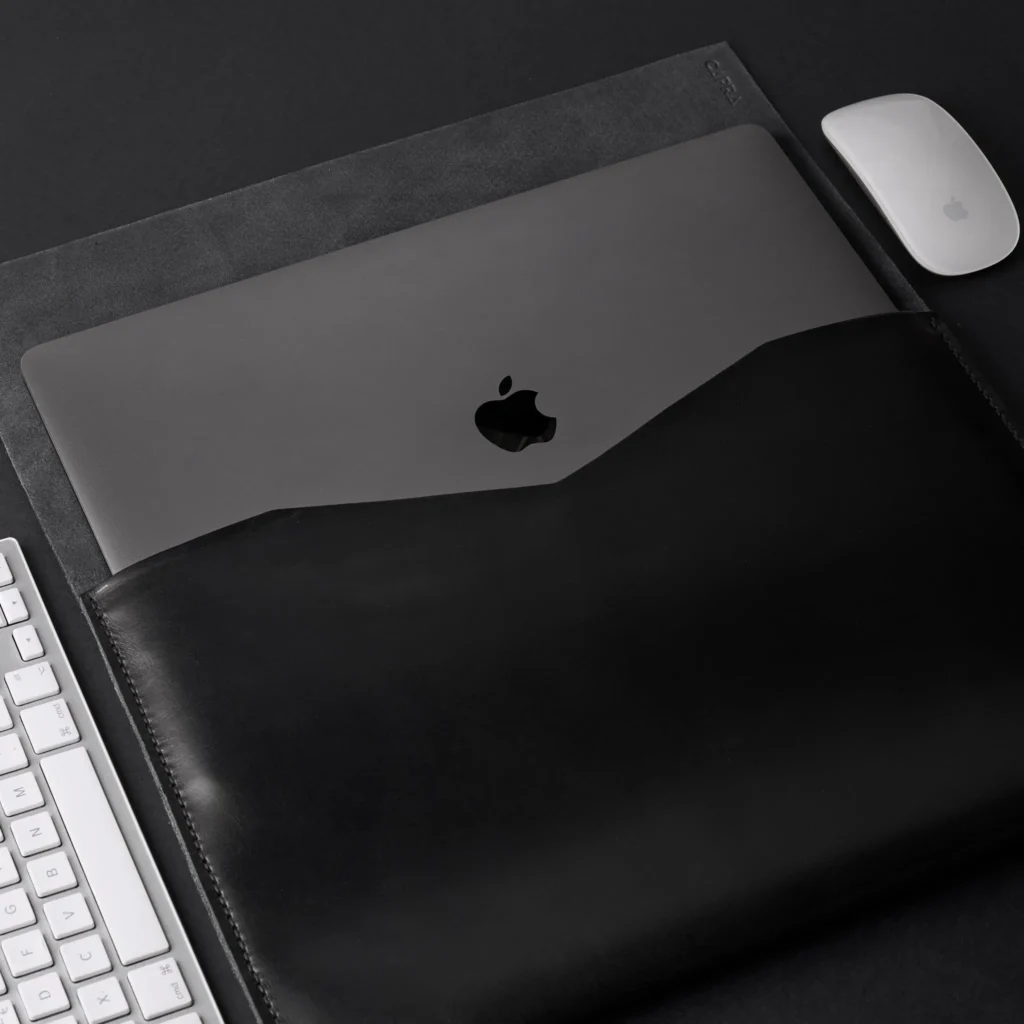
Leather laptop sleeve sample
Quick Answer
A custom laptop sleeve should be developed around the actual dimensions of the target laptop, rather than screen size alone.
Before production, OEM/ODM buyers should define:
- Laptop width, depth and thickness
- Model and generation
- Corner shape and radius
- Desired fit
- Leather and lining thickness
- Padding and reinforcement
- Opening and closure structure
- Corner and edge protection
- Logo placement
- Packaging
- Target quantity and price
The sleeve should be tight enough to hold the laptop securely but not so tight that insertion causes excessive friction or pressure.
The most reliable way to validate the design is to manufacture a physical prototype and test it with the actual target device before mass production.
1. Why Laptop Sleeve Fit Matters More Than Screen Size
Laptop sleeves are commonly marketed using labels such as:
- 13-inch laptop sleeve
- 14-inch laptop sleeve
- 15-inch laptop sleeve
- 16-inch laptop sleeve
- Universal laptop sleeve
These labels are useful for consumers, but they are not sufficient for OEM manufacturing.
Two laptops with the same screen size may have different:
- Width
- Depth
- Thickness
- Corner radius
- Body shape
- Hinge construction
Different generations of the same laptop family may also have different external dimensions.
Therefore, a custom laptop sleeve manufacturer should develop the sleeve around the actual target device.
Information to provide before sampling
Ideally, buyers should provide:
- Laptop brand
- Exact model
- Model generation or year
- External width
- External depth
- External thickness
- Corner information, if available
- Whether the laptop will have a protective shell
- Whether accessories need to fit inside
If a universal sleeve is required, all intended laptop models should be tested before approval.
2. How to Measure a Laptop for a Custom Sleeve
Accurate measurements are the starting point for a successful laptop sleeve sizing guide.
Measure the device in its normal closed position.
Width
Measure from the left edge to the right edge.
Depth
Measure from the front edge to the rear edge.
Thickness
Measure the thickest point of the closed laptop.
Corner Shape
Corner geometry can affect the internal pattern, especially when the sleeve has:
- Structured corners
- Padding
- Reinforcement
- Tight fit
- Rounded construction
A sleeve should be designed according to the actual device rather than simply adding a generic allowance to the screen size.
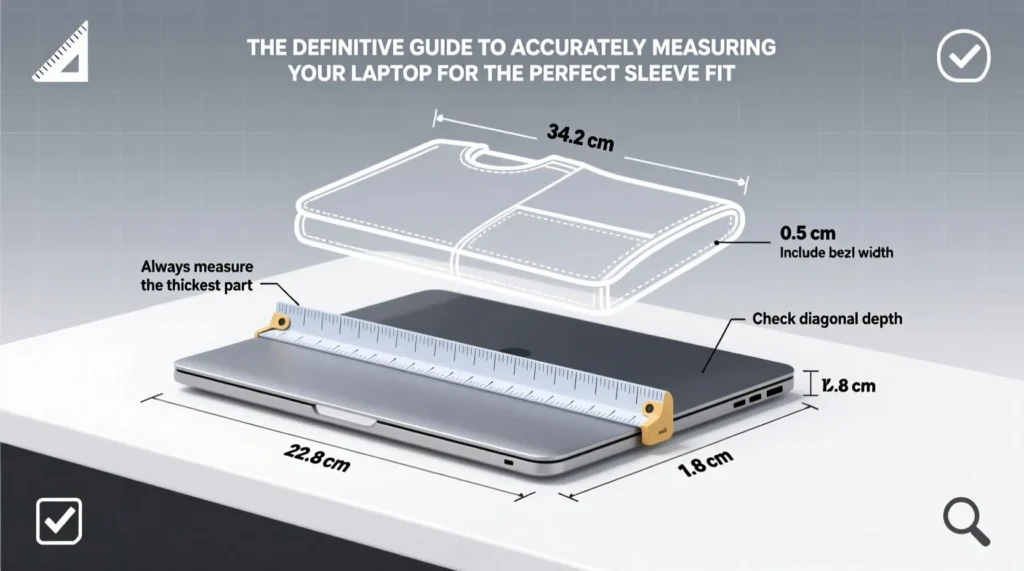
How to measure the dimension
3. How to Determine Laptop Sleeve Fit and Tolerance
There is no single universal clearance value that works for every sleeve.
The appropriate internal space depends on:
- Laptop dimensions
- Leather thickness
- Lining thickness
- Padding
- Reinforcement
- Seam construction
- Closure design
- Material compression
- Intended use
The key objective is a secure but usable fit.
Slim Fit
A slim sleeve is generally intended for:
- Business use
- Office carry
- Executive products
- Minimalist designs
- Desk-to-meeting use
The laptop should fit closely with limited internal movement.
Standard Fit
A standard sleeve provides a little more room for easier insertion and removal.
It may be suitable for:
- Daily commuting
- Retail products
- Private-label products
- General everyday use
Padded or Travel Fit
A more protective sleeve may require additional internal space because of:
- Thicker padding
- Reinforced corners
- Protective structure
- A laptop protective shell
The final fit should be confirmed through physical sampling.
4. Too Tight vs. Too Loose: Common Fit Problems
When a Laptop Sleeve Is Too Tight
A sleeve that is too tight may cause:
- Difficult insertion
- Difficult removal
- Excessive friction
- Pressure on corners
- Stressed stitching
- Leather distortion
- Closure misalignment
- Poor user experience
This can happen when the design is based only on laptop dimensions without considering the complete material stack.
When a Laptop Sleeve Is Too Loose
A loose sleeve may cause:
- Excessive internal movement
- Laptop sliding during carrying
- Reduced corner protection
- Poor retention
- Less premium perceived quality
The ideal sleeve should allow the laptop to enter and exit smoothly while preventing excessive movement during normal use.
Practical fit testing
During prototype approval, test:
- Insertion
- Removal
- Internal movement
- Sleeve inversion
- Closure alignment
- Repeated insertion and removal
5. Key Fit Zones in a Custom Laptop Sleeve
| Fit Zone | What It Controls | Common Failure |
|---|---|---|
| Internal width | Side-to-side fit | Too tight or excessive movement |
| Internal depth | Insertion depth | Device exposed or difficult to remove |
| Internal thickness | Usable space | Sleeve too tight or bulky |
| Corners | Corner protection | Corners insufficiently protected |
| Opening edge | Access | Difficult insertion or excessive friction |
| Closure area | Carrying security | Closure strains or laptop slips out |
| Lining | Surface contact | Scratches or rough contact |
| Padding | Cushioning | Insufficient protection or excessive bulk |
| Seams and edges | Durability | Stitching stress or edge failure |
These areas should be evaluated during prototype development rather than relying on appearance alone.
6. Understanding Laptop Sleeve Construction
A leather laptop sleeve is a multi-layer product.
The outer leather is only one part of the construction. The final performance also depends on the backing, reinforcement, padding, lining, adhesive, stitching, and edge finishing.
A typical construction may look like:
Outer Leather / PU / Microfiber
↓
Backing / Reinforcement
↓
Padding, if required
↓
Lining
↓
Laptop
Every layer can affect the finished:
- Thickness
- Weight
- Flexibility
- Protection
- Hand feel
- Cost
- Appearance
For this reason, material selection should be considered together with the overall construction.
7. Choosing Leather for a Custom Laptop Sleeve
Different materials create very different product positioning.
Full-Grain Leather
Full-grain leather can provide:
- Natural grain character
- Premium appearance
- High perceived value
- Distinctive aging characteristics
It is particularly suitable for:
- Luxury brands
- Premium accessories
- Executive products
- High-end corporate gifts
Top-Grain Leather
Top-grain leather can offer a balance between:
- Premium appearance
- Consistent surface
- Refined hand feel
- Production consistency
It can be suitable for premium business and private-label products.
PU Leather
PU can provide:
- More consistent appearance
- Broader color options
- Lower material cost
- Easier large-volume consistency
It may be suitable for:
- Fashion brands
- Private-label programs
- Larger-volume projects
- Cost-sensitive product lines
Microfiber
Microfiber can provide:
- Smooth hand feel
- Lightweight construction
- Modern appearance
- Consistent surface
It can be considered for minimalist or contemporary laptop sleeve designs.
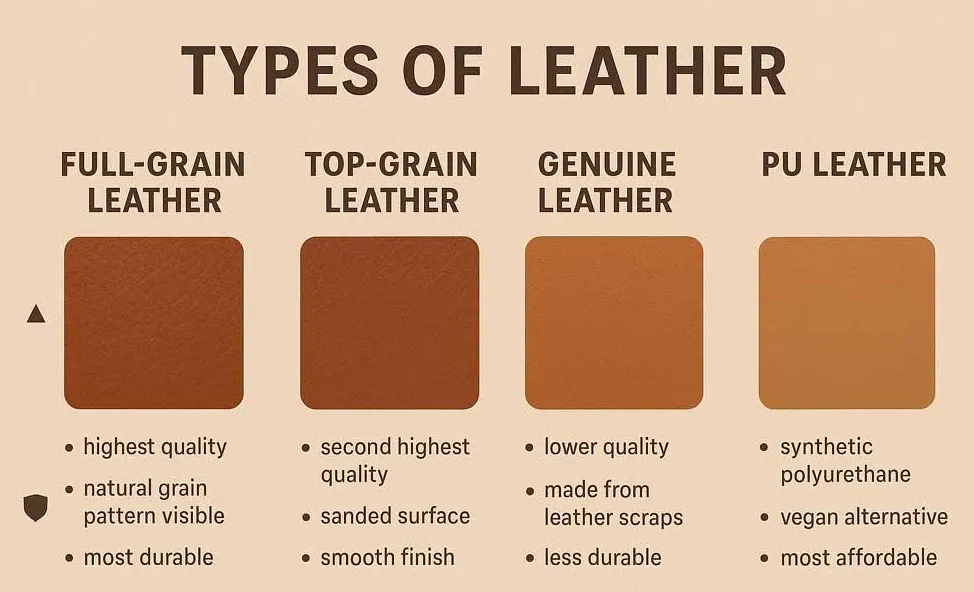
Types of leather
There is no universally “best” material
The appropriate material depends on:
- Brand positioning
- Target price
- Desired hand feel
- Appearance
- Durability requirements
- Production quantity
- Construction
8. Why Leather Thickness Matters
Leather thickness affects more than the appearance of the sleeve.
It can influence:
- Overall product thickness
- Flexibility
- Edge construction
- Stitching
- Folding
- Weight
- Padding requirements
- Perceived quality
Thicker leather does not automatically mean a better laptop sleeve.
For a slim executive sleeve, excessive thickness may make the product unnecessarily bulky.
For a structured sleeve, additional material or reinforcement may help maintain shape.
The final material stack should therefore be evaluated as a complete structure.
9. Leather Skiving and Edge Construction
Leather thickness may need to be controlled in specific areas during manufacturing.
Skiving can reduce leather thickness in areas such as:
- Folded edges
- Seam areas
- Overlapping sections
- Corners
- Closure structures
Proper thickness control can help improve:
- Folding
- Stitching
- Edge appearance
- Overall bulk
- Assembly consistency
This is one reason a production-ready leather laptop sleeve cannot be evaluated only from a 2D drawing.
The physical construction matters.
10. Laptop Sleeve Lining and Scratch Protection
The lining is the material that comes into direct contact with the laptop.
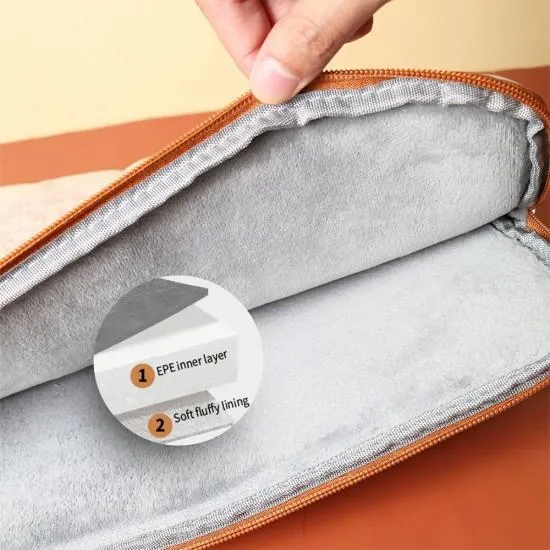
Inner structure
A suitable lining should be:
- Soft
- Smooth
- Clean
- Consistent
- Free from exposed hard components
- Properly bonded
Common options include:
- Microfiber
- Soft textile lining
- Suede-like materials
- Felt-like materials
- Other customized fabrics
For premium laptop sleeves, the lining should complement the outer material rather than simply functioning as an inexpensive internal layer.
A rough surface, exposed adhesive or poorly finished seam can negatively affect the user’s experience even when the exterior looks premium.
11. Leather Laptop Sleeve Padding and Protection
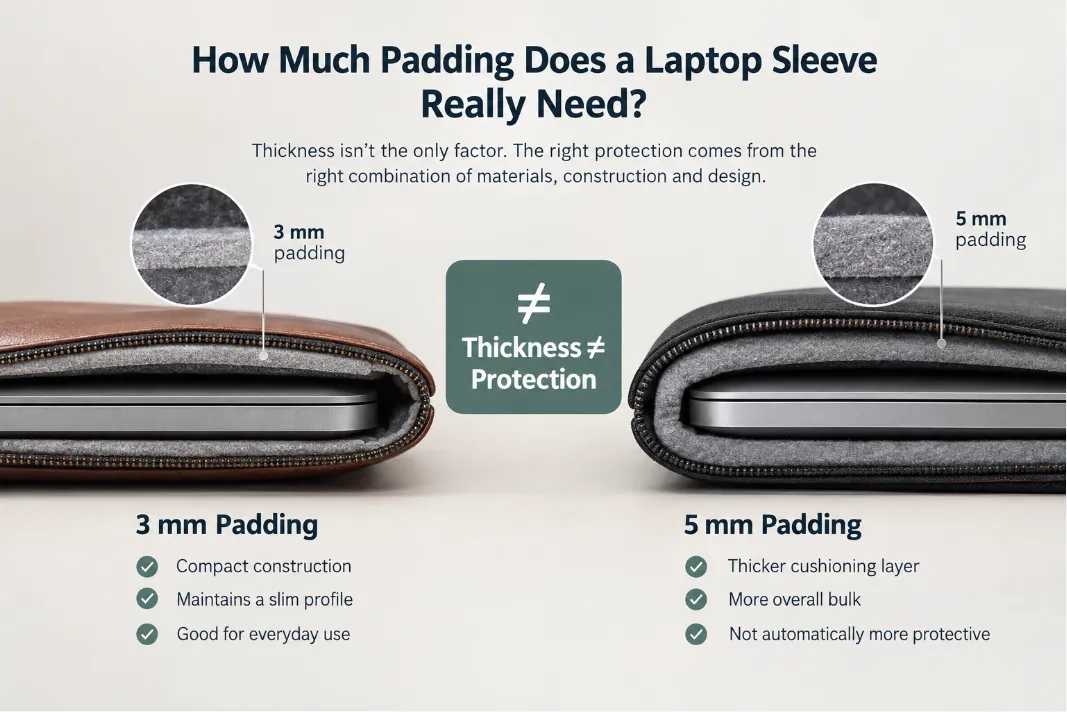
Padding can provide additional cushioning during everyday carrying.
However, more padding does not automatically create a better product.
Excessive padding can increase:
- Thickness
- Weight
- Shipping volume
- Material consumption
- Cost
The right padding level depends on the intended product position.
| Product Position | Suggested Direction |
|---|---|
| Slim executive sleeve | Soft lining + light structural support |
| Daily commuter sleeve | Soft lining + moderate cushioning |
| Travel sleeve | More cushioning + secure closure |
| Premium gift sleeve | Refined materials + balanced protection |
| Protective sleeve | Increased cushioning + reinforced corners |
The objective is to achieve appropriate protection without unnecessary bulk.
12. Corner and Edge Protection
Laptop corners can experience concentrated impact during everyday bumps.
A well-designed sleeve should consider:
- Corner radius
- Internal corner clearance
- Padding placement
- Bottom construction
- Seam position
- Edge wrapping
- Corner reinforcement
- Distance between the laptop and outer edge
Common corner problems
Exposed corners
The laptop sits too close to the sleeve edge.
Insufficient padding
The body is padded, but the corner area has little cushioning.
Excessive compression
The sleeve presses too strongly against the laptop corners.
Weak bottom structure
The bottom corners collapse or deform over time.
Seam interference
A seam or internal construction point creates hard contact with the laptop.
Corner protection should therefore be checked with the actual laptop fully inserted.
13. Choosing the Right Laptop Sleeve Closure
The closure affects security, appearance, usability and manufacturing complexity.
| Closure Type | Best For | Main Consideration |
|---|---|---|
| Open sleeve | Slim office use | Laptop retention |
| Magnetic flap | Premium and executive products | Magnet position and closure force |
| Zipper | Secure everyday carry | Zipper isolation |
| Snap button | Classic leather designs | Pressure and alignment |
| Elastic strap | Lightweight products | Long-term elasticity |
| Flap with tab | Fashion and gifting | Fold alignment and bulk |
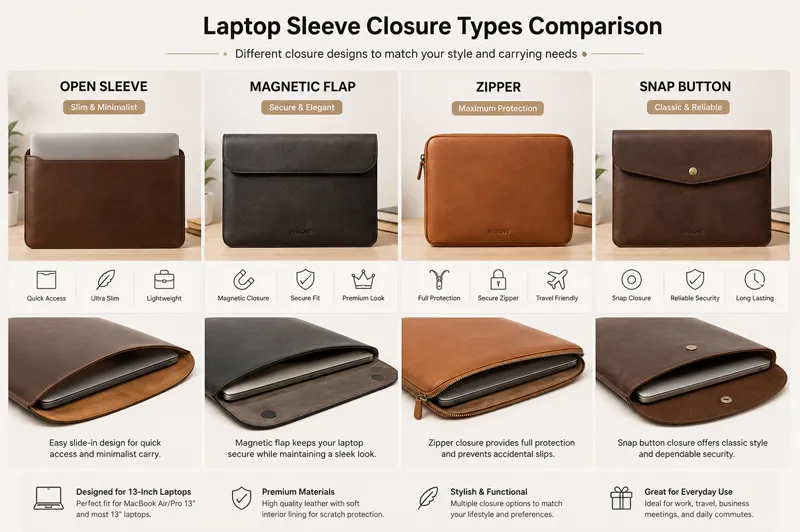
Laptop Sleeve Closure Types Comparison
Zipper Sleeves
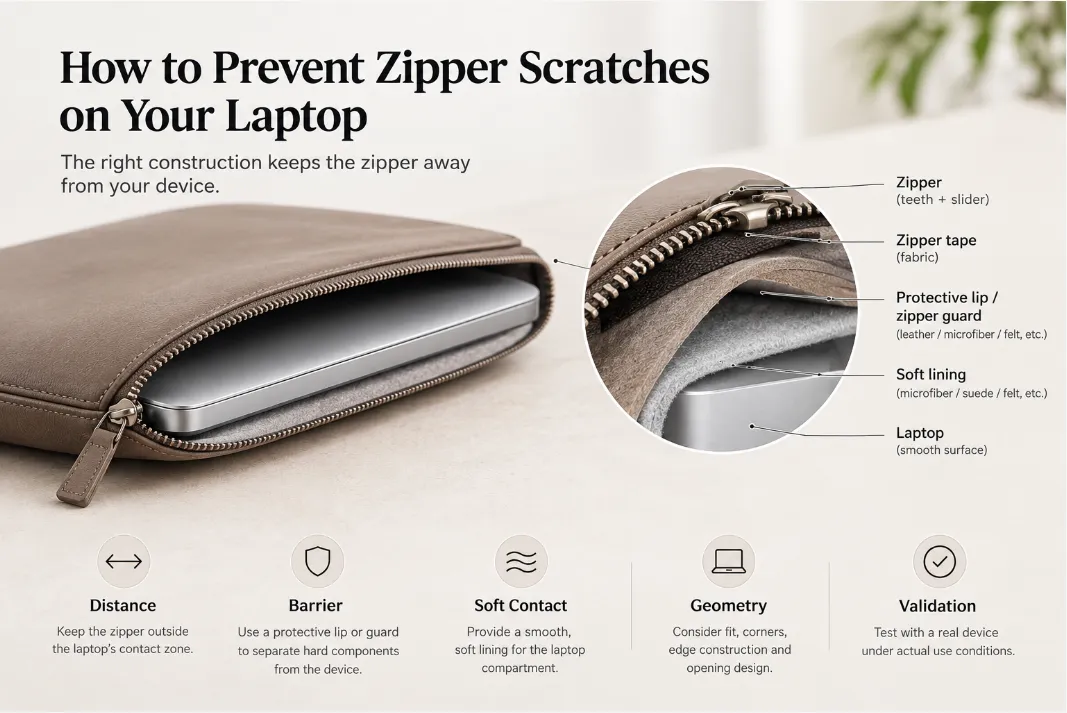
A zipper provides a secure enclosure but should not directly contact the laptop.
A protective lining strip or zipper guard can help reduce the risk of hard contact.
The zipper should also:
- Run smoothly
- Avoid excessive pressure
- Remain aligned
- Maintain consistent operation after repeated use
Magnetic Flap Sleeves
Magnetic closures can provide a clean and premium appearance.
Development should consider:
- Magnet position
- Magnet strength
- Leather thickness
- Flap structure
- Closure alignment
- Ease of opening
- Security during carrying
Open Sleeves
Open sleeves provide a minimalist appearance and low bulk.
They can work well for:
- Offices
- Business meetings
- Desk-to-meeting use
- Premium gifting
- Minimalist collections
However, the internal fit should provide enough retention for normal handling.
14. MacBook Leather Sleeve Development
A MacBook leather sleeve is often marketed according to screen size, but OEM development should still use the exact model.
Buyers should specify:
- MacBook Air or MacBook Pro
- Screen size
- Model generation
- External dimensions
- Whether a protective case must be accommodated
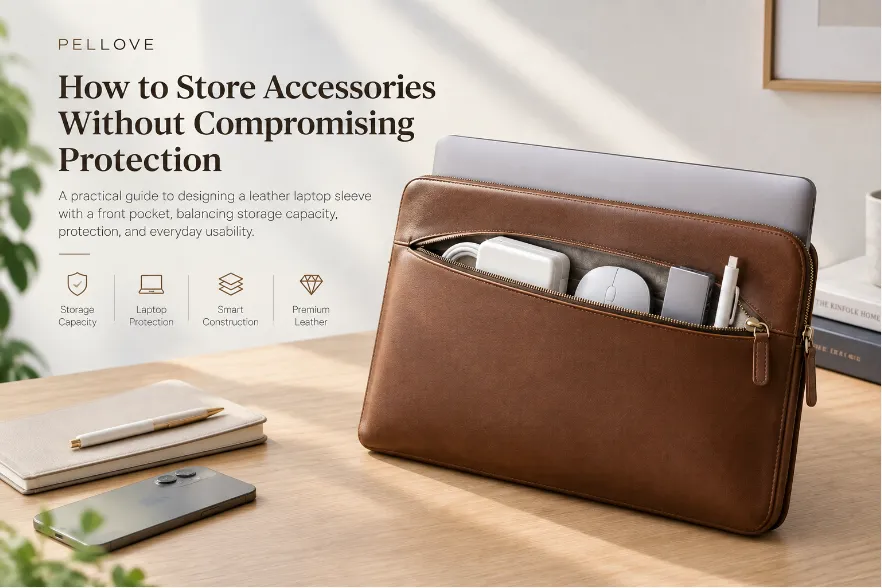
- Whether accessories need to be stored inside
The same principle applies to:
- Microsoft Surface
- Dell
- HP
- Lenovo
- Other business laptops
- Gaming laptops
Gaming laptops require particular attention because their thickness can differ substantially from slim business laptops.
15. Universal vs. Model-Specific Laptop Sleeves
A universal sleeve can reduce SKU complexity, but it usually involves a compromise in fit.
Model-specific sleeve
Advantages:
- More precise fit
- Less internal movement
- Better appearance
- More consistent protection
- Stronger premium positioning
Universal sleeve
Advantages:
- Fewer SKUs
- Broader compatibility
- Simplified inventory
For a universal design, all intended device models should be tested before production approval.
A sleeve that fits one laptop well does not automatically fit every laptop within the same screen-size category.
16. What Determines Custom Laptop Sleeve Cost?
The unit price of a custom laptop sleeve depends on more than its finished size.
Important cost factors include:
Material
Leather grade, PU, microfiber and other materials have different costs.
Leather Yield
For genuine leather products, the usable leather area can affect material consumption.
Factors include:
- Hide size
- Natural defects
- Grain direction
- Cutting layout
- Leather grade
- Color
Therefore, finished product dimensions alone do not determine leather consumption.
Construction
Additional:
- Padding
- Reinforcement
- Hardware
- Zippers
- Magnetic components
- Complex folds
- Multiple layers
can increase production cost.
Branding
Logo methods such as:
- Debossing
- Foil
- Printing
- Metal emblems
have different production requirements.
Packaging
Custom boxes, dust bags, inserts and other packaging components can also affect the total project cost.
MOQ
Higher quantities can improve production efficiency, while low-volume projects may have higher development and setup costs.
17. Common OEM Laptop Sleeve Manufacturing Problems
| Problem | Likely Cause | OEM Prevention |
|---|---|---|
| Laptop too tight | Incorrect sizing | Use actual device dimensions |
| Laptop slides inside | Excessive clearance | Define intended fit |
| Corners exposed | Poor corner planning | Review corner radius and padding |
| Zipper scratches laptop | No protective guard | Add lining or guard strip |
| Sleeve feels bulky | Excessive material stack | Optimize construction |
| Interior scratches | Rough lining or exposed hard areas | Use suitable lining and clean assembly |
| Closure strains | Insufficient clearance or poor flap design | Test filled sleeve |
| Sample differs from production | Material variation | Approve production materials |
| Edge peeling | Weak bonding or edge process | Validate edge finishing |
| Sleeve deforms | Insufficient reinforcement | Add suitable structural support |
| Logo position varies | Inconsistent production control | Use approved positioning standards |
A strong prototype process can identify many of these problems before mass production.
18. Prototype Validation: Test the Actual Laptop
A professional custom laptop sleeve manufacturer should not rely only on drawings or computer dimensions.
The prototype should be tested with the actual target laptop.
Fit
Check:
- Insertion
- Removal
- Internal movement
- Device exposure
- Corner coverage
- Repeated use
Protection
Check:
- Padding coverage
- Corner protection
- Bottom protection
- Edge construction
- Closure security
Interior
Check:
- Lining softness
- Surface cleanliness
- Exposed adhesive
- Loose fibers
- Seam contact
Closure
Check:
- Zipper movement
- Magnetic alignment
- Snap pressure
- Flap position
- Opening and closing experience
Appearance
Check:
- Leather grain
- Color
- Stitching
- Edge finishing
- Logo position
- Logo quality
The prototype should be approved only after the buyer is satisfied with both functional performance and visual execution.
19. Why Physical Sampling Matters in OEM Production
A drawing cannot fully reproduce how leather behaves during manufacturing.
Leather can vary in:
- Thickness
- Softness
- Stretch
- Grain
- Surface characteristics
Similarly, padding and lining can compress differently after assembly.
A physical prototype allows the manufacturer and buyer to evaluate the complete material stack.
This helps identify problems such as:
- Excessive tightness
- Bulky construction
- Poor corner coverage
- Closure misalignment
- Uneven edges
- Incorrect logo positioning
before mass production begins.
20. Custom Logo and Private Label Laptop Sleeves
A private label laptop sleeve can be customized to match a brand’s broader product identity.
Common options include:
- Debossed logo
- Foil logo
- Printed logo
- Metal logo
- Woven label
- Custom leather colors
- Custom lining
- Custom stitching
- Custom packaging
- Dust bags
- Gift boxes
- Retail packaging
A custom logo laptop sleeve should be developed with branding considered from the beginning.
Logo placement can affect:
- Flap construction
- Stitching
- Folding areas
- Leather grain
- Packaging orientation
For premium brands, the laptop sleeve can also be coordinated with other accessories to create a consistent product collection.
21. Custom Laptop Sleeve Manufacturing Process
A typical OEM/ODM project can follow the process below.
Step 1 — Requirement Review
The buyer provides:
- Laptop model
- Device dimensions
- Reference design
- Material preference
- Closure preference
- Logo requirements
- Quantity
- Packaging requirements
Step 2 — Structure Development
The supplier reviews:
- Internal dimensions
- Fit tolerance
- Construction
- Padding
- Lining
- Closure
- Corner protection
Step 3 — Material Selection
Materials are selected based on:
- Product positioning
- Target price
- Appearance
- Hand feel
- Durability
- Production requirements
Step 4 — Prototype Development
The initial sleeve is manufactured for physical evaluation.
Step 5 — Actual-Device Testing
The target laptop is inserted and tested for:
- Fit
- Movement
- Insertion
- Removal
- Closure
- Corner protection
Step 6 — Revision
Any problems identified during testing are corrected.
Step 7 — Branding and Packaging Approval
The buyer approves:
- Logo
- Logo position
- Color
- Packaging
- Accessories
Step 8 — Mass Production
Production follows the approved sample and confirmed specifications.
Step 9 — Quality Inspection
Finished products are checked for:
- Dimensions
- Materials
- Stitching
- Edge finishing
- Logo
- Closure
- Appearance
- Packaging
22. MOQ, Sampling and Production Considerations
OEM buyers should clarify commercial requirements before development.
Important factors include:
- Sample quantity
- Sample cost
- MOQ
- MOQ per color
- MOQ per model
- Custom packaging quantity
- Production schedule
- Material availability
- Logo development
- Packaging development
MOQ can vary according to:
- Material
- Color
- Construction
- Hardware
- Packaging
- Production quantity
If a project includes multiple laptop models or multiple colors, buyers should discuss the MOQ structure with the manufacturer before finalizing the product range.
23. How to Choose a Custom Laptop Sleeve Manufacturer
When evaluating an OEM laptop sleeve supplier, buyers should look beyond product photos.
A capable supplier should be able to demonstrate control over:
Product Development
- Pattern development
- Size adjustment
- Prototype development
- Device fit testing
Material Processing
- Leather cutting
- Skiving
- Lamination
- Material bonding
Assembly
- Stitching
- Edge finishing
- Hardware installation
- Logo application
Quality Control
- Dimensional inspection
- Appearance inspection
- Stitching inspection
- Logo inspection
- Closure testing
- Packaging inspection
Most importantly, the manufacturer should be able to maintain consistency between the approved prototype and mass production.
24. What Factory Evidence Should OEM Buyers Request?
When evaluating a custom laptop sleeve manufacturer, useful evidence includes:
Material Control
- Leather inspection
- Thickness control
- Color consistency
- Lining quality
Structural Development
- Prototype samples
- Padding structures
- Corner construction
- Closure development
Manufacturing
- Cutting
- Skiving
- Lamination
- Stitching
- Edge finishing
- Logo application
Quality Control
- Dimensional inspection
- Appearance inspection
- Finished-product inspection
- Packaging inspection
For a B2B project, real production evidence can be more useful than generic product photography.
25. Best Laptop Sleeve Structure by Buyer Scenario
| Buyer Type | Recommended Direction |
|---|---|
| Corporate gifting | Slim leather construction, subtle logo, premium packaging |
| Premium DTC brand | Genuine leather, refined lining, custom branding |
| Amazon seller | Clear compatibility, practical construction, efficient packaging |
| Enterprise buyer | Durable structure, stable sizing, easy insertion |
| Fashion brand | Slim profile, distinctive colors, refined logo placement |
| Travel buyer | More padding, secure closure, reinforced corners |
| Accessory brand | Coordinated design with phone cases, tablet cases and organizers |
There is no single best laptop sleeve structure.
The correct design depends on the buyer’s:
- Target customer
- Sales channel
- Price point
- Brand positioning
- Use scenario
- Protection requirements
26. Coordinating Laptop Sleeves With a Broader Accessory Collection
For brands developing a premium technology accessory collection, the laptop sleeve does not have to be developed as an isolated product.
A coordinated collection may include:
- Phone cases
- Tablet cases
- Laptop sleeves
- MagSafe wallets
- Card holders
- AirPods cases
- Watch straps
- Cable organizers
Using consistent:
- Leather colors
- Leather textures
- Stitching
- Edge finishing
- Logo treatment
- Packaging
can create a more unified brand identity.
For OEM/ODM buyers, developing several products with the same manufacturer can also simplify material and branding coordination.
27. RFQ Checklist for a Custom Laptop Sleeve
To receive an accurate quotation from an OEM laptop sleeve supplier, buyers should provide:
- Target laptop brand and model
- Model generation
- Exact device dimensions
- Screen size
- Whether a protective shell must be accommodated
- Reference images
- Desired fit: slim, standard or padded
- Closure preference
- Outer material
- Lining preference
- Padding requirement
- Logo file
- Logo position
- Custom colors
- Packaging requirements
- Target MOQ
- Target price range
- Sales channel
- Sample quantity
- Expected launch schedule
If some specifications are not finalized, the supplier can review the intended application and recommend a suitable construction for sampling.
28. How Pellove Supports Custom Leather Laptop Sleeve OEM/ODM Projects
Pellove develops and manufactures leather technology accessories for OEM/ODM customers.
For custom laptop sleeve projects, development can cover:
- Device dimension review
- Sleeve size recommendation
- Structure development
- Leather selection
- Material selection
- Lining selection
- Padding and reinforcement planning
- Closure development
- Logo customization
- Prototype development
- Actual-device fit testing
- Packaging coordination
- Production inspection
Pellove’s leather accessory capabilities can also support coordinated product collections, including phone cases, tablet cases, wallets, card holders, AirPods cases and other technology accessories.
For brands developing a complete premium accessory line, this allows product materials, colors, stitching, branding and packaging to be coordinated across multiple SKUs.
29. Why Prototype-to-Production Consistency Matters
One of the most important considerations in OEM manufacturing is not simply whether a factory can make one good sample.
The more important question is:
Can the factory reproduce the approved sample consistently at production volume?
This requires control over:
- Material specifications
- Leather thickness
- Pattern dimensions
- Cutting
- Skiving
- Adhesive application
- Stitching
- Edge finishing
- Logo positioning
- Hardware installation
- Final inspection
A successful OEM process therefore starts with a clearly approved prototype and continues with controlled production specifications.
30. FAQ
Should a laptop sleeve be designed by screen size?
No. Screen size is useful for marketing, but OEM development should be based on the laptop’s actual width, depth, thickness and shape.
What measurements are needed for a custom laptop sleeve?
At minimum, provide the laptop’s external width, depth and thickness. Exact model information is also recommended.
How tight should a leather laptop sleeve be?
The sleeve should hold the laptop securely while allowing smooth insertion and removal. Excessive force should not be required.
What lining is best for laptop protection?
Soft microfiber and other smooth lining materials are commonly considered because they provide a soft contact surface and help reduce surface scratching.
Is padding necessary for a leather laptop sleeve?
Not necessarily. Slim business sleeves may use light cushioning, while travel-oriented products may require more padding and corner reinforcement.
How thick should laptop sleeve padding be?
There is no universal thickness. The appropriate construction depends on the desired protection level, laptop dimensions, outer material, lining and target product thickness. Physical prototype testing should determine the final structure.
Can a zipper scratch a laptop?
Yes. If the zipper comes into direct contact with the laptop, it may create scratches or hard contact points. A zipper guard or protective lining can help reduce this risk.
Can one laptop sleeve fit multiple laptop models?
Yes, but universal compatibility usually involves a compromise in fit precision. All intended models should be tested before production.
Can I customize the leather color?
Yes. Custom leather colors can be considered according to the selected material and production requirements.
Can I customize the logo?
Yes. Depending on the material and construction, branding can include debossing, foil, printing, metal logos and other methods.
Can I customize the packaging?
Yes. OEM/ODM projects can include custom boxes, dust bags, inserts, labels and other packaging components.
What is the MOQ for a custom laptop sleeve?
MOQ depends on the material, construction, color, customization and packaging requirements. Buyers should confirm the MOQ based on their specific project.
Can I order a sample before mass production?
A prototype should be developed and reviewed before mass production so that fit, construction, branding and appearance can be validated.
What should I test before approving a laptop sleeve sample?
At minimum, test:
- Device fit
- Insertion and removal
- Internal movement
- Corner coverage
- Lining
- Padding
- Closure
- Stitching
- Edge finishing
- Logo
- Weight
- Overall thickness
- Packaging
Conclusion
A successful custom leather laptop sleeve is not simply a leather pouch that matches a screen-size label.
For OEM/ODM production, the design should begin with the actual laptop dimensions and then consider the complete product structure:
- Fit and tolerance
- Leather and material selection
- Lining
- Padding
- Reinforcement
- Corner and edge protection
- Closure
- Logo
- Packaging
- Prototype validation
- Mass-production consistency
The best sleeve is not necessarily the thickest or tightest. It is the one that strikes the right balance among protection, fit, usability, slimness, material quality, and brand positioning.
For OEM buyers, the most reliable development process is to define the target device, determine the intended use scenario, select the appropriate construction, develop a physical prototype and test it with the actual laptop before approving mass production.
Pellove can support custom laptop sleeve projects from structure and material selection through prototype development, branding, packaging and production inspection.
Get a Custom Laptop Sleeve Prototype
If you are developing a custom leather laptop sleeve, private-label laptop sleeve or OEM laptop sleeve, send us:
- Laptop model and dimensions
- Reference design or product photos
- Preferred material
- Lining preference
- Closure preference
- Logo requirements
- Target quantity
- Packaging requirements
Our team can review the requirements and recommend a suitable sleeve structure, material combination and fit direction for prototype development and production.