
The best leather iPad case material depends on the finished product, not on which material sounds most premium. PU leather is often practical for cost-controlled programs and consistent colors. Microfiber-based synthetic leather can suit structures that need stable folding and repeatable dimensions. Genuine leather works well when natural grain and a premium feel are central to the product. In every case, buyers should approve the complete construction, including the backing, lining, adhesive, shell, reinforcement, edge finish, and Pencil-side geometry.
That last point prevents a common sourcing mistake. A surface material can look excellent as a flat swatch and still perform poorly after it is wrapped, folded, bonded, embossed, or installed around magnets and an Apple Pencil holder. Material selection should therefore follow the case structure, target market, and required functions.
Start With the Case, Not the Material Name
An iPad case is a layered product. The visible leather or synthetic surface is only one part of the assembly. Depending on the design, the case may also include a textile or microfiber backing, lining, adhesive, foam, board, magnets, a PC or TPU shell, and folded or painted edges.
These layers work together. A soft outer material paired with a stiff reinforcement can produce a rigid cover. A thin surface laminated over a heavy backing can create more bulk than expected. A genuine leather panel can fold cleanly in one direction but resist the same fold when cut from another area of the hide.
Before comparing materials, define the product architecture:
– exact iPad model or model family;
– folio, magnetic, detachable, or fully wrapped construction;
– storage-only or charging-compatible Apple Pencil holder;
– required stand positions and cover movement;
– target price and market position;
– logo process and packaging format;
– appearance, aging, and cleaning expectations;
– production quantity and repeat-order needs.
Buyers planning a wider tablet case program should begin with Pellove’s iPad case manufacturer guide. That pillar explains supplier selection and sampling. This article has a narrower role: choosing and controlling the materials used in the case.
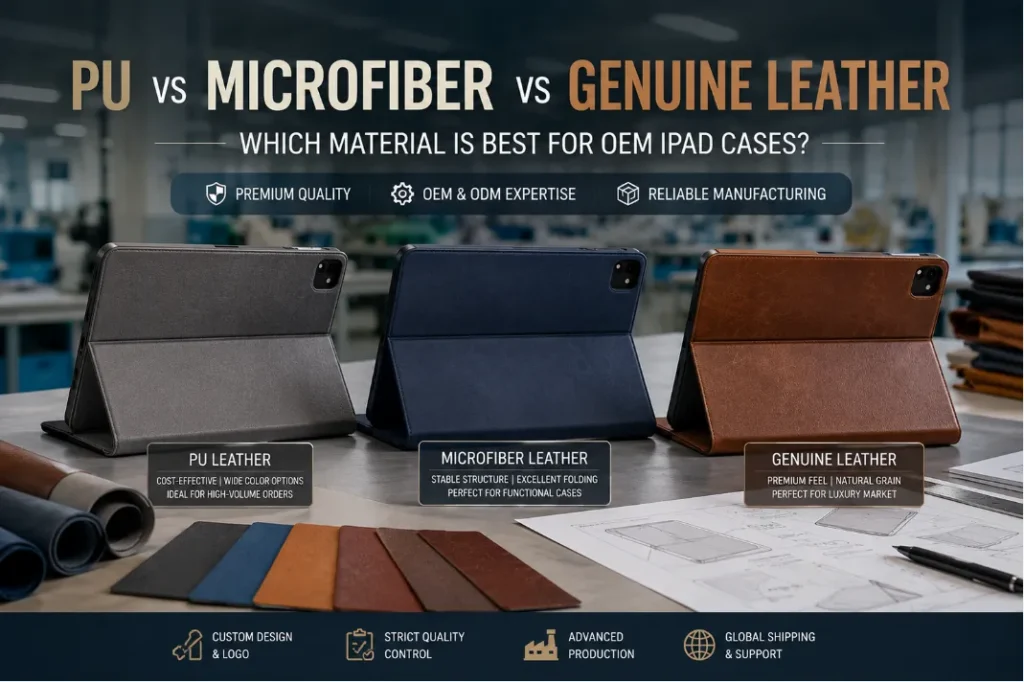
PU VS Microfiber VS Genuine Leather
Material names are useful starting points, but they are not complete specifications. Two materials sold under the same name can use different coatings, backings, finishes, or constructions. Request a physical reference and a written specification for the exact material being quoted.
Leather iPad Case Material Guide
| Material direction | Best suited to | Main strengths | Main limitations | What the buyer should verify |
|---|---|---|---|---|
| PU leather | Cost-controlled retail, promotional, and high-volume programs | Broad color and texture options; generally consistent appearance; practical for repeat production | Quality varies widely; some surfaces can whiten, peel, or crack at stressed folds | Coating and backing construction, fold behavior, abrasion, bonding, edge finish, and lot consistency |
| Microfiber-based synthetic leather | Magnetic, folio, modular, and Pencil-holder designs that benefit from stable construction | Often provides a dense, consistent backing and predictable handling during cutting and lamination | Does not provide natural grain variation or the aging character of genuine leather | Surface coating, microfiber base, compression, folding, lamination, and finished thickness |
| Genuine leather | Premium retail, executive gifting, and products where natural character matters | Natural grain, distinctive hand feel, and an appearance that can develop with use | Variation between hides and within a hide; requires grading, cutting, and thickness control | Leather type, finish, usable cutting areas, skiving, color range, stretch, backing, and approved appearance standard |
PU leather and microfiber leather are not always mutually exclusive categories. PU describes a polyurethane surface or coating system, while microfiber usually describes the fiber-based substrate. A microfiber material may also use a PU surface. Ask the supplier to describe both the surface and the backing instead of choosing from labels alone.
“Genuine leather” also needs clarification. It confirms that the material is leather, but it does not tell the buyer how the manufacturer finished the surface, how much the manufacturer corrected it, how thick the leather is, or how the leather will perform in a case. Buyers should verify terms such as full-grain, top-grain, corrected-grain, and split leather against an actual material reference and a construction specification.
How Each Material Behaves in an iPad Case
PU leather for consistent colors and controlled cost
PU leather is widely used when a project needs several colors, a defined texture, repeatable branding, or a cost target that genuine leather cannot meet. It can work well for standard folios, promotional programs, entry-level retail lines, and early market tests.
The word “PU” does not indicate one quality level. The surface formulation, backing fabric, overall thickness, flexibility, and finish all affect performance. A material that works on a flat back panel may not suit a narrow hinge that bends every time the folio opens.
Check PU leather in the final structure for:
– whitening or cracking along fold lines;
– surface peeling after edge wrapping or repeated flexing;
– visible glue texture or bubbles after lamination;
– stretching around corners and camera openings;
– color change after logo application;
– marking from packaging pressure;
– consistency between the approved sample and the production lot.
PU leather is not automatically a low-end choice. A suitable grade, matched to the construction and tested in the finished case, can be more reliable than a more expensive material selected only for its name.
Microfiber-based synthetic leather for structural consistency
Microfiber-based synthetic leather is often considered when the product needs a dense backing, clean cutting, stable folding, or predictable lamination. These characteristics can be useful in magnetic covers, detachable structures, and leather iPad cases with Pencil holders.
Its value is repeatability rather than a universal performance advantage. The surface coating can still scratch or wear, the backing can still absorb adhesive, and the finished case can still warp if the full material stack is unbalanced. Compare the exact material, not the category label.
Review:
– how the material compresses after lamination;
– whether the folded edge becomes bulky;
– whether the surface rebounds after embossing;
– whether the backing bonds evenly with the chosen adhesive;
– whether the cover remains flat after final assembly;
– whether different colors use the same base construction.
Microfiber-based materials do not replace the need for device testing. They may make dimensions easier to control, but they do not guarantee magnetic closure or Apple Pencil charging.
Genuine leather for natural character and premium positioning
Genuine leather is appropriate when the grain, touch, and natural variation are part of the product’s value. It can support premium retail lines, executive folios, corporate gifts, and smaller collections where each piece is expected to look slightly individual.
Natural variation is not a defect by itself. It becomes a production problem when the buyer and supplier have not agreed on the acceptable range. A leather standard should cover the reference color, grain character, surface finish, feel, thickness range, visible marks, and areas that may or may not be used.
The manufacturer also needs a plan for:
– hide inspection and grading;
– cutting around unsuitable areas;
– thickness sorting;
– skiving near folds, corners, and wrapped edges;
– managing stretch and grain direction;
– controlling adhesive application;
– matching color within a set or production lot;
– retaining an approved reference for repeat orders.
A genuine leather case may require more material preparation than a synthetic alternative. Buyers should account for that when comparing price, yield, sample revisions, and repeat-order consistency.
Match the Material to the Product Structure
The same material can succeed in one iPad case and fail in another. Use the product architecture to narrow the choice before comparing color and texture.
| Product Structure | Practical Material Direction | Main Reason | Main Validation Focus |
|---|---|---|---|
| Standard folio | Suitable PU or microfiber-based synthetic leather | Supports repeatable cutting, folding, and color programs | Hinge behavior, cover flatness, edge finish, and stand stability |
| Premium folio | Genuine leather or a premium synthetic material | Allows the brand to balance natural character, feel, and structure | Leather grading, skiving, fold behavior, lining, and logo result |
| Magnetic folio | Material with a controlled backing and predictable finished stack | Helps the design maintain consistent spacing and cover behavior | Finished-case closure, magnet alignment, cover stiffness, and device function |
| Leather iPad case with Pencil holder | Material that can be controlled around the holder and Pencil-side edge | Holder dimensions and edge buildup affect storage, access, attachment, and charging | Exact iPad/Pencil pair, holder fit, removal, surface protection, and charging if required |
| Detachable or modular case | Dimensionally stable outer and reinforcement materials | Deformation can change the alignment between removable parts | Attachment alignment, cover flatness, repeated use, and pair matching |
| Fully wrapped shell | Material that can form cleanly around corners and openings | Tight curves and cutouts can expose stretch, bulk, or lifting | Corner adhesion, camera opening, button access, and edge durability |
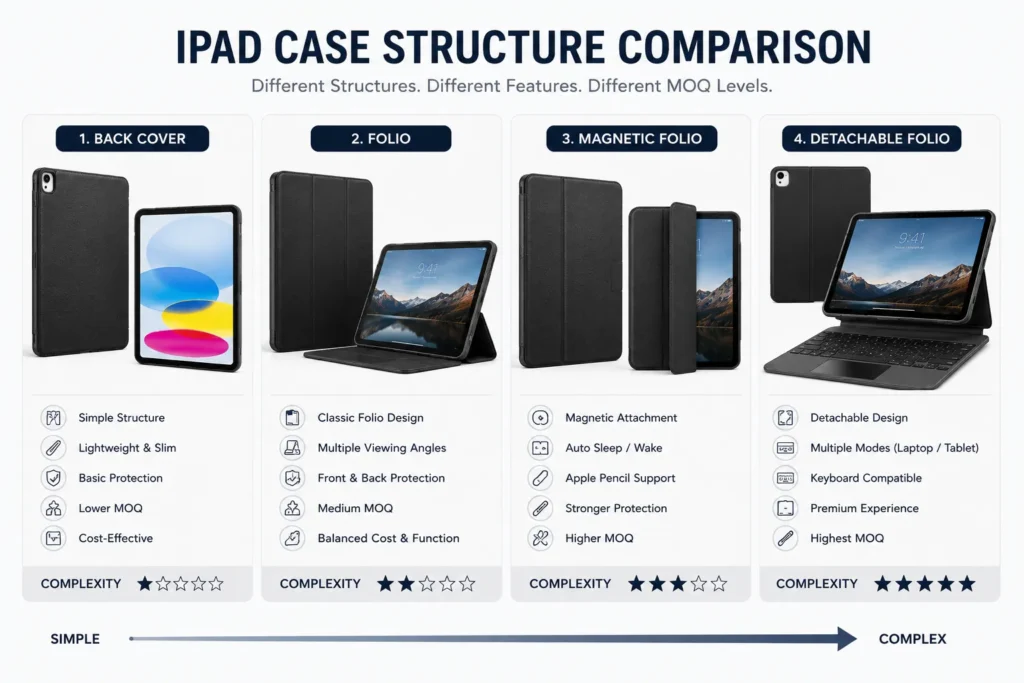
iPad Case Structure Comparison
Leather iPad cases with Pencil holders
A Pencil holder changes the material decision because storage, magnetic attachment, and charging are separate requirements. A molded slot can store the Pencil away from the iPad’s charging edge. A side channel may place it against the device. An elastic loop may fit several styluses but provide no charging function.
The outer material, folded edge, lining, shell lip, and holder depth can all change how the Pencil sits. A stable material helps, but the finished geometry still determines performance. Pellove’s Leather iPad Case With Pencil Holder manufacturer guide explains how to specify the holder, device combination, access, and production checks.
Magnetic leather iPad cases
For a magnetic case, material selection affects the distance and stiffness around the magnetic system, but it is not the only variable. Magnet position, polarity, cover construction, reinforcement, and assembly alignment also matter.
Do not approve a material because a loose swatch appears thin enough. Test it after lamination and final assembly. Projects built around magnetic closure or device retention should use the magnetic iPad case manufacturing guide for the full engineering and QC requirements.
Apple Pencil charging areas
Leather itself is not automatically the cause of charging failure. Problems usually come from the finished stack and alignment along the Pencil-side edge. Surface material, backing, lining, adhesive, reinforcement, shell geometry, and holder design can combine to change the fit.
When charging is required, test the named iPad and Apple Pencil models with the complete case installed. The separate guide to Apple Pencil charging problems with iPad cases provides a step-by-step diagnostic and production validation process.
Specifications That Matter Beyond the Surface
Choosing between PU, microfiber, and genuine leather is only the first decision. The following details often have as much influence on the finished product as the visible surface.
Backing and lining
The backing affects stretch, adhesive absorption, edge bulk, and cutting behavior. The lining affects surface contact, friction, appearance, and how the inner layer moves against the reinforcement. A soft lining can improve touch while still creating wrinkles or excess thickness if it is not matched to the construction.
Specify the backing and lining together with the outer material. Do not allow an unapproved substitution simply because the visible face looks similar.
Adhesive and lamination
Bonding changes the material. Adhesive coverage, drying, pressure, and heat can affect flatness, stiffness, texture, and edge behavior. Natural leather and synthetic backings may absorb or respond to adhesive differently.
Approve the laminated assembly, not only the separate materials. Check for bubbles, local high spots, bleed-through, odor concerns, panel curl, and layer movement around fold lines.
Reinforcement and foam
Board, foam, and reinforcement determine how the cover holds its shape. Added structure can improve protection or stand stability, but it can also increase weight, create a hard transition, or make the Pencil-side edge too bulky.
The reinforcement should stop, taper, or flex where the design requires movement. A uniform sheet placed across the entire cover is not automatically the most stable solution.
Skiving, edge wrapping, and edge paint
Skiving reduces leather thickness where layers fold or overlap. Too little skiving can create bulky corners and stiff hinges. Too much can weaken the edge or make the surface appear uneven.
Wrapped edges need enough material for secure bonding without creating excessive buildup. Painted edges need a compatible preparation and coating system that can tolerate the intended movement. Evaluate the edge after the case has been opened, closed, installed, and packed, not only when the sample is new.
Color, grain, and logo process
Color standards should be based on approved physical references under agreed viewing conditions. Genuine leather needs an acceptable range because natural surfaces will not be identical. Synthetic materials also vary between production lots, especially when different colors or finishes use different base constructions.
Logo approval must use the final material. Embossing depth, foil adhesion, print sharpness, and metal-logo seating can change with surface finish, backing density, and lamination.
Sample Validation Before Bulk Production
A material swatch helps narrow the choice, but it cannot approve the finished case. Use a staged process that moves from material selection to a production-intent sample.
1. Approve the material reference
Record the material name, supplier reference, color, finish, backing, lining, and any other detail needed to identify what was approved. For genuine leather, include the acceptable natural variation. For synthetic materials, identify both the surface and base construction.
2. Build the complete sample
Use the planned shell, adhesive, reinforcement, lining, magnets, holder, logo, and edge construction. Clearly mark any temporary component. A sample made with a substitute material cannot approve a function that depends on thickness, compression, folding, or bonding.
3. Test the real user sequence
Install the correct iPad. Open and close the folio, use each stand position, access the controls, insert and remove the Pencil, and test every promised magnetic or charging function. Review how the case behaves in motion, not only in a product photo.
4. Check material-related failure modes
Inspect for:
– whitening, cracking, peeling, or surface marking at folds;
– lifting, bubbles, wrinkles, or warpage after lamination;
– rough or bulky corners;
– edge-paint cracking or wrapped-edge movement;
– changes around embossed, printed, or attached logos;
– holder fit and Pencil contact surfaces;
– cover closure and stand stability;
– color and grain differences from the approved reference;
– deformation after the product is packed as intended.
5. Freeze the production standard
Retain a controlled sample and the written material specification. Record the case revision, device model, Pencil model, color, logo, packaging, and approved functions. Define which material or construction changes require a new sample.
Avoid copying a universal cycle count, thickness limit, or acceptance number from an unrelated case. Test methods and limits should reflect the actual material, structure, use case, and buyer requirement.
Bulk Material Control and Supplier Questions
Bulk production adds variation that may not appear in a carefully made sample. The manufacturer needs to translate the approved material into incoming, in-process, and finished-product checks.
Incoming control should confirm that the material matches the approved reference before it is cut. For synthetic materials, check the surface, backing, color, thickness range, and visible defects. For genuine leather, grade the hides, separate unsuitable areas, and plan cutting around natural variation.
In-process checks should focus on operations that change the material: skiving, cutting, lamination, forming, wrapping, edge finishing, and logo application. Finished inspection should confirm both appearance and function on the assembled case.
Ask the supplier:
1. What exact surface, backing, lining, and finish are included in the quotation?
2. Which parts of the material specification will be fixed after approval?
3. How will genuine leather variation or synthetic-material lot variation be controlled?
4. Which areas will be skived, folded, wrapped, or painted?
5. Has the material been tested in the proposed shell and cover structure?
6. How will the Pencil holder, magnetic function, or charging requirement be checked?
7. What happens if the approved material becomes unavailable?
8. Which substitutions require buyer approval and a revised sample?
9. How will repeat orders be matched to the original color and construction?
10. What records or retained references will support a material-related complaint?
Within Pellove’s custom iPad case collection, different folio, magnetic, and Pencil-holder structures place different demands on the material stack. A representative leather iPad case with a Pencil holder also shows why material decisions should be made around the complete product rather than the outer surface alone.
Frequently Asked Questions
Which material is best for a leather iPad case?
There is no single best material for every iPad case. PU leather often suits cost-controlled and color-driven programs. Microfiber-based synthetic leather can suit structures that benefit from a stable backing. Genuine leather suits products where natural grain and premium touch justify additional grading and process control.
Is PU leather suitable for OEM iPad case manufacturing?
Yes. A suitable PU leather can work well for OEM retail, promotional, and private-label programs. Buyers should verify the exact coating and backing, then test folding, lamination, abrasion, edge finishing, logo application, and packaging in the finished case.
Is microfiber leather always better than standard PU?
No. The categories can overlap, and performance depends on the actual surface, backing, finish, and case construction. Compare named material samples using the same product design and acceptance criteria rather than relying on the label.
Does genuine leather make an iPad case more durable?
Not automatically. Genuine leather provides a strong, attractive surface, but manufacturers must also consider the leather type, finish, thickness, cutting, skiving, backing, adhesive, lining, reinforcement, and edge construction, as well as how users handle the case, to ensure durability.
What material is best for a leather iPad case with a Pencil holder?
Choose a material that allows you to control the fit around the holder and Pencil-side edge, then test it with the exact iPad and Pencil combination. A stable synthetic construction may simplify dimensional control, while genuine leather can work when grading and skiving account for natural variation. The holder geometry and complete material stack remain decisive.
Can case material affect Apple Pencil charging?
It can contribute, but the outer material is rarely the only cause. Charging may be affected by the combined thickness and alignment of the outer material, backing, lining, adhesive, reinforcement, shell edge, and holder. Test the fully assembled case with a compatible iPad and Pencil.
What should an OEM buyer approve before production?
Approve the material reference, backing, lining, color, finish, thickness range, case construction, shell, reinforcement, adhesive approach, logo, edges, packaging, device fit, and every required function. Retain a controlled sample and revision record for bulk production and repeat orders.