
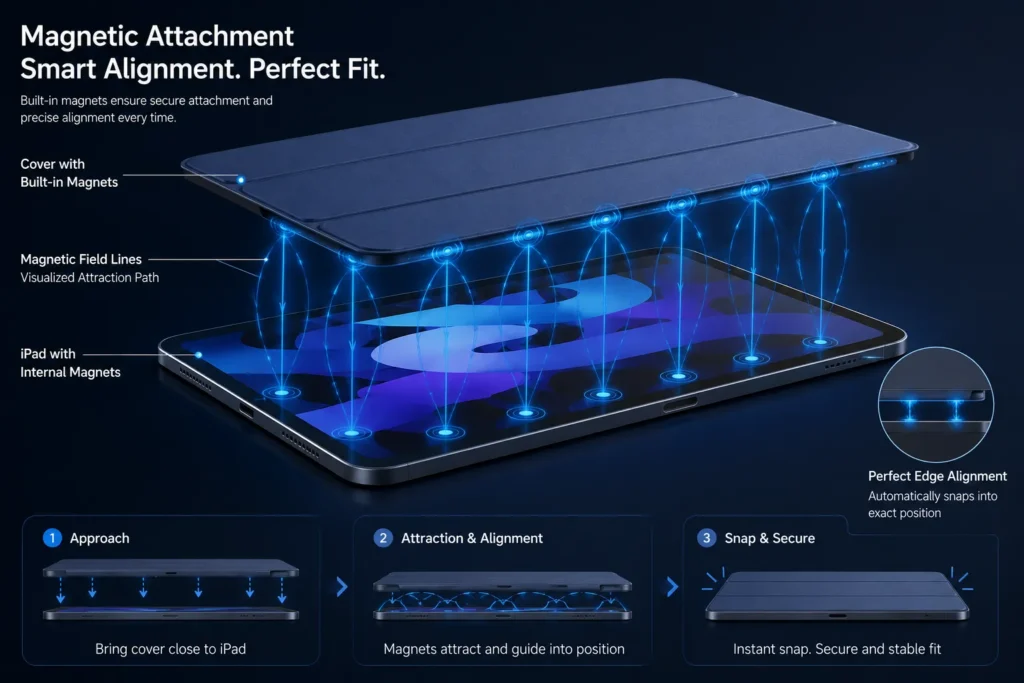
Magnetic iPad cases are engineered tablet accessories that rely on embedded magnet systems and structural alignment architecture rather than traditional stitching or adhesive-based construction.
For OEM/ODM buyers, a magnetic iPad case is not a simple design variation of a folio case—it is a precision-controlled magnetic system that directly affects alignment accuracy, closure stability, Apple Pencil compatibility, and long-term structural durability.
This guide explains how magnetic iPad cases are designed and manufactured from an OEM engineering perspective, including magnet layout design, polarity control, detachable architectures, and quality control systems. For a broader understanding of supplier evaluation, production capability, and tablet accessory sourcing strategy, you can also refer to the Tablet Case Manufacturer Guide for Brand Wholesale Buyers

Layer structure of magnetic ipad case
Use This Magnetic Guide With These OEM Checks
Magnetic iPad case development should not be evaluated in isolation. Buyers should connect magnet layout decisions with the broader leather tablet case manufacturing strategy and the iPad-specific requirements covered in the leather iPad case manufacturer guide.
| Risk area | Supporting guide |
|---|---|
| Closure force, corner lifting, and unstable folio alignment | Why Magnetic iPad Cases Do Not Close Properly |
| Apple Pencil attachment, charging, and magnetic interference | Why Leather iPad Cases Can Affect Apple Pencil Charging |
What Buyers Commonly Search Before Choosing a Manufacturer
Before sourcing, buyers typically search:
- magnetic iPad case manufacturer OEM
- custom magnetic iPad case supplier
- iPad case magnet alignment problem
- why magnetic iPad case not closing properly
- detachable magnetic tablet case factory
This article is structured to answer these sourcing and engineering questions directly.
What Is a Magnetic iPad Case?
A magnetic iPad case is a structural system that uses embedded magnet arrays to control functional behavior, including:
- Automatic alignment between cover and device
- Magnetic folio closure stability
- Detachable shell-to-cover connection
- Multi-angle stand positioning
- Apple Pencil attachment compatibility (model dependent)
Unlike traditional folio cases, magnetic systems rely on force field engineering instead of mechanical fastening.
Magnetic iPad Case vs Standard Folio Case
| Aspect | Standard Folio Case | Magnetic iPad Case |
|---|---|---|
| Structural System | Stitching + folding | Embedded magnet arrays |
| Alignment Control | Manual positioning | Magnetic auto-alignment |
| Closure Mechanism | Physical flap | Magnetic force balance |
| Engineering Complexity | Low | Medium–High |
| Failure Risk | Wear & tear | Polarity/misalignment issues |
Types of Magnetic iPad Case Structures
1. Integrated Magnetic Folio Structure (Mass Production Standard)
This is the most common OEM structure.
Structure Composition
- PC or TPU inner shell
- PU or leather outer cover
- Embedded magnet strip system
- Microfiber lining
- Folding hinge system
Engineering Targets for Magnetic Tablet Cases
- Closure force: 300–800 gf (optimized per device weight and hinge stiffness)
- Magnetic alignment tolerance: ±0.5–1.5 mm, depending on Pencil charging requirement
- Folding durability: 10,000–20,000 cycles minimum under standard ASTM flex testing
Best for
- Amazon sellers
- Retail distribution
- Cost-sensitive OEM programs
2. Detachable Magnetic Architecture (Premium Modular System)
This system separates the protective shell from the folio cover via magnetic coupling.
Engineering Structure
- Bi-polar magnet pairing system
- Reinforced connection frame
- Controlled detachment force design
- Load distribution balancing
Key Engineering Risks
- Polarity mismatch causing repulsion
- Misalignment during attachment
- Magnet fatigue over long-term use
Best for
- Premium brands
- Modular product positioning
- High ASP product lines
3. Magnetic Keyboard Hybrid System
This is the most complex magnetic tablet case structure.
System Components
- Magnetic docking interface
- Keyboard alignment system
- Multi-angle hinge structure
Engineering Challenges
- Uneven magnetic force distribution
- Hinge fatigue under load
- Docking misalignment during use
Best for
- Productivity devices
- Enterprise tablet accessories
Material selection also plays a major role in magnetic performance stability, structural durability, and premium positioning. If you are comparing leather-based OEM solutions, our Leather iPad Case Manufacturer Guide explains the key material and manufacturing considerations in detail.
Magnetic System Engineering
Magnet Types Used in OEM Production
| Type | Role | Advantage | Limitation |
|---|---|---|---|
| Neodymium (NdFeB) | High-performance systems | Very strong force density | Higher cost |
| Ferrite | Low-cost systems | Stable supply | Weak magnetic force |
Neodymium magnets dominate OEM production due to their high force-to-size efficiency, which is critical for thin tablet case structures.
Magnetic Layout Design
Magnetic layout determines how the case behaves in real usage.
Key Functional Zones
- Closure zone (folio sealing)
- Alignment strip (device positioning)
- Corner stabilization points
- Stand support region
- Apple Pencil exclusion zone
Core Engineering Principle
Magnetic systems must balance:
- Holding force
- Alignment accuracy
- Structural flexibility
Poor balance leads to:
- weak closure
- misalignment
- unstable folding behavior
Polarity Control System
Polarity mismatch is one of the most common mass production failures.
Failure Modes
- Magnetic repulsion instead of attraction
- Random alignment behavior
- High assembly rejection rate
Required Manufacturing Controls
- Pre-embedding polarity inspection
- Fixture-based orientation control
- Batch-level magnet verification
Without polarity control, stable mass production cannot be guaranteed.
Apple Pencil Compatibility Engineering
Apple Pencil performance depends on magnetic system design, not accessories.Many charging and attachment failures are actually caused by magnetic field overlap, wall thickness variation, and structural interference inside the case architecture. We explain these engineering failures in detail in our guide on Why Leather iPad Cases Affect Apple Pencil Charging Performance.
Key Constraints
- Magnetic field interference near the charging zone
- Wall thickness affects signal transmission
- Device model differences
Engineering Solution
- Magnetic shielding layer
- Exclusion zone design
- Field isolation strip architecture
Strong magnets improve closure stability but may reduce Pencil compatibility if not properly controlled.
OEM Manufacturing Process (Engineering View)
1: Product Definition
- iPad model selection
- Magnetic architecture selection
- Functional requirements definition
2: CAD Magnet Layout Design
- Magnet positioning mapping
- Polarity orientation design
- Force distribution simulation
- Tolerance stacking analysis
3: Structural Lamination
- Layer thickness control
- Adhesive uniformity
- Deformation prevention
4: Magnet Embedding
- Orientation accuracy control
- Position tolerance (±0.3–0.5 mm)
- Structural fixation stability
5: Assembly Calibration
- Closure force testing
- Alignment verification
- Folding hinge testing
6: Quality Control Testing
| Test | Purpose |
|---|---|
| Pull force test | Closure stability |
| Polarity verification | Magnetic direction correctness |
| Alignment test | Structural accuracy |
| Cycle test | Long-term durability |
Common Magnetic iPad Case Problems
1. Alignment Instability
Caused by uneven magnet spacing or poor layout design.
2. Polarity Mismatch
Caused by incorrect magnet orientation during embedding.
3. Apple Pencil Interference
Caused by the magnetic field overlap near the charging area.
4. Magnet Displacement
Caused by weak fixation or poor structural bonding.
How to Choose a Magnetic iPad Case Manufacturer
Magnet Engineering Capability
- Layout design experience
- Force balancing control
- Polarity management system
CAD Design Capability
- Device-specific modeling
- Tolerance simulation
- Rapid prototyping capability
Quality Control System
- Polarity inspection
- Alignment testing
- Force consistency verification
Structural Prototyping Ability
- Fast sampling cycles
- Iterative engineering feedback
- Design optimization capability
Product Structure Selection Guide
Integrated Magnetic Structure
Best for:
- Mass retail
- Amazon OEM programs
- Cost-sensitive markets
Detachable Magnetic Structure
Best for:
- Premium branding
- Modular product positioning
- High-margin product lines
Magnetic Keyboard Structure
Best for:
- Productivity devices
- Enterprise markets
- High complexity OEM projects
FAQ
What is a magnetic iPad case?
A magnetic iPad case uses embedded magnet arrays to control alignment, closure, and structural behavior instead of mechanical fastening.
Why is my magnetic iPad case not closing properly?
This issue is commonly linked to polarity mismatch, weak magnetic force distribution, or excessive structural thickness. Our detailed guide on Why Magnetic iPad Cases Not Closing Properly explains the engineering causes and OEM solutions behind these failures.
Do magnetic iPad cases affect Apple Pencil charging?
Yes. If the magnetic field overlaps the charging zone, it can interfere with Apple Pencil functionality.
What magnets are used in iPad cases?
Most OEM manufacturers use neodymium magnets due to their strong magnetic force and compact size.
How do I choose a magnetic iPad case manufacturer?
Evaluate CAD capability, magnet layout engineering, polarity control systems, and QC testing standards.
OEM RFQ
If you are developing magnetic iPad cases for retail, Amazon, or branded distribution, your supplier must control:
- Magnet alignment consistency
- Polarity accuracy in mass production
- Apple Pencil compatibility design
- Structural tolerance stability
To start OEM development, provide:
- iPad model
- Case structure type (integrated/detachable/keyboard)
- Target magnet strength and positioning requirements
Turn Engineering Complexity into Market-Ready Products
In magnetic iPad case development, most product failures do not come from design aesthetics—they come from uncontrolled engineering variables: unstable magnet force distribution, polarity misalignment in mass production, inconsistent closure force, and Apple Pencil interference caused by untested magnetic field overlap.
For OEM/ODM buyers, these issues directly translate into higher return rates, unstable user experience, and lost retail performance.
At Pellove, we eliminate these risks at the engineering source.
Our magnetic iPad case development system is built around four core control layers:
- Magnet Layout Engineering: device-specific force balancing for stable closure and alignment
- Polarity Control System: batch-level verification to prevent production mismatch failures
- Tolerance Management: CAD-driven structural calibration for consistent ±0.3–1.5 mm accuracy control
- Apple Pencil Compatibility Design: field isolation architecture to ensure functional stability without signal disruption
This is not generic OEM manufacturing—it is precision-controlled magnetic system engineering designed for scalable retail success.
If your product strategy requires stable mass production, predictable user experience, and premium positioning in Amazon, retail, or branded distribution channels, Pellove provides end-to-end development support from prototype validation to full production rollout.
Share your iPad model and product structure requirements, and our engineering team will respond with a manufacturability assessment and optimization proposal.
Related Magnetic and Modular iPad Case Planning
Magnetic system design should be planned with the wider iPad case structure. Buyers can compare this guide with the leather iPad case manufacturer guide, the detachable modular iPad case manufacturer guide, and the leather iPad case category. Before bulk production, connect magnetic validation with MOQ planning and a leather goods quality checklist.
Conclusion
Magnetic iPad cases are precision-engineered structural systems defined by:
- Magnet layout design
- Polarity control systems
- Force distribution engineering
- Device-level compatibility constraints
Unlike material-focused products, magnetic systems require strict control across CAD design, embedding processes, and QC validation.
For OEM/ODM buyers, success depends on selecting manufacturers with proven capability in magnetic engineering, structural tolerance control, and device-specific system design.