
Apple Pencil charging appears simple on the surface. Attach the Pencil magnetically to the side of the iPad, and charging begins automatically.
In reality, the system depends on highly precise magnetic alignment, controlled material thickness, stable edge geometry, and consistent structural tolerances. Even small deviations inside a leather iPad case can weaken magnetic attachment, reduce charging efficiency, or interrupt Bluetooth pairing.
As magnetic charging systems become increasingly integrated into modern tablet accessories, leather case engineering now requires significantly tighter structural control than traditional folio designs. For OEM and ODM buyers, Apple Pencil compatibility has become one of the most engineering-sensitive aspects of leather iPad case manufacturing.
Many charging problems are not caused by the leather material itself, but by how the leather structure is engineered around Apple’s magnetic charging system.
This article explains why leather iPad cases can affect Apple Pencil charging performance, what manufacturing failures commonly cause interference, and how professional OEM suppliers optimize their designs for stable charging reliability.
For buyers evaluating large-scale production projects, understanding the broader engineering architecture behind magnetic tablet accessories is equally important. Our complete guide to magnetic iPad case manufacturing explains how magnet layout systems, structural layering, folio mechanics, and OEM production tolerances affect long-term product performance.
Related Guides for Apple Pencil and Magnetic iPad Case Engineering
Apple Pencil charging problems often overlap with magnet layout, folio closure, and material-stack design. Buyers planning an OEM project should read this article together with the magnetic iPad case manufacturing guide and the leather iPad case manufacturer guide.
| Engineering question | Recommended guide |
|---|---|
| How do magnet layout and polarity affect the full case system? | Magnetic iPad case manufacturing guide |
| Why does the folio lift, shift, or fail to stay closed? | Why Magnetic iPad Cases Do Not Close Properly |
| How does this fit into tablet case supplier evaluation? | Leather tablet case manufacturer guide |
How Apple Pencil Magnetic Charging Works
Magnetic Alignment System on iPad
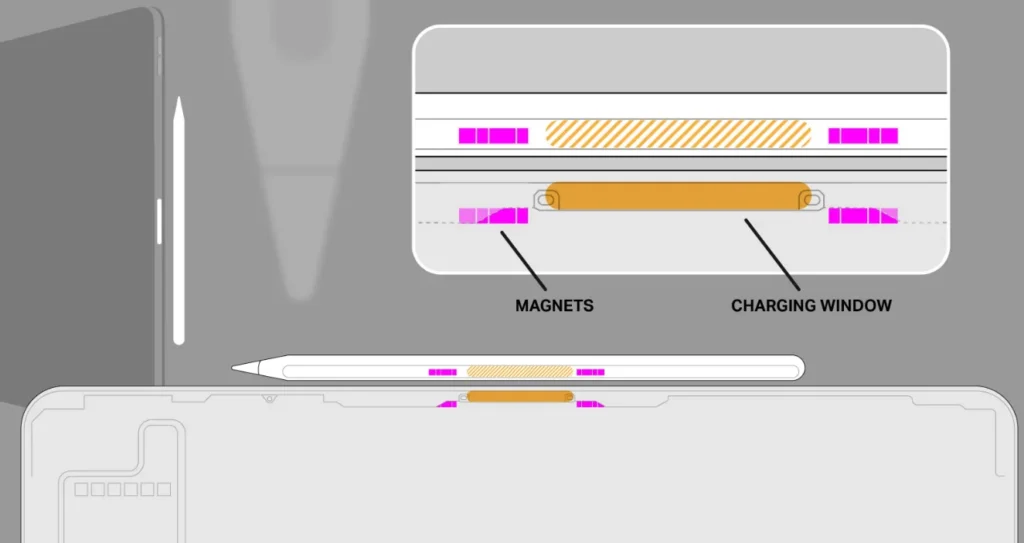
Modern iPads use an integrated magnetic array along the side frame to align and secure the Apple Pencil. Once attached, a wireless charging system transfers power through close-range electromagnetic induction while simultaneously activating Bluetooth pairing.
The system depends on three functions working together precisely:
- Magnetic positioning
- Wireless charging coil alignment
- Bluetooth pairing activation
Even minor structural deviation can weaken overall charging stability.
Suggested image placement:
- Internal diagram of iPad and Apple Pencil magnetic charging structure
Critical Tolerances Required for Stable Charging
Apple Pencil charging is highly sensitive to dimensional tolerances.
Even an additional 0.3–0.5 mm of material buildup near the Pencil charging zone may reduce magnetic efficiency significantly. Likewise, slight magnet displacement can weaken attachment force or interrupt charging recognition.
Several factors directly affect charging reliability:
- Edge thickness
- Magnet polarity direction
- Magnet positioning accuracy
- Surface flatness
- Compression consistency
- Material rebound behavior
In mass production, tolerance accumulation becomes especially important because multiple material layers gradually stack together and exceed acceptable limits.
Why Small Structural Errors Cause Major Charging Problems
Many Apple Pencil charging failures originate from relatively small structural defects.
Common symptoms include:
- Intermittent charging
- Pencil disconnecting during movement
- Weak magnetic attachment
- Delayed pairing recognition
- Pencil falling off during transport
In most cases, the issue is not electronic failure. Instead, the leather case changes the magnetic geometry surrounding the charging area.
Why Leather iPad Cases Commonly Interfere With Charging
Excessive Material Thickness Along the Pencil Edge
Leather iPad cases usually contain multiple structural layers:
- Outer leather
- Microfiber lining
- Adhesive film
- Structural backing board
- Protective foam
- Edge wrapping material
When all layers accumulate near the Pencil charging edge, total thickness may exceed Apple’s effective charging distance.
This is one of the most common causes of unstable charging in folio-style leather iPad cases.
Suggested image placement:
- Cross-sectional comparison between optimized and overly thick Pencil edge structures
Leather Edge Wrapping Pressure
Leather wrapping tension directly affects charging stability.
During production, leather is stretched and folded around the edge structure. If wrapping pressure becomes excessive, the edge geometry may gradually deform after assembly.
This can create:
- Uneven magnetic contact
- Increased charging gap distance
- Edge compression distortion
- Long-term dimensional instability
Aggressive edge wrapping is especially problematic in ultra-thin leather folio designs where tolerance margins are already limited.
Misaligned Embedded Magnets
Many leather iPad cases use embedded magnets for:
- Folio closure
- Stand positioning
- Pencil retention
If these magnets are improperly positioned, they can interfere with the iPad’s original magnetic array.
Typical manufacturing failures include:
- Magnet offset during assembly
- Incorrect polarity orientation
- Uneven magnetic force distribution
- Low-grade magnet materials
Even a few millimeters of deviation can reduce charging stability significantly.
Metal Components Blocking Magnetic Fields
Some premium leather cases include decorative or structural metal components such as:
- Metal logos
- Steel reinforcement plates
- Magnetic stand supports
These components may partially shield or redirect magnetic fields around the charging area.
As a result, the Apple Pencil may appear attached visually while failing to maintain stable charging contact internally.
Poor Compression Consistency
Leather is a flexible material that changes slightly during production.
Problems occur when:
- Adhesive accumulates unevenly
- Leather expands after lamination
- Folded edges create localized pressure buildup
- Heat pressing alters material dimensions
Without proper compression control, the Pencil charging edge may become uneven or distorted over time.
How Leather Materials Affect Apple Pencil Charging Stability
Full-Grain Leather
Full-grain leather provides a premium texture and natural appearance, but it also introduces dimensional inconsistency.
Natural leather thickness varies between batches, which makes tolerance control more difficult during mass production. These dimensional-control challenges are common in leather iPad case manufacturing, particularly in wrapped folio structures where edge geometry directly affects Apple Pencil charging stability.
Advantages:
- Premium feel
- Strong luxury positioning
- Natural grain texture
Potential engineering challenges:
- Thickness variation
- Material stretching
- Compression inconsistency
- Moisture-related dimensional change
Because genuine leather is an organic material, environmental humidity can slightly affect long-term edge stability near the Pencil charging zone.
Why Leather Skiving Precision Matters
Skiving is one of the most important processes in leather iPad case manufacturing.
During skiving, leather thickness is reduced near folding areas and edge sections to control final structural dimensions.
Poor skiving precision can create:
- Uneven edge buildup
- Excessive material overlap
- Folding thickness accumulation
- Inconsistent Pencil charging gaps
For Apple Pencil-compatible designs, skiving tolerance control is often far more critical than external cosmetic appearance.
Professional factories typically maintain tighter skiving tolerances near the Pencil edge than in other areas of the case.
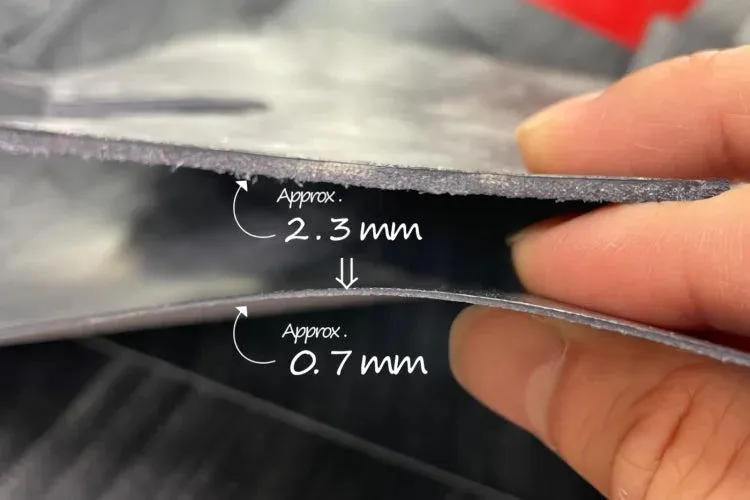
Leather skiving
PU Leather
PU leather is widely used in tablet case manufacturing because it offers more stable dimensional control.
Compared with natural leather, PU materials generally provide:
- More uniform thickness
- Better lamination consistency
- Easier large-scale process control
- Lower material variation
This makes PU leather easier to optimize for Apple Pencil charging compatibility.
Vegan Leather and Microfiber Composite Materials
Modern vegan leather materials often use engineered microfiber composite structures that improve flexibility and dimensional stability.
These materials can support:
- Ultra-thin edge construction
- Better folding consistency
- Reduced magnetic interference
- Improved compression uniformity
As a result, many high-volume OEM factories now prefer microfiber composite systems for magnetic tablet case production.
Suggested image placement:
- Different leather material thickness and compression comparison
Common Engineering Failures in Leather iPad Case Manufacturing
Incorrect Pencil Channel Dimensions
The Pencil storage channel must balance:
- Magnetic retention
- Easy removal
- Stable charging contact
If the channel is too deep, charging distance increases. If too shallow, the Pencil may detach during transport.
Weak Magnetic Retention Force
Some suppliers prioritize ultra-thin construction while reducing magnet size excessively.
This may create:
- Weak attachment force
- Poor transportation stability
- Frequent Pencil displacement
- Intermittent charging
Charging Coil Misalignment
The charging coil area inside the iPad has limited alignment tolerance.
Poor tooling precision during assembly may shift the magnetic zone away from the optimal charging position.
Even small alignment errors become amplified when combined with leather thickness variation.
Adhesive Absorption Problems in Genuine Leather
Natural leather absorbs adhesive differently from synthetic materials.
Uneven glue penetration may create:
- Localized thickness variation
- Surface warping
- Compression inconsistency
- Uneven edge rebound
These problems are more difficult to detect visually but can affect long-term charging stability.
Overly Tight Leather Wrapping
Aggressive leather wrapping techniques may create excessive edge stress that gradually deforms the charging area after prolonged use.
This issue becomes more severe under:
- High temperatures
- Long-term folding pressure
- Transportation compression
Tolerance Stack-Up Problems in Mass Production
Prototype samples often perform well because they are assembled manually with extra care.
However, mass production introduces:
- Material variation
- Assembly speed fluctuations
- Adhesive inconsistency
- Tool wear
- Operator variation
These small deviations combine into cumulative tolerance errors that affect Apple Pencil charging performance.
Suggested image placement:
- Factory Apple Pencil charging QC inspection process
How OEM Manufacturers Optimize Pencil Charging Compatibility
Precision Magnet Positioning Systems
Professional factories use specialized fixtures to maintain accurate magnet placement.
Typical methods include:
- CNC positioning fixtures
- Automated polarity inspection
- Magnetic force verification systems
- Position tolerance measurement
Controlled Material Stack Thickness
Manufacturers optimize total edge thickness by:
- Reducing unnecessary foam layers
- Using thinner adhesive films
- Compressing material stacks precisely
- Controlling leather skiving consistency
The goal is to maintain charging efficiency without sacrificing protection.
Edge Structure Optimization
Advanced leather case designs often use:
- Open-edge Pencil channels
- Floating magnetic structures
- Reduced edge overlap zones
- Split-layer edge construction
These solutions minimize charging interference while preserving premium appearance quality.
Suggested image placement:
- Exploded-view magnetic leather iPad case structure
Apple Pencil Charging Reliability Testing
Professional OEM suppliers usually perform multiple validation tests, including:
- Continuous charging cycles
- Vibration testing
- Transportation simulation
- Drop testing with a pencil attached
- Magnetic force consistency testing
- Long-term attachment durability testing
These procedures help ensure stable charging performance across large production batches.
Design Trade-Offs Between Protection and Charging Performance
There is always a balance between protection level and magnetic charging efficiency.
| Design Goal | Potential Trade-Off |
|---|---|
| Thicker protection | Reduced magnetic efficiency |
| Strong Pencil retention | Harder Pencil removal |
| Luxury leather construction | Increased thickness variation |
| Heavy folio structures | Additional magnetic interference |
| Multi-layer reinforcement | Greater tolerance accumulation |
Professional product engineering focuses on balancing these competing requirements rather than maximizing only one factor.
What Buyers Should Ask Leather iPad Case Suppliers?
When sourcing leather iPad cases, buyers should evaluate engineering capability carefully rather than focusing only on exterior appearance.
Pencil Charging Validation
Important questions include:
- Has the case been tested with Apple Pencil Pro and Apple Pencil Gen 2?
- What charging failure rate is considered acceptable?
- Are magnets polarity-tested during production?
- Is charging stability validated after drop testing?
Material Engineering
Buyers should also ask:
- What is the total edge thickness near the Pencil charging area?
- Which magnet grade is used?
- How is adhesive thickness controlled?
- How is leather skiving tolerance monitored?
Production QC
Production quality control is equally important:
- Is every unit charging-tested?
- How are assembly tolerances inspected?
- Are long-term durability tests performed?
- How is magnet positioning verified during mass production?
These questions reveal whether a supplier truly understands magnetic charging engineering for leather tablet accessories.
Future Trends in Pencil-Compatible Leather iPad Cases
Several industry trends are improving Apple Pencil charging compatibility.
Ultra-Thin Structural Engineering
New materials allow thinner protective structures without sacrificing durability.
Hidden Magnet Optimization
Manufacturers are improving internal magnet layouts to reduce charging interference while maintaining strong folio functionality.
Modular Pencil Holder Systems
Some brands now separate the Pencil holder from the main folio structure to improve charging reliability and reduce tolerance accumulation.
AI-Assisted Magnetic Simulation
Advanced factories increasingly use simulation software to optimize magnetic positioning before tooling development begins.
FAQ
Why does my Apple Pencil stop charging when using a leather iPad case?
This is usually caused by excessive material thickness or magnetic misalignment in the Pencil charging area. Leather, microfiber, adhesive layers, and internal reinforcement can collectively increase the distance between the Pencil and the iPad’s magnetic charging strip, reducing charging efficiency or causing intermittent connection.
Do all leather iPad cases affect Apple Pencil charging?
Not all cases cause issues. Well-engineered cases with controlled skiving, optimized magnet placement, and thin-edge construction can maintain stable charging performance. Problems typically occur in low-precision OEM designs rather than leather material itself.
Can Apple Pencil charge through thick cases?
Apple Pencil charging is highly sensitive to distance. Once total material thickness exceeds the effective magnetic induction range, charging becomes unstable or fails entirely. Even an additional 0.3–0.5 mm in the Pencil zone can make a noticeable difference.
Why does my Apple Pencil disconnect when I move the iPad?
This is often related to weak magnetic retention or uneven force distribution. If the case uses poorly aligned magnets or has inconsistent edge compression, the Pencil may shift slightly during movement, interrupting both charging and Bluetooth connection.
Does leather quality affect Apple Pencil charging performance?
Indirectly, yes. Genuine leather has natural thickness variation and moisture sensitivity, which can lead to dimensional inconsistency over time. PU leather or microfiber composites generally provide more stable structural control for precision charging zones.
Why do some cases work fine in samples but fail in mass production?
This is a common OEM issue. Sample units are often handcrafted with tighter control, while mass production introduces tolerance stack-up from:
- Material variation
- Adhesive inconsistency
- Magnet placement deviation
- Tool wear
- Assembly speed differences
These small deviations accumulate and impact Apple Pencil charging stability.
Can magnets in the case interfere with Apple Pencil charging?
Yes, if not properly engineered. Incorrect polarity, excessive magnet strength, or poor positioning can distort the iPad’s internal magnetic field layout, leading to unstable attachment or reduced charging efficiency.
What is the best material for Apple Pencil-compatible iPad cases?
From an engineering standpoint, PU leather and microfiber composite structures are often more stable than natural leather because they offer:
- More consistent thickness
- Better lamination control
- Lower dimensional variation
- Higher repeatability in mass production
How do OEM factories test Apple Pencil charging compatibility?
Professional manufacturers typically perform:
- Continuous charging cycle tests
- Vibration and transport simulations
- Drop tests with Pencil attached
- Magnetic force consistency checks
- Long-term attachment durability testing
These ensure batch-level reliability rather than single-sample performance.
Why does my Apple Pencil feel less “snappy” with some cases?
Reduced “snap strength” usually indicates weaker magnetic coupling caused by added distance, internal metal interference, or suboptimal magnet alignment inside the case structure.
Conclusion
Apple Pencil charging compatibility is fundamentally an engineering challenge rather than a simple material issue.
Leather itself does not automatically interfere with charging performance. Most charging problems originate from:
- Excessive structural thickness
- Poor magnet alignment
- Improper material stacking
- Weak skiving precision
- Uneven compression control
- Inconsistent manufacturing tolerances
For wholesale buyers and private-label brands, selecting the right tablet case manufacturer involves far more than product appearance alone. Factors such as material engineering, production consistency, QC systems, tooling capability, and long-term OEM reliability all directly affect final product performance.
You can read our complete tablet case manufacturer guide for brand and wholesale buyers
As magnetic tablet accessories continue evolving, manufacturers that understand precision structural engineering, leather processing control, magnetic system optimization, and mass-production consistency will be better positioned to deliver reliable Apple Pencil-compatible leather iPad cases.Developing Apple Pencil-compatible leather iPad cases requires more than premium materials alone. At PELLOVE, we help brands and wholesale buyers build precision-engineered tablet cases with optimized magnetic structures, stable charging performance, and reliable OEM production consistency.
From leather skiving control and magnet alignment to folio structure engineering and mass-production QC, our team focuses on balancing premium aesthetics with long-term functional reliability.
Contact PELLOVE to discuss your OEM or ODM tablet case project.
Related iPad Case Sourcing Guides
Apple Pencil charging performance should be reviewed together with the leather iPad case manufacturer guide, the magnetic iPad case manufacturing guide, and the detachable modular iPad case manufacturer guide. Buyers can also start from the leather iPad case category to compare product structures before sampling.