
Magnetic iPad folio cases are designed to close smoothly, align precisely, and remain stable during transport and repeated folding. In practice, however, many magnetic folio projects develop closure problems after sampling or mass production.
Common issues include:
- Covers opening too easily
- Corner lifting
- Uneven closure pressure
- Sideways shifting
- Apple Pencil charging instability
- Samples performing differently from bulk production
In most cases, these failures are not caused by a single weak magnet. They are caused by an imbalance inside the magnetic folio system itself.
A stable magnetic leather iPad case depends on the interaction between:
- Magnet layout
- Material-stack thickness
- Hinge geometry
- Lamination precision
- Folding stress
- Polarity consistency
- Apple Pencil magnetic zoning
This becomes especially important in premium leather folio development, where soft materials, layered construction, and folding structures make magnetic behavior more sensitive to engineering tolerances.
This article focuses specifically on magnetic closure failure analysis in iPad folio development — including weak magnetic transmission, alignment failure, hinge-related instability, and Apple Pencil interference.
For a broader overview of OEM tablet case sourcing, supplier evaluation, and production capability assessment, see our Tablet Case Manufacturer Guide for Brand & Wholesale Buyers.

Layer structure of magnetic ipad case
Related Manufacturing Guides for Closure Problems
Closure failure usually connects back to the full magnetic system, not only one weak magnet. For a complete sourcing review, compare this troubleshooting article with the broader magnetic iPad case manufacturing guide and the leather iPad case manufacturer guide.
| Problem pattern | Useful follow-up |
|---|---|
| The case closes but Apple Pencil attachment or charging becomes unstable. | Apple Pencil charging and leather case engineering |
| The project needs broader supplier, MOQ, and tablet case sourcing context. | Leather tablet case manufacturer guide |
Quick Diagnosis: Why a Magnetic iPad Case Does Not Stay Closed
| Symptom | Likely Engineering Cause | What Should Be Checked |
|---|---|---|
| Cover opens during movement | Weak magnetic transmission or excessive stack thickness | Pull-force test and material-stack review |
| One corner lifts after closing | Hinge deformation or panel warping | Folding-cycle and flatness inspection |
| Cover shifts sideways | Magnet alignment failure | CAD magnet map and positioning tolerance |
| Closure feels inconsistent | Lamination drift or assembly variation | Fixture precision and production QC |
| Cover closes unevenly | Hinge-axis deviation | Folding geometry validation |
| Apple Pencil charging becomes unstable | Magnetic interference near the charging zone | Pencil compatibility testing |
| Sample works, but bulk production fails | Polarity inconsistency or tolerance stacking | Batch-level polarity and assembly inspection |
In most cases, stronger magnets alone do not solve the problem. A magnetic folio requires the correct magnetic force in the correct position, at the correct depth, with the correct folding geometry.
How Magnetic iPad Folio Closure Systems Actually Work
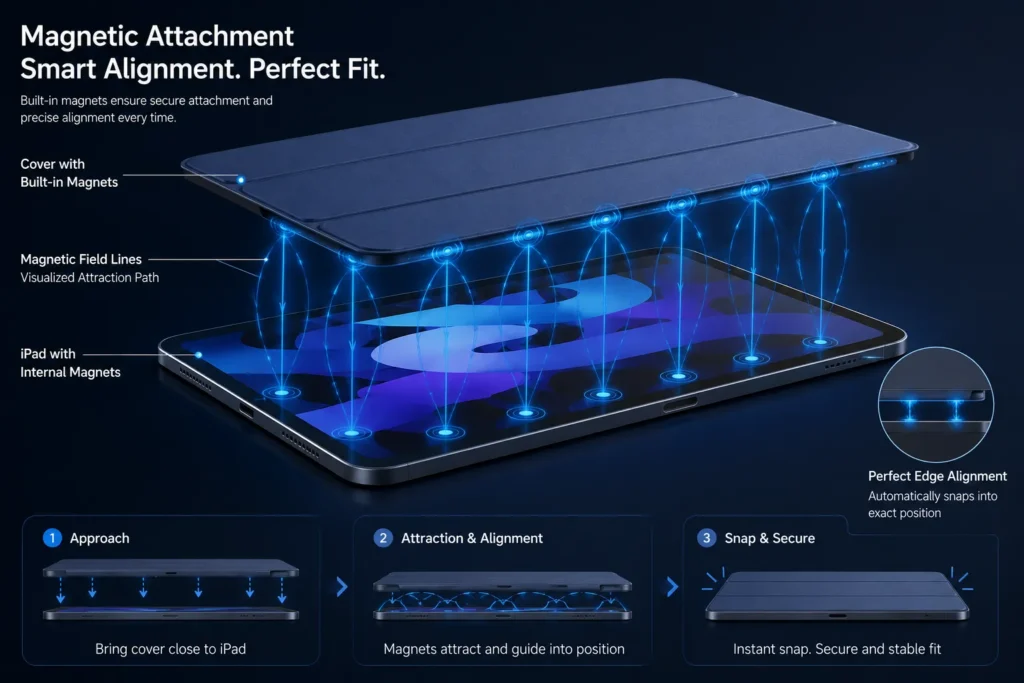
A magnetic iPad folio is not a single magnetic component. It is a coordinated magnetic architecture made of multiple functional zones embedded inside the folio structure.
Typical magnetic folio systems include:
- Closure magnets
- Alignment magnets
- Folding-support magnets
- Wake/sleep trigger magnets
- Stabilization magnets
- Apple Pencil compatibility zones
The objective is not maximum magnetic force. The objective is controlled closure behavior:
- Secure closing
- Natural opening feel
- Stable alignment
- Smooth folding
- Reliable Apple Pencil compatibility
- Long-term structural consistency
Many low-cost magnetic folio projects fail because they only add magnets without engineering the complete magnetic system.
Magnetic Functional Layer Architecture
Modern magnetic iPad folio development usually separates the magnetic system into independent functional layers.
| Magnetic Layer | Main Function |
|---|---|
| Closure layer | Keeps the folio shut |
| Alignment layer | Guides the cover into the correct position |
| Folding stabilization layer | Supports stand geometry and folding stability |
| Pencil compatibility layer | Prevents charging interference |
| Sensor trigger layer | Controls wake/sleep behavior |
A professional magnetic folio design balances all of these layers simultaneously. If one layer dominates the system, closure behavior often becomes unstable.
For example:
- Excessive closure force may distort alignment
- Poor alignment may create corner lifting
- Incorrect Pencil-zone separation may weaken charging stability
- Unbalanced folding support may create hinge stress
This is why magnetic folio engineering is fundamentally a system design problem rather than a single-component one.
Weak Magnetic Force vs Magnet Alignment Failure
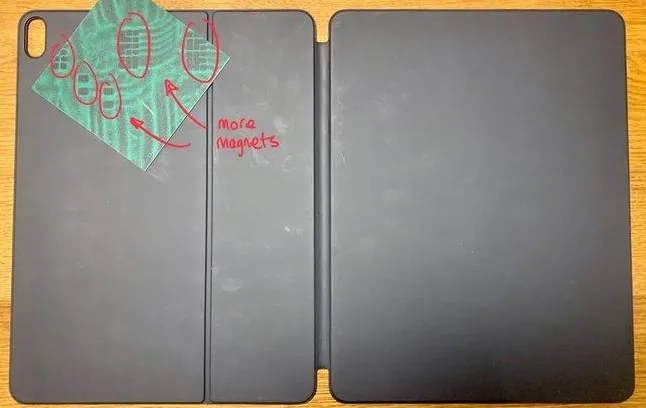
Many buyers assume that a magnetic folio opens because the magnets are too weak. In reality, closure failures usually belong to one of two engineering categories.
| Problem Type | Main Cause | Typical Result |
|---|---|---|
| Weak magnetic transmission | Magnetic force cannot pass efficiently through the structure | The cover opens too easily |
| Alignment failure | Magnetic zones do not meet correctly | Cover shifts, lifts, or closes unevenly |
This distinction is critical because the solutions are completely different.
Weak magnetic transmission usually requires:
- Magnet-grade adjustment
- Reduced material thickness
- Magnet-depth optimization
Alignment failure usually requires:
- Magnet repositioning
- Hinge correction
- Lamination control
- Tolerance adjustment
Many factories incorrectly increase magnet strength when the actual problem is geometric misalignment.
When Magnetic Transmission Becomes Too Weak
Weak magnetic transmission often appears as a loose or unstable closure feeling. The cover initially closes but opens easily during movement or transport.
Common causes include:
- Low magnetic density
- Excessive leather thickness
- Thick microfiber lining
- Foam padding between magnetic zones
- Deep magnet embedding
- Reinforcement-board spacing
- Multi-layer decorative structures
In leather iPad folio cases, this problem is especially common because magnetic force must pass through multiple structural layers.
A typical leather folio stack may include:
- Outer leather
- Adhesive
- Cushion layer
- Reinforcement board
- Magnet layer
- Microfiber lining
As distance increases, magnetic attraction drops significantly.
Engineering Note from Pellove
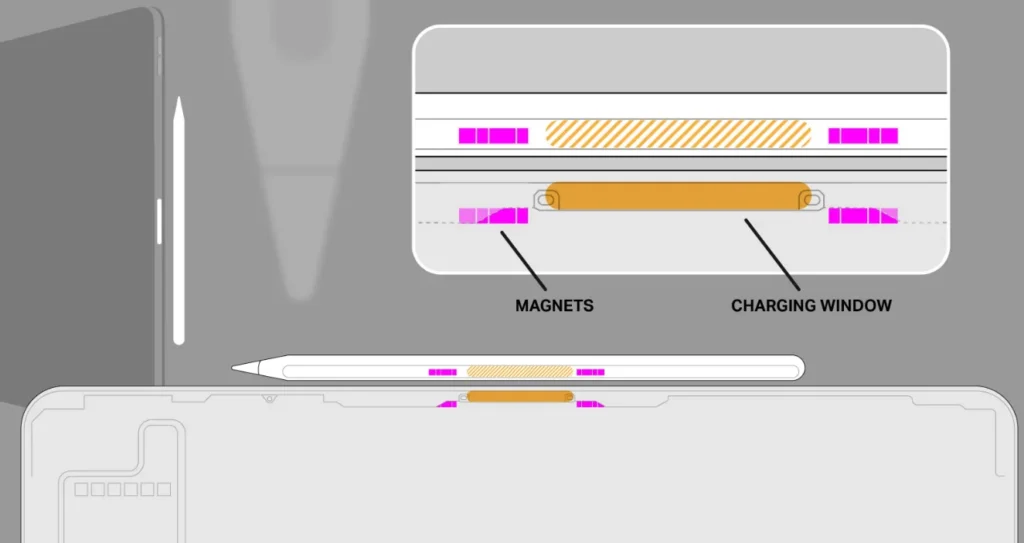
During internal sample validation, Pellove observed that increasing microfiber thickness by approximately 0.4 mm near the Apple Pencil edge noticeably reduced closure stability during movement testing. The issue was corrected by adjusting magnet depth and separating the Pencil charging zone from the closure zone.
This type of issue is difficult to detect visually, but becomes obvious during repeated folding and transport simulation.

When Magnet Alignment Fails
Alignment failure occurs when the magnets are strong enough but cannot align correctly during closure.
Typical symptoms include:
- Sideways shifting
- Corner lifting
- Uneven edge contact
- Partial closure of gaps
- “Pulled” closing behavior
- Inconsistent alignment after repeated folding
In severe cases, stronger magnets actually worsen the problem because the magnets pull the cover toward the wrong position more aggressively.
Common causes include:
- Incorrect CAD magnet mapping
- Poor magnet spacing
- Shell deformation
- Hinge-axis drift
- Lamination movement
- Tolerance stacking
- Uneven board placement
For OEM projects, closure behavior should always be evaluated dynamically during opening, closing, and folding — not only in static photos.
Why Leather iPad Folio Cases Are More Difficult to Engineer
Leather magnetic folios are structurally more complex than standard plastic tablet covers because they combine:
- Premium appearance
- Soft hand feel
- Folding performance
- Structural protection
- Magnetic functionality
inside a one-layered assembly.
The same features that improve perceived quality can also reduce magnetic stability if not engineered carefully.
Material Stack Thickness and Magnetic Decay
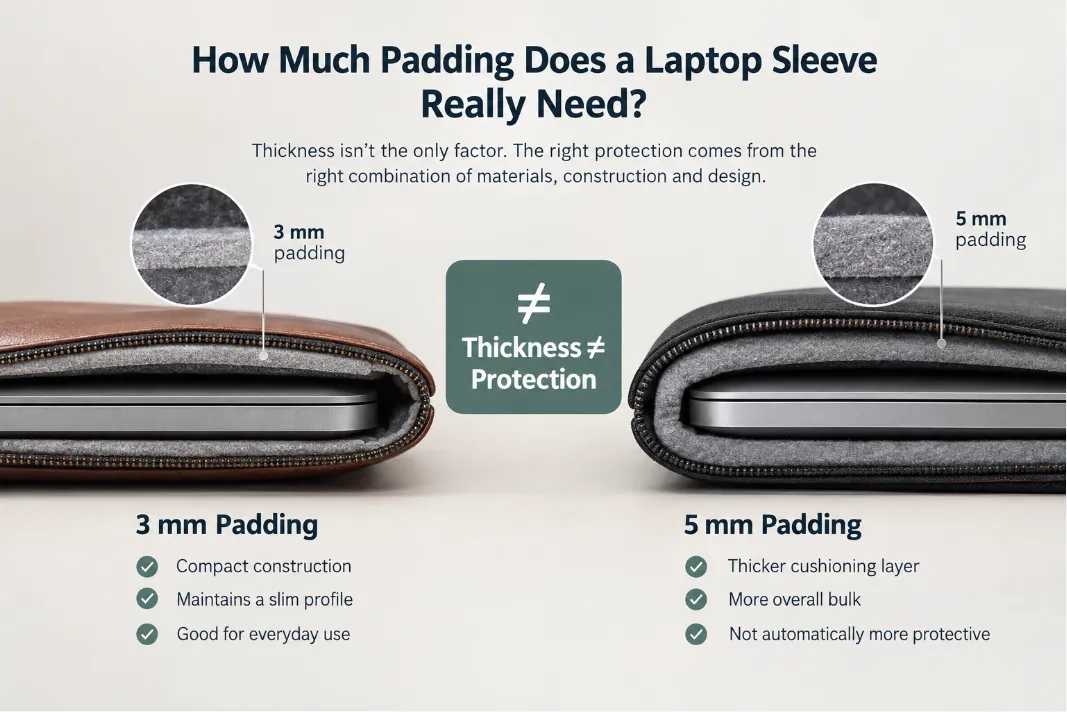
Leather folios rely on layered construction. Every added layer increases the distance between magnetic zones.
Typical layers include:
- Leather or synthetic leather
- Microfiber lining
- Adhesive film
- Cushion foam
- Reinforcement board
- Magnet embedding layer
- Folded edge structure
- Inner shell
Magnetic force does not decrease linearly with distance. Small increases in stack thickness can create disproportionately weaker closure performance.
This explains why a magnetic layout that works well in a thin PU case may fail when transferred into a thicker premium leather folio.
Soft Hand Feel vs Stable Magnetic Closure
Premium folio projects often request:
- Softer surfaces
- Thicker cushioning
- Rounded edges
- Slim outer profiles
- Smooth folded structures
These features improve user perception but can weaken magnetic efficiency.
| Buyer Preference | Engineering Risk |
|---|---|
| Softer padding | Reduced magnetic transmission |
| Thicker leather | Increased magnetic distance |
| Slim profile | Limited magnet-depth flexibility |
| Rounded folded edge | Higher alignment deviation |
| Extra reinforcement | Increased stack thickness |
Professional folio engineering requires balancing these tradeoffs simultaneously.
Hinge Geometry: The Most Underestimated Failure Point
The hinge is not just a fold line. It is a structural guidance system that controls how the cover reaches the magnetic closure position.
If the hinge geometry changes, the magnets may never align correctly, even when the magnetic strength is sufficient.
Hinge-related problems may cause:
- Corner lifting
- Uneven pressure
- Cover twisting
- Stand instability
- Folding fatigue
- Misalignment after repeated use
In leather folio structures, hinge behavior can be affected by:
- Leather tension
- Reinforcement-board placement
- Adhesive distribution
- Folding stress
- Long-term material memory
This is why folding-cycle testing is essential before mass production.
Why Samples Pass, but Bulk Production Fails
One of the most common OEM problems is:
The prototype works well, but mass-production goods show closure instability.
This usually happens because magnetic folio systems are highly sensitive to production tolerances.
Small variations can change closure behavior significantly:
| Production Variation | Possible Result |
|---|---|
| Lamination drift | Magnet position changes |
| Board placement deviation | Alignment shifts |
| Adhesive thickness variation | Magnet depth inconsistency |
| Hinge tension difference | Uneven closure pressure |
| Polarity inconsistency | Repelling magnetic zones |
| Edge-folding tension | Panel warping |
In mass production, these small deviations combine into tolerance stacking.
A folio may appear visually acceptable while still failing structurally.
Common OEM Engineering Mistakes That Cause Closure Failure
1: Adding More Magnets Without Force Mapping
More magnets do not automatically create better closure.
If the magnetic force distribution is uneven, the cover may:
- Pull too strongly in one area
- Lift in another
- Twist during folding
- Shift during closure
Professional folio development requires balanced magnetic zoning rather than maximum magnetic quantity.
2: Ignoring Polarity Control
Incorrect polarity orientation is one of the most serious magnetic assembly defects.
A reversed magnet may:
- Repel instead of attract
- Distort alignment
- Shift closure behavior
- Destabilize stand positioning
Professional factories should use:
- Magnet orientation fixtures
- Pre-assembly polarity checks
- In-process inspection
- Batch-level polarity validation
Polarity control should be treated as a production-control checkpoint, not a simple visual inspection.
3: Embedding Magnets Too Deep
Deep magnet embedding improves surface appearance but weakens closure efficiency.
This problem is common in premium leather projects requesting:
- Thick leather
- Soft-touch padding
- Decorative multi-layer structures
- Reinforced folio covers
The magnetic system must always be designed according to the final material stack, not the visual concept alone.
4: Treating the Hinge as a Cosmetic Fold
Many factories focus only on magnet strength while ignoring hinge geometry.
A hinge that is:
- Too stiff
- Too soft
- Misaligned
- Structurally unstable
can prevent the magnetic zones from meeting correctly.
The hinge should guide the cover naturally into the closed position rather than relying on magnets to compensate for structural errors.
Apple Pencil Charging and Magnetic Interference
Modern iPad folio designs often require Apple Pencil attachment and charging compatibility. As discussed in our guide on why leather iPad cases affect Apple Pencil charging performance, the Pencil charging area is highly sensitive to magnetic positioning, material thickness, and structural alignment.
This creates a second magnetic system that must coexist with the closure system.
Poor magnetic zoning may cause:
- Weak Pencil attachment
- Charging interruption
- Uneven magnetic pull
- Closure instability near the Pencil edge
- Wake/sleep inconsistency
The correct solution is not removing magnets entirely. The solution is separating functional magnetic zones.
Practical Magnetic Zoning for Apple Pencil Compatibility
| Magnetic Zone | Function |
|---|---|
| Closure zone | Keeps the folio closed |
| Alignment zone | Controls positioning |
| Folding zone | Supports stand geometry |
| Pencil zone | Allows attachment and charging |
| Sensor zone | Supports wake/sleep behavior |
In premium leather folios, these zones must remain stable even after repeated folding and structural fatigue.
A magnetic layout that works on a flat prototype may fail after long-term use if the hinge and material stack are not considered together.
Engineering Validation Metrics for Magnetic Folio Projects
Professional magnetic folio development should include measurable engineering standards.
| Engineering Parameter | Typical Validation Range |
|---|---|
| Closure holding force | 300–800 gf |
| Magnet alignment tolerance | ±1.0–1.5 mm |
| Panel flatness deviation | <0.5 mm |
| Folding-cycle durability | 5,000–20,000 cycles |
| Magnet-depth consistency | ±0.2 mm |
| Corner lift after folding | Minimal or none |
Exact targets depend on:
- iPad model
- Folio structure
- Leather thickness
- Pencil requirement
- Stand geometry
However, engineering validation should always rely on measurable standards rather than visual inspection alone.
How Factories Should Diagnose Magnetic Closure Problems
Reliable factories should separate:
- Magnetic-force issues
- Alignment issues
- Hinge problems
- Lamination problems
- Production-consistency problems
instead of treating all closure failures as “weak magnet” problems.
1: Identify the Failure Pattern
| Symptom | First Area to Investigate |
|---|---|
| Cover opens too easily | Magnetic transmission |
| Cover shifts sideways | Alignment geometry |
| Corner lifts | Flatness and hinge |
| Closure weakens after folding | Structural fatigue |
| Pencil charging unstable | Magnetic interference |
| Bulk differs from the sample | Production consistency |
Correct diagnosis prevents incorrect engineering adjustments.
2: Review the Magnet Map
The magnet map should define:
- Magnet quantity
- Magnet spacing
- Polarity direction
- Embedding depth
- Distance from Pencil zone
- Relationship to folding areas
- Relationship to wake/sleep sensors
This review should happen before tooling approval.
3: Review Real Material Thickness
Factories should validate actual production thickness for:
- Leather
- Lining
- Adhesive
- Foam
- Reinforcement boards
- Folded edges
Small stack-thickness changes can dramatically affect closure behavior.
4: Validate Hinge Behavior
Hinge validation should evaluate:
- Folding resistance
- Cover return position
- Axis consistency
- Twisting behavior
- Folding fatigue
- Closure repeatability
If hinge geometry is unstable, increasing the magnetic force alone rarely solves the problem.
5: Verify Polarity Consistency
Mass production should include polarity validation throughout assembly.
A case may pass visual inspection while still having internal magnetic assembly defects.
This is why polarity verification should be integrated into QC procedures.
Recommended Engineering Validation Flow
| Development Stage | Validation Focus |
|---|---|
| Concept stage | Define closure, Pencil, stand, and wake/sleep requirements |
| Material review | Confirm stack thickness and folding structure |
| Magnet-layout review | Validate zoning, spacing, and polarity |
| Prototype testing | Test closure behavior and alignment |
| Engineering revision | Adjust the hinge or magnetic structure |
| Pre-production sample | Confirm production-ready consistency |
| Mass production QC | Validate polarity, flatness, and closure repeatability |
| Final inspection | Check pull force, folding stability, and Pencil compatibility |
This approach reduces the risk of approving visually attractive samples that fail during production or long-term use.
FAQ
Why won’t my magnetic iPad case stay closed?
Common causes include weak magnetic transmission, alignment failure, excessive material thickness, hinge deformation, polarity errors, or Apple Pencil magnetic interference.
Can leather thickness affect magnetic closure?
Yes. Leather, microfiber, adhesive, padding, and reinforcement boards increase the distance between magnetic zones, which weakens magnetic transmission.
Is the problem always caused by weak magnets?
No. Many closure failures are caused by alignment problems rather than insufficient magnetic strength.
Can Apple Pencil charging interfere with the magnetic folio closure?
Yes. Poorly separated magnetic zones may affect Pencil charging stability, attachment behavior, or closure performance.
Do stronger magnets always solve the issue?
No. If the folio structure or alignment geometry is incorrect, stronger magnets may worsen uneven closure behavior.
Why does one corner of the folio lift?
Corner lifting is usually caused by hinge deformation, lamination stress, flatness deviation, or alignment failure rather than simple magnet weakness.
How should OEM factories validate magnetic closure quality?
Factories should validate pull force, alignment repeatability, folding-cycle durability, polarity consistency, flatness, and Apple Pencil compatibility.
Conclusion
Magnetic iPad folio closure problems are fundamentally engineering problems rather than simple cosmetic defects.
Stable closure depends on the interaction between:
- Magnet layout
- Material-stack thickness
- Hinge geometry
- Polarity control
- Lamination precision
- Folding durability
- Apple Pencil compatibility
In leather folio development, these challenges become even more complex because premium materials introduce additional thickness, softness, and structural movement.
A folio can look visually excellent while still failing mechanically if the magnetic system is not engineered together with the leather structure.
OEM and ODM buyers should evaluate magnetic folio suppliers based on how they manage:
- Magnetic zoning
- Magnet depth
- Hinge consistency
- Flatness control
- Folding-cycle durability
- Polarity inspection
- Apple Pencil charging compatibility
Pellove supports custom magnetic leather iPad folio development for brands, wholesalers, distributors, and private-label projects. If you are developing a magnetic iPad folio case, the project should be reviewed from both structural and magnetic-engineering perspectives before tooling approval and bulk production.
Related iPad Case Engineering Guides
If magnetic closure problems are part of a new OEM project, compare the root causes with the magnetic iPad case manufacturing guide, the leather iPad case manufacturer guide, and the detachable modular iPad case manufacturer guide. For final approval, use the leather goods quality checklist to define inspection points before bulk production.