
A qualified leather tablet case manufacturer should combine leather craftsmanship, precision device engineering, magnetic system integration, Apple Pencil compatibility, OEM customization, packaging development, and batch-level quality control.
For premium brands and wholesale buyers, sourcing a leather tablet case supplier is not only about unit pricing.
The right manufacturing partner should understand how:
- Leather thickness
- Microfiber lining
- Adhesive layering
- Fold geometry
- Magnetic positioning
- Edge finishing
- Packaging pressure
all directly affect the final user experience.
Premium leather tablet cases are no longer simple protective accessories.
For modern brands, they have become a combination of:
- Material craftsmanship
- Functional engineering
- Apple ecosystem compatibility
- Magnetic precision
- Luxury presentation
- Brand identity
Today’s buyers evaluate far more than appearance alone.
They increasingly need to assess:
- Leather quality consistency
- Apple Pencil charging compatibility
- Magnetic alignment precision
- Folding durability
- Edge paint longevity
- OEM and ODM capability
- Packaging presentation
- Long-term production stability
This guide explains how premium leather tablet cases are designed, engineered, manufactured, and quality-controlled for modern OEM and ODM projects.
Quick Summary
| Buyer Question | Short Answer |
|---|---|
| What makes leather tablet case manufacturing different? | Leather tablet cases require both leather craftsmanship and device-specific engineering. |
| What should buyers check first? | Material quality, magnetic alignment, Apple Pencil compatibility, folding performance, and production consistency. |
| Is genuine leather always better than PU leather? | Not always. Full-grain leather offers premium positioning, while PU and microfiber leather often provide better production consistency for OEM projects. |
| Can leather iPad cases support Apple Pencil charging? | Yes, but the magnetic structure, material thickness, and edge geometry must be engineered carefully. |
| What buyers are best suited for this product category? | Premium accessory brands, executive gifting companies, Apple ecosystem brands, and boutique DTC businesses. |
Why Leather Tablet Case Manufacturing Requires Specialized Expertise
Leather tablet cases are significantly more complex than standard TPU or plastic tablet accessories.
A basic plastic case mainly depends on mold accuracy and assembly efficiency.
A premium leather tablet case must additionally control:
- Material behavior
- Fold tension
- Structural rebound force
- Magnetic calibration
- Apple Pencil compatibility
- Long-term durability
- Luxury hand feel
- Retail presentation
Unlike injection-molded accessories, leather tablet cases combine:
- Leather craftsmanship
- Structural engineering
- Magnetic integration
- Manual finishing
- Device compatibility
- Premium packaging
Even small changes in:
- Leather thickness
- Microfiber density
- Adhesive layering
- Reinforcement board stiffness
- Magnet positioning
can directly affect:
- Apple Pencil charging
- Magnetic closure strength
- Folding stability
- Product weight
- Stand angle reliability
- Cover alignment
- Long-term durability
Critical Engineering Reality
Many failed leather iPad case projects are not caused by weak magnets.
The real issue is the uncontrolled material stack built around the magnet.
A manufacturer producing premium leather tablet accessories must understand both:
- Leather craftsmanship
- Apple ecosystem engineering
Balancing luxury aesthetics with functional precision is one of the most difficult aspects of premium leather tablet case manufacturing.
Pellove Engineering Observation
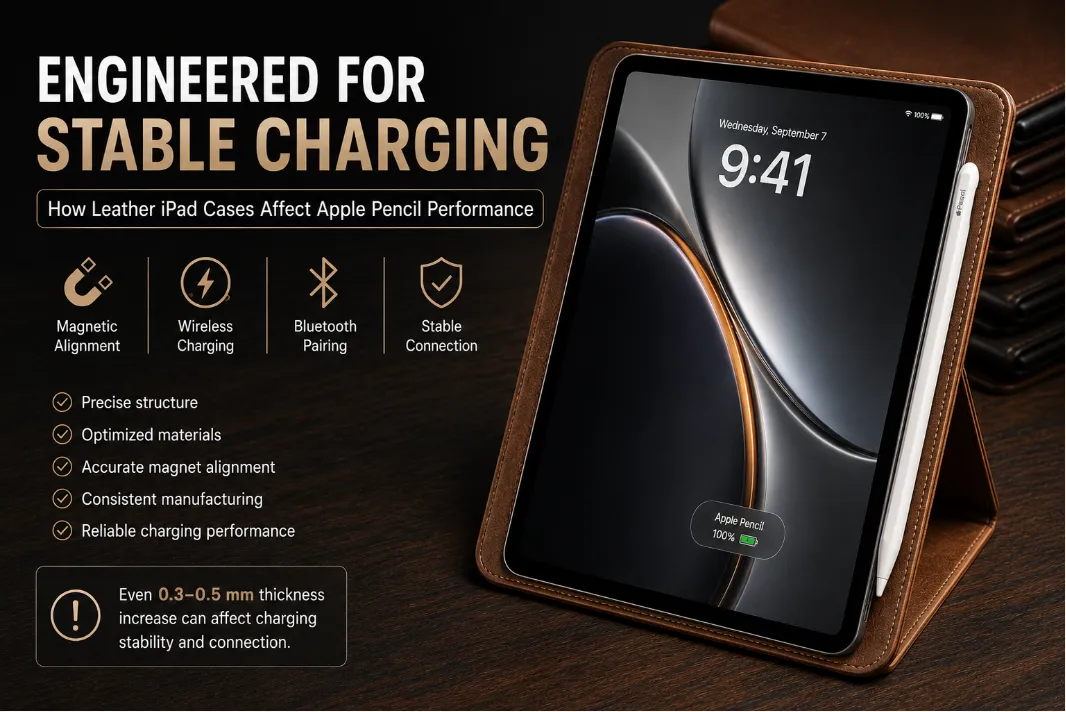
During one leather iPad folio sampling project, Pellove found that increasing microfiber thickness by only 0.3mm noticeably weakened Apple Pencil attachment stability during carrying tests.
The magnets themselves were not defective.
The issue came from the additional material distance between the iPad body and the internal magnetic layer.
After reducing microfiber density and adjusting the edge geometry near the Pencil charging side, charging stability improved significantly.
This type of engineering adjustment is common in premium leather iPad case development.
What Types of Projects Fit a Leather Tablet Case Manufacturer?
Not every tablet case project is suitable for a leather goods factory.
A premium leather tablet case manufacturer is strongest when the project depends on:
- Material craftsmanship
- Refined finishing
- OEM branding
- Premium presentation
- Magnetic engineering
- Structural precision
| Project Type | Fit for Leather Manufacturing? | Why |
|---|---|---|
| Leather iPad folio cases | Strong fit | Requires leather wrapping, fold engineering, lining, branding, and packaging |
| Leather tablet sleeves | Strong fit | Closely aligned with luxury leather goods production |
| Apple Pencil-compatible leather iPad cases | Strong fit | Combines craftsmanship with magnetic engineering |
| Magnetic leather tablet covers | Strong fit | Requires controlled thickness and precise magnet layout |
| Executive gifting tablet accessories | Strong fit | Requires presentation-level packaging and branding |
| Private label leather tablet accessories | Strong fit | Requires OEM customization and repeat production consistency |
| Rugged industrial tablet cases | Weak fit | Usually depends on shockproof TPU engineering |
| Kids silicone tablet cases | Weak fit | Does not align with premium leather positioning |
| Keyboard tablet cases | Limited fit | Often involves electronics and separate supply chains |
Best Leather Materials for Tablet Case Manufacturing
Material selection directly affects:
- Product positioning
- Durability
- Hand feel
- Production consistency
- Retail perception
- Pricing structure
Different materials serve different market segments.
| Material | Best For | Advantages | Buyer Caution |
|---|---|---|---|
| Full-grain leather | Luxury brands | Natural grain, premium aging, strong luxury positioning | Higher cost and natural variation |
| Top-grain leather | Premium DTC brands | Cleaner appearance and better consistency | Slightly less natural texture |
| Genuine leather | Mid-range products | Real leather positioning at a lower cost | Lower durability |
| PU leather | High-volume OEM | Stable cost and easier production | Low-grade PU may crack or peel |
| Vegan leather | Sustainability-focused brands | Supports eco positioning | Folding fatigue must be tested |
| Microfiber leather | Premium tech accessories | Stable thickness and refined hand feel | Surface durability still requires verification |
Full-Grain Leather
Full-grain leather is widely considered the highest-quality natural leather option because it retains the original grain surface.
It is commonly used for:
- Luxury retail collections
- Executive gifting
- Designer accessories
- Premium leather iPad cases
Advantages include:
- Premium appearance
- Natural patina development
- Strong durability
- Luxury tactile feel
However, manufacturing becomes more difficult because full-grain leather is highly sensitive to:
- Wrapping tension
- Fold engineering
- Thickness variation
- Surface grading consistency
PU Leather
PU leather remains one of the most common materials in OEM leather tablet case manufacturing because it offers:
- Stable pricing
- Flexible colors
- Easier mass production
- Better batch consistency
It is often used for:
- Corporate gifting
- Promotional products
- Large-volume OEM projects
- Mid-market tablet accessories
However, buyers should evaluate material quality carefully.
Low-grade PU leather may:
- Crack over time
- Peel at folds
- Become sticky in heat
- Lose coating durability
Professional buyers should always request:
- Material samples
- Aging test results
- Fold testing reports
Microfiber Leather
Microfiber leather is increasingly popular in premium tech accessories because it combines synthetic consistency with a refined hand feel.
Advantages include:
- Stable thickness
- Better structural consistency
- Good wear resistance
- Premium surface feel
Compared with low-grade PU leather, microfiber leather usually provides a more controlled production experience.
Pellove Material Testing Observation
During internal fold testing, Pellove compared:
- Standard PU leather
- Microfiber leather
- Top-grain leather
under repeated folding cycles.
The microfiber leather sample maintained more stable edge performance and lower surface deformation.
The top-grain leather sample delivered the strongest premium hand feel but required tighter thickness control during production.
This is why premium OEM projects often balance engineering stability with aesthetic positioning rather than selecting materials based only on cost.
How Leather Thickness Affects Magnets and Apple Pencil Charging
Leather thickness is one of the most underestimated factors in leather iPad case manufacturing.
Many magnetic failures are not caused by weak magnets. They are caused by improper material layering.
A premium leather tablet case may contain:
- Outer leather
- Adhesive layer
- Reinforcement board
- Magnet layer
- Inner shell
- Microfiber lining
- Edge wrapping
Each layer changes:
- Thickness
- Weight
- Magnetic distance
- Fold tension
- Structural behavior
Excessive thickness may reduce:
- Apple Pencil charging efficiency
- Magnetic attachment strength
- Folding flexibility
- Stand stability
- Cover alignment accuracy
Thin leather may improve magnetic performance but reduce:
- Structural rigidity
- Luxury perception
- Long-term durability
Critical Manufacturing Insight
A premium leather tablet case should not simply feel thick and expensive.
It should feel refined while still supporting the functional requirements of the device.
Professional leather iPad case manufacturers must carefully balance:
- Leather thickness
- Magnet strength
- Fold geometry
- Microfiber density
- Adhesive layering
- Edge construction
- Device tolerance
This balance is especially critical for:
- Apple Pencil-compatible iPad cases
- Magnetic folio covers
- Slim luxury tablet accessories
Why Leather iPad Cases Affect Apple Pencil Charging
Apple Pencil charging depends on far more than magnetic attraction alone.
The system requires:
- Precise magnetic alignment
- Controlled material thickness
- Stable edge geometry
- Consistent assembly tolerance
Leather construction can interfere with:
- Magnetic attachment
- Bluetooth pairing
- Wireless charging efficiency
- Pencil storage stability
| Issue | Possible Cause | What Buyers Should Test |
|---|---|---|
| The pencil does not charge | Material stack is too thick | Test charging after full assembly |
| Weak attachment | Excessive magnetic distance | Test carrying stability |
| Pencil shifts during closure | Fold tension issue | Test cover closure repeatedly |
| Bulk production failures | Thickness variation | Add charging tests to QC |
| Pencil difficult to remove | Holder too tight | Test repeated one-hand removal |
Buyer Warning
For Apple Pencil-compatible projects, ‘with Pencil holder’ is not specific enough.
The RFQ should clearly specify whether the project requires:
- Pencil storage only
- Magnetic attachment
- Wireless charging support
- Full cover closure with Pencil installed
- Specific Pencil generation compatibility
These are completely different engineering requirements.
Magnetic Design Challenges in Leather Tablet Cases
Modern iPad accessories increasingly rely on magnetic systems.
Premium leather tablet cases may need to support:
- Magnetic closure
- Auto sleep/wake
- Stable folding positions
- Apple Pencil attachment
- Wireless charging compatibility
In leather tablet accessories, magnetic performance is affected by the entire material structure — not only magnet strength.
Magnetic Attenuation
Leather and microfiber layers increase the distance between magnets and the device body.
Even small thickness increases may weaken:
- Magnetic closure pressure
- Pencil attachment stability
- Charging reliability
Structural Rebound Force
Leather naturally creates rebound tension around folds and corners.
If fold geometry is not calibrated correctly, the cover may:
- Lift at corners
- Shift during closure
- Open too easily
- Reduce sleep/wake reliability
Folding Fatigue
Repeated opening gradually affects:
- Material memory
- Hinge rigidity
- Magnet positioning
- Internal reinforcement stability
High-end leather tablet engineering requires long-term structural testing rather than cosmetic evaluation alone.
Pellove Factory Observation
During one OEM leather iPad folio project, Pellove found that the original fold structure created visible corner lifting after repeated opening cycles.
The engineering team adjusted:
- Skiving depth
- Reinforcement board stiffness
- Fold hinge spacing
After revision, the magnetic closure stability improved significantly.
Leather Craftsmanship in Premium Tablet Case Production
Premium leather tablet accessories require significantly more craftsmanship than standard molded cases.
Modern buyers increasingly evaluate details that directly affect luxury perception.
Leather Cutting
Precision cutting helps ensure:
- Stable wrapping
- Consistent fit
- Clean edge alignment
- Better batch consistency
Poor cutting may create:
- Visible asymmetry
- Uneven corners
- Fold misalignment
Skiving
Skiving reduces leather thickness in folding areas.
Proper skiving improves:
- Fold smoothness
- Structural flexibility
- Corner finishing
- Magnetic alignment
Poor skiving may create:
- Bulging edges
- Uneven folds
- Excessive stiffness
Wrapping
Wrapping is one of the most important steps in the craftsmanship of leather tablet case production, especially for folio-style and edge-covered structures.
It refers to the process where leather is precisely folded and bonded around:
- Internal reinforcement boards
- Plastic or PC shells
- Magnetic modules
- Edge structures and corners
Unlike cutting or skiving, wrapping directly determines the product’s final 3D shape and perceived luxury.
Proper wrapping execution ensures:
- Tight and uniform edge tension
- Seamless corner transition
- No visible glue overflow
- Clean geometric alignment
- Stable long-term adhesion between layers
Poor wrapping may result in:
- Edge lifting over time
- Visible glue marks
- Uneven corner curvature
- Wrinkling at fold zones
- Structural loosening after repeated folding
For premium leather tablet cases, wrapping quality is often the first visual difference between mid-tier and luxury products, especially on corners and hinge areas.
Edge Painting
Edge painting strongly affects luxury perception.
High-quality edge finishing should provide:
- Smooth touch
- Uniform color
- Crack resistance
- Long-term adhesion
Poor edge paint often becomes one of the earliest visible failures in low-quality leather accessories.
Microfiber Lamination
Microfiber lining improves:
- Interior softness
- Device protection
- Premium hand feel
However, improper lamination may create:
- Wrinkles
- Bubble formation
- Uneven tension
- Charging interference
Microfiber should always be evaluated after folding, not only while flat.
OEM and ODM Leather Tablet Case Development Process
Professional leather tablet case development usually follows several stages.
A reliable leather iPad case manufacturer should guide buyers through:
- Structural engineering
- Material selection
- Functional testing
- Packaging development
- Production QC
1. Product Positioning
The first stage defines:
- Target market
- Material grade
- Packaging direction
- Device compatibility
- Brand positioning
An executive gifting project requires very different decisions from a low-cost online retail product.
2. Structural Engineering
Engineering teams evaluate:
- Device generation
- Magnet layout
- Camera opening
- Fold geometry
- Leather thickness
- Weight distribution
- Apple Pencil compatibility
For Apple devices, small dimensional differences between generations can affect charging and fit.
3. Material Selection
Manufacturers help buyers select:
- Leather type
- Surface finish
- Magnet specification
- Reinforcement materials
- Edge coating systems
- Microfiber lining
Material selection should support both:
- Brand positioning
- Engineering requirements
4. Sampling
Professional buyers should test:
- Magnetic stability
- Apple Pencil charging
- Stand angles
- Product weight
- Fold durability
- Packaging pressure
Pellove Sample Development Experience
For most premium leather tablet case projects, Pellove typically completes the first structural sample within 7–14 days depending on material complexity and logo requirements.
Projects involving Apple Pencil charging optimization or custom fold engineering may require additional revisions to calibrate:
- Material thickness
- Fold tension
- Magnet positioning
- Edge geometry
Premium projects usually achieve better long-term stability when buyers prioritize functional testing during sampling rather than cosmetic approval alone.
OEM vs ODM Leather Tablet Case Manufacturing
| Development Type | Best For | Buyer Provides | Manufacturer Supports |
|---|---|---|---|
| OEM leather tablet case | Buyers with existing specifications | Structure and branding direction | Production, sourcing, QC |
| ODM leather tablet case | Buyers needing development support | Device model and market positioning | Structure design and engineering |
| Private label tablet case | Faster market entry | Logo and packaging | Existing structure with customization |
Many premium projects combine both OEM and ODM support.
Leather Tablet Case QC Checklist
Premium leather accessory manufacturing requires stricter QC than standard plastic products.
Inspection should evaluate not only appearance but also:
- Magnetic alignment
- Pencil charging
- Fold tension
- Edge adhesion
- Packaging pressure
- Material consistency
Material QC
Inspect:
- Leather thickness
- Grain consistency
- Color variation
- Surface scratches
- Material odor
Structural QC
Inspect:
- Device fit
- Camera alignment
- Button access
- Fold angle stability
- Product thickness and weight
Magnetic QC
Inspect:
- Magnetic closure strength
- Auto sleep/wake
- Apple Pencil charging
- Cover closure with Pencil installed
Craftsmanship QC
Inspect:
- Edge paint smoothness
- Stitching alignment
- Glue marks
- Microfiber wrinkles
- Logo positioning
Packaging QC
Inspect:
- Box structure
- Insert fit
- Barcode accuracy
- Fold protection
- Retail presentation quality
Common Problems in Leather Tablet Case Mass Production
Many leather iPad case projects perform well during sampling but fail during mass production.
This usually happens when:
- Material variation increases
- Manual assembly becomes inconsistent
- QC standards are not enforced properly
| Problem | Likely Cause | Prevention |
|---|---|---|
| Weak magnetic closure | Excessive material stack | Confirm full assembly before production |
| Pencil charging instability | Thickness variation | Add charging tests to QC |
| Corner lifting | Poor fold engineering | Adjust hinge structure |
| Edge paint cracking | Excessive fold stress | Test folding fatigue |
| Color inconsistency | Different leather batches | Approve bulk material before cutting |
RFQ Checklist for Leather Tablet Case Buyers
A detailed RFQ helps manufacturers recommend the correct structure and production method.
Professional buyers should provide:
- Device model and generation
- Case type
- Material preference
- Apple Pencil requirements
- Logo method
- Packaging requirement
- MOQ
- Target pricing
- Color requirement
- Compliance requirement
For Apple Pencil-compatible projects, the RFQ should additionally specify:
- Pencil generation
- Charging requirement
- Magnetic attachment requirement
- Closure requirement with Pencil installed
Packaging and Brand Presentation
Luxury tablet accessories increasingly depend on a premium packaging experience.
Packaging affects:
- Retail perception
- Brand positioning
- Giftability
- Customer experience
Common premium packaging options include:
- Rigid gift boxes
- Magnetic presentation boxes
- Debossed logos
- Soft-touch paper finishes
- Recycled paper packaging
- Custom foam inserts
Packaging should also:
- Protect leather surfaces
- Prevent fold deformation
- Reduce shipping pressure
Logo and Branding Options
Leather provides multiple premium branding possibilities.
| Logo Method | Best For | Notes |
|---|---|---|
| Debossed logo | Premium business accessories | Elegant and durable |
| Embossed logo | Raised texture branding | Requires pressure calibration |
| Foil stamping | Luxury gifting | Metallic visual effect |
| Metal logo plate | Retail collections | Higher perceived value |
| Printed logo | PU and microfiber projects | Flexible color options |
How to Choose the Right Leather Tablet Case Manufacturer
Selecting a manufacturing partner should involve more than price comparison.
Professional buyers should evaluate whether the supplier can support:
- Leather craftsmanship
- Magnetic engineering
- Apple Pencil optimization
- OEM development
- Packaging coordination
- Long-term production consistency
Engineering Capability
Can the factory support:
- Magnetic calibration
- Pencil charging optimization
- Device-specific fit engineering
- Long-term fold durability
Leather Expertise
Does the supplier understand:
- Leather aging behavior
- Wrapping tension
- Edge paint systems
- Luxury finishing standards
OEM Experience
Can the supplier support:
- Custom packaging
- Branding integration
- Small-batch premium production
- Repeat-order consistency
QC System
Does the factory test:
- Pencil charging
- Magnetic stability
- Fold fatigue
- Structural consistency
- Packaging presentation
Common Buyer Mistakes
Choosing Only by Unit Price
Low pricing may hide:
- Weak materials
- Poor edge paint systems
- Unstable magnets
- Inconsistent craftsmanship
For premium leather tablet accessories, the lowest price is rarely the lowest long-term risk.
Approving Samples Without Functional Testing
A sample may look attractive while failing during real-world use.
Always test:
- Folding
- Pencil charging
- Magnetic closure
- Stand stability
- Packaging pressure
Ignoring Material Thickness
Leather thickness affects:
- Hand feel
- Magnets
- Folding
- Weight
- Charging performance
Professional buyers should approve the full material stack, not only the surface appearance.
The Future of Premium Leather Tablet Accessories
The premium tablet accessory market continues to evolve.
As tablets become increasingly integrated into:
- Business workflows
- Education systems
- Creative environments
- Executive workspaces
leather tablet accessories are evolving from simple protective products into refined functional tools.
Future trends increasingly include:
- More precise magnetic systems
- Better Apple ecosystem integration
- Sustainable leather materials
- Slimmer structural engineering
- Luxury-focused customization
- Hybrid material construction
Pellove’s Engineering Philosophy
At Pellove, premium tablet accessories are engineered around long-term usability rather than appearance alone.
A leather iPad case should not only look luxurious on the first day.
It should maintain:
- Fold stability
- Magnetic performance
- Structural consistency
- Apple Pencil compatibility
after thousands of opening cycles and repeated daily use.
For premium OEM and ODM projects, engineering precision is just as important as material selection.
Develop Premium Leather Tablet Accessories With Pellove
Pellove specializes in premium leather tablet case manufacturing for:
- Premium accessory brands
- Apple ecosystem accessory companies
- Executive gifting businesses
- Boutique DTC brands
- Wholesale OEM buyers
From:
- Material selection
- Structural engineering
- Apple Pencil optimization
- Sampling
- Packaging development
- Production QC
Pellove supports premium leather iPad case projects focused on long-term product quality and brand positioning.
Whether the project requires:
- Full-grain leather iPad folio cases
- Magnetic leather tablet covers
- Apple Pencil-compatible iPad cases
- Executive gifting accessories
- Private label tablet products
professional engineering and production consistency remain essential.
FAQ
What is a leather tablet case manufacturer?
A leather tablet case manufacturer produces tablet folios, sleeves, magnetic covers, and related accessories using leather, PU leather, vegan leather, microfiber leather, and other premium materials.
Qualified manufacturers should support:
- OEM and ODM development
- Material selection
- Structural engineering
- Logo customization
- Packaging
- Production QC
Can leather iPad cases support Apple Pencil charging?
Yes.
However, charging performance depends on:
- Material thickness
- Magnetic alignment
- Edge geometry
- Assembly tolerance
- Microfiber density
Professional manufacturers should test charging after full assembly and during bulk QC.
Why do leather tablet cases require magnetic engineering?
Modern leather tablet cases increasingly rely on magnets for:
- Closure
- Folding positions
- Auto sleep/wake
- Apple Pencil attachment
Leather layers and reinforcement materials can weaken magnetic force if not engineered correctly.
What should buyers test before mass production?
Professional buyers should test:
- Device fit
- Pencil charging
- Magnetic closure
- Fold durability
- Stand stability
- Edge paint adhesion
- Packaging pressure
- Logo positioning
How do buyers choose a reliable leather tablet case manufacturer?
Buyers should evaluate:
- Leather craftsmanship
- Magnetic engineering capability
- Apple Pencil experience
- OEM support
- QC systems
- Packaging capability
- Production consistency
A reliable manufacturer should explain engineering tradeoffs clearly rather than competing only on low pricing.