
A reliable iPad case manufacturer in China should do more than provide an attractive catalog and a low unit price. The supplier should be able to explain where the product is made, how each iPad model is validated, which processes are performed in-house or outsourced, and how the approved sample will be reproduced during mass production.
The safest sourcing process has four parts: verify the supplier, evaluate its product-engineering capability, approve a complete sample, and define the quality standard before production. This matters because an iPad case can look acceptable in a photograph while still having inaccurate openings, unstable magnets, weak stand angles, poor lamination, or unreliable Apple Pencil compatibility.
Brands defining a new collection can review Pellove’s leather iPad case range before preparing an RFQ.
What Should a Reliable iPad Case Manufacturer Provide?
The right manufacturer must combine commercial reliability with product-specific engineering. A buyer should expect clear evidence in the following areas.
| Area | Evidence to request | Warning sign |
|---|---|---|
| Company identity | Registered company name, factory address, export entity, and payment details | Different names appear on the quotation, invoice, and bank account without explanation |
| Production responsibility | Process flow, production-site evidence, and disclosure of subcontracted work | The supplier will not explain where cutting, lamination, assembly, or packing takes place |
| Model engineering | Model list, drawings, tooling records, and sample revisions | The supplier assumes one shell or magnet layout fits several iPad generations |
| Material control | Approved swatches, material codes, color references, and specifications | Materials are described only as “premium” with no measurable definition |
| Functional validation | Fit, closure, stand, wake/sleep, and Pencil checks when relevant | Inspection is limited to appearance |
| Sample control | A dated or numbered approval sample with a written specification | Changes are approved only through informal messages |
| Bulk quality control | Incoming, first-article, in-process, functional, and final inspection points | The supplier checks the product only after packing |
| Commercial clarity | MOQ, tooling, samples, packaging, lead time, and payment terms | Important costs appear after sample approval |
The best supplier isn’t automatically the largest factory or the cheapest quote. The best supplier can identify risks early, consistently build the required structure, and maintain the approved specification across production batches.
Factory, Trading Company, or Integrated Manufacturing Partner?
The word “manufacturer” is used loosely in online sourcing. Before comparing quotations, determine the role each supplier actually performs.
Direct factory
A direct factory controls the main production processes and employs the people responsible for engineering, production, and quality. This can provide stronger visibility when a project requires repeat production or technical changes.
However, even a genuine factory may outsource injection molding, special printing, electronic keyboard modules, metal parts, or retail packaging. Outsourcing is not automatically a problem. The real risks are undisclosed subcontracting, unclear responsibility, and weak incoming inspection.
Trading company
A trading company sources from one or more factories and manages communication, consolidation, or export services. It may suit buyers purchasing several accessory categories or placing smaller mixed orders.
The limitation is reduced production visibility. Buyers should ask which factory will make the product, who owns any tooling, who approves changes, and who is responsible if bulk goods do not match the approved sample.
Integrated manufacturing partner
Some suppliers combine internal leather-case assembly and product engineering with a managed network for molded shells, magnets, tooling, keyboards, or packaging. This model can work well for a complex program if responsibilities and inspection points are transparent.
Instead of asking only, “Are you a factory?”, ask:
Which processes do you perform in-house, which processes are subcontracted, and how do you inspect outsourced components before assembly?
That question produces more useful information than a yes-or-no factory claim.
Where and How to Find iPad Case Manufacturers in China
Buyers usually build a supplier list through direct manufacturer websites, B2B sourcing platforms, trade shows, referrals, or professional networks. Each channel is useful, but none replaces product-specific verification.
Direct manufacturer websites
A manufacturer’s website can reveal its product focus, technical knowledge, factory information, and contact details. Review the product pages, About page, OEM/ODM information, and technical articles together. Check whether the company name, location, products, and capabilities remain consistent across the site.
A large catalog alone is not proof of manufacturing capability. Look for evidence that the supplier understands materials, model compatibility, production risks, sample development, and quality control.
B2B sourcing platforms
Alibaba, Global Sources, Made-in-China, and similar platforms can help buyers create an initial shortlist. Verification badges and audit reports are useful screening inputs, but they should not replace checking the legal company, production location, samples, and product-specific quality plan.
Trade shows
Trade shows allow buyers to compare samples and speak with supplier teams in person. Bring a short product brief and a consistent question list so each supplier is evaluated on the same requirements. After the show, confirm that the company issuing the quotation is the same one represented at the booth.
Referrals and professional networks
A referral is most useful when the referring buyer has ordered a similar construction, quality level, and volume. A supplier that performs well on a simple promotional case may not be suitable for a premium magnetic leather folio.
How to Verify an iPad Case Manufacturer
Confirm the legal company and payment identity
Request the registered company name, operating address, export entity, and payment details. Compare them with the quotation, pro forma invoice, email domain, and beneficiary account.
If several companies are involved, ask for a written explanation. A factory may use an affiliated export company, but that relationship should be clear before payment.
Verify the production site and process ownership
An on-site audit offers the clearest view, but a structured live video audit can support early qualification. Ask to see material storage, cutting, lamination, assembly, in-process inspection, finished-goods inspection, packing, and the sample room.
Do not rely only on a polished factory video. During a live review, ask the supplier to follow a current production lot and explain which records control materials, revisions, and inspections.
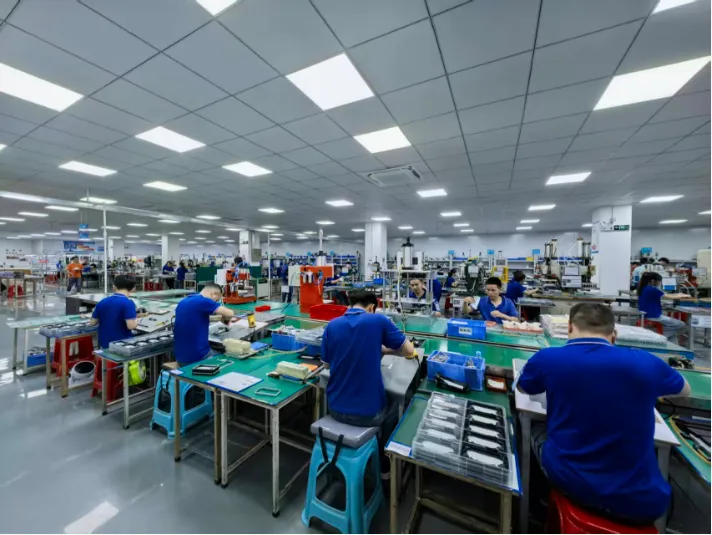
One of our workshops
Check category-specific experience
Leather craftsmanship alone does not prove iPad case capability. A manufacturer also needs to understand model-specific tolerances, camera openings, speaker and button access, magnet polarity, wake/sleep behavior, stand geometry, and Apple Pencil clearance.
Ask for evidence from similar structures without requesting confidential customer information. Suitable evidence may include anonymized inspection records, model checklists, tooling records, checking fixtures, or a demonstration of a finished sample on the correct device.
Review engineering and revision control
An RFQ should identify the exact iPad model and generation rather than using a broad description such as “iPad Pro case.” Similar product names can cover devices with different camera modules, speakers, buttons, chassis dimensions, magnetic zones, or Pencil compatibility.
Ask how the manufacturer:
– confirms model numbers and dimensions;
– controls drawings and tooling revisions;
– prevents similar shells from being mixed;
– validates a new model before bulk production;
– records changes after each sample round.
A reliable supplier should be able to show a controlled path from the buyer’s request to an approved production specification.
Review actual quality records
Generic certificates do not prove that a particular case will fit or function correctly. Ask to see inspection points relevant to your construction. These may include incoming material checks, first-article approval, alignment checks, magnetic-function checks, fold and stand inspection, appearance review, and final packaging verification.
Pellove’s leather goods quality checklist can help buyers convert general expectations into written checkpoints.
Choose the Right Structure and Materials
The manufacturer should be evaluated against the product you intend to make. Different structures create different sourcing and quality risks.
| Case structure | Best for | Main advantage | Main risk to verify |
|---|---|---|---|
| Shell folio | Mainstream retail and corporate programs | Familiar protection and efficient customization | Shell fit, fold fatigue, and edge wear |
| Magnetic folio | Slim premium collections | Clean profile and flexible stand positions | Magnet placement, polarity, and closure alignment |
| Pencil-holder folio | Education, creative, and productivity users | Integrated Pencil storage | Bulky side profile or charging interference |
| Detachable magnetic folio | Buyers who want several use modes | Inner case separates from the outer folio | Retention force and repeated alignment stability |
| Keyboard case | Enterprise, education, and productivity programs | Adds typing functionality | Electronics, hinge balance, weight, and supply-chain complexity |
| Genuine leather folio | Premium and gift collections | Natural surface and aging character | Hide variation, thickness control, and panel matching |
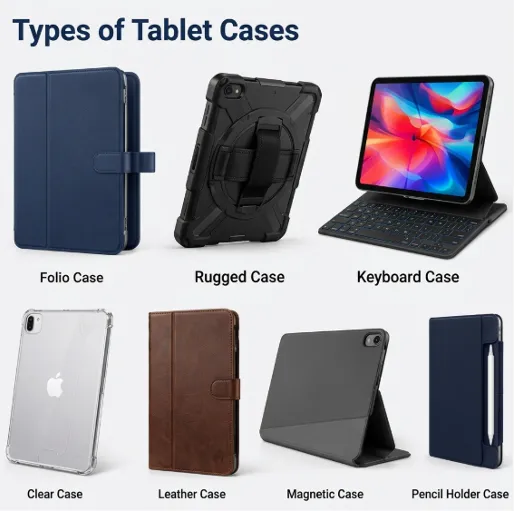
Types of tablet case
There is no universally best structure. The right choice depends on retail positioning, thickness, protection, model range, order quantity, launch timing, and the functions customers actually need.
Material selection
Material selection affects appearance, consistency, folding behavior, edge treatment, cost, and scalability.
| Material | Suitable positioning | Advantage | Manufacturing consideration |
|---|---|---|---|
| Full-grain leather | Luxury and smaller premium collections | Natural grain and distinctive aging | Greater variation and more demanding panel selection |
| Top-grain leather | Premium retail | Refined appearance with better consistency | Requires clear color, grain, and thickness standards |
| PU leather | Scalable private label and retail programs | Consistent surface and easier batch matching | Flex, abrasion, peel, and aging depend on material quality |
| Microfiber synthetic leather | Premium synthetic programs | Controlled hand feel and batch consistency | Backing, thickness, fold response, and edge treatment require approval |
| Microfiber lining | Premium interior surface | Soft contact with the device | Color transfer, abrasion, contamination, and adhesion should be checked |
For natural leather programs, buyers can review what full-grain leather means and the differences between full-grain and top-grain leather.

Material comparison
Do not approve a material from a digital image alone. A useful specification identifies the material code, color reference, thickness range, surface finish, backing, lining, and physical approval swatch.
Technical Capabilities an iPad Case Manufacturer Should Control
A leather iPad case is a layered functional product. The exterior, lining, shell, reinforcement, magnets, adhesive, edges, and folding zones must work together after final assembly.
Model-specific fit
The camera, speakers, microphones, charging port, buttons, screen edge, and Pencil area must align on the correct device. The shell should be checked before and after wrapping because adhesive, heat, and material tension can change dimensions.
Fold and stand geometry
Board stiffness, hinge width, fold position, layer thickness, and adhesive behavior determine how the cover closes and supports the device. A stand should be evaluated with the iPad installed on a representative surface. Inspecting an empty case is not enough.
Magnetic alignment
Magnet count alone does not determine performance. Position, polarity, grade, spacing, retention, material thickness, and assembly tolerance all affect closure, stand positions, detachable attachment, and wake/sleep behavior.
The magnet map should be controlled during assembly, and the finished case should receive a functional check. Buyers developing a magnetic structure can use the detailed magnetic iPad case manufacturing guide.
Apple Pencil compatibility
A case may provide Pencil storage, an exposed charging side, a protective flap, or a combination of these features. Compatibility must be validated for the intended iPad and Apple Pencil combination.
Leather, lining, shell geometry, adhesive, and reinforcement add distance around the charging area. Excess thickness or assembly variation may weaken attachment or interrupt charging. Test the fully assembled case rather than the bare shell. The separate guide to Apple Pencil charging performance explains this issue in more detail.
Lamination, edges, and hinge durability
The exterior, reinforcement, shell, and lining must remain bonded while the cover folds during normal use. Adhesive compatibility, application, pressure, heat, curing, and material preparation all affect stability.
Painted, wrapped, raw-cut, and stitched edges behave differently. The folding zone receives repeated stress and should be assessed separately from static edges. Warning signs include whitening, cracking, lifting, paint separation, wrinkles, bubbles, and loss of stand stiffness.
Approve the Sample and Define Bulk Quality
A sample is not only a visual reference. It should represent the exact model, materials, color, construction, magnets, functions, logo, workmanship, and packaging intended for production.
Build a written sample checklist
Record:
– exact iPad model and generation;
– shell or internal-frame version;
– exterior and lining material codes;
– approved physical color reference;
– logo method, size, color, and position;
– magnet layout and required functions;
– Apple Pencil storage or charging requirement;
– camera, speaker, port, and button alignment;
– stand positions and stability;
– edge finish and fold construction;
– packaging, labels, inserts, and barcode data.
Test the assembled sample on the intended device. A bare shell test does not reveal dimensional or functional changes caused by leather wrapping, lining, reinforcement, adhesive, and lamination.
Control the approved version
Identify the approved sample by date or revision. The buyer and manufacturer should retain the same reference or an agreed specification pack. Any change made for bulk production should be approved in writing.
Check causes, not only visible defects
| Defect | Likely cause to investigate | Buyer verification |
|---|---|---|
| Camera or speaker misalignment | Wrong shell, model mix-up, or wrapping deformation | Model identification, first-article check, and post-lamination fit |
| Weak or uneven closure | Magnet shift, incorrect polarity, or excessive layer thickness | Controlled magnet map and finished-case function check |
| Wake/sleep failure | Magnet position does not match device response | Test the specified device after final assembly |
| Pencil charging instability | Excess thickness, side deformation, or alignment variation | Test the intended Pencil and iPad combination |
| Unstable stand | Weak reinforcement or incorrect fold geometry | Evaluate every intended position with the device installed |
| Fold cracking | Incompatible material, tight hinge, or edge stress | Approve the complete fold construction and durability method |
| Wrinkles or bubbles | Uneven adhesive, trapped air, or inconsistent pressure | Inspect lamination during assembly and at final inspection |
| Delamination | Adhesive mismatch, contamination, or insufficient curing | Validate the selected materials and production conditions |
| Color variation | Mixed material lots or uncontrolled natural variation | Approve lots, swatches, and panel-matching rules |
| Logo inconsistency | Variable heat, pressure, location, or surface texture | Use an approved position reference and first-article comparison |
Sorting visible defects at the end of production is not a complete quality system. A strong corrective action identifies and controls the process that created the defect.
Compare OEM, ODM, MOQ, Price, and Lead Time
OEM uses an existing structure
An existing, validated structure is usually the more efficient route when differentiation comes from material, color, logo, lining, or packaging. It can reduce tooling requirements, technical uncertainty, and development time.
This route is often suitable for a market test or a collection with several colorways. The tradeoff is that other brands may use a similar base structure.
ODM with a new or modified structure
ODM development is appropriate when the product requires exclusive geometry, a new fold system, a different magnet layout, a custom Pencil solution, a detachable design, or another functional change.
It may create stronger differentiation, but it also adds engineering decisions, tooling, testing, revisions, cost, and schedule risk. Buyers should define which features create genuine user value before commissioning a new structure. Pellove’s OEM versus ODM guide provides a broader comparison.
Compare quotations on the same specification
MOQ, price, and timing depend on more than total quantity. Important variables include:
– existing shell versus new tooling;
– stocked material versus custom leather or color;
– standard folio versus a new magnetic or detachable system;
– logo method and artwork versions;
– custom packaging, labels, and barcodes;
– model and color mix;
– inspection and testing requirements;
– shipping terms and delivery location.
Ask each shortlisted supplier to quote against the same RFQ. Separate sample and development charges, tooling, unit-price tiers, logo and packaging charges, inspection costs, shipping terms, and estimated timelines. A lower unit price is not a fair comparison when it excludes costs included elsewhere.
RFQ Checklist for OEM and ODM Buyers
A clear RFQ produces more comparable quotations and reduces avoidable sample rounds. Include:
– company profile and target market;
– exact iPad models and generations;
– forecast quantity by model and color;
– reference product, drawing, or marked-up images;
– case type and required use modes;
– exterior, lining, shell, reinforcement, and edge preferences;
– Apple Pencil version and storage or charging requirement;
– required stand positions and magnetic functions;
– logo method and artwork;
– packaging, barcode, labeling, and compliance requirements;
– target quality level and inspection expectations;
– requested sample date and shipment date;
– shipping term and destination.
If part of the specification is still open, identify the areas where the manufacturer should recommend a solution. This makes it easier to distinguish a technical partner from a supplier that only returns a price.
Common sourcing mistakes to avoid
– Comparing prices before aligning materials and construction.
– Treating a platform badge as complete supplier verification.
– Approving appearance without testing fit and function.
– Using one generic sample to approve several iPad models.
– Leaving packaging and labels until production is nearly complete.
– Approving changes through informal messages without revising the specification.
– Choosing a complicated ODM structure without defining the customer benefit.
Discuss Your iPad Case Project with Pellove
Pellove works with business buyers evaluating leather and mixed-material iPad case programs. A productive first discussion should cover the exact iPad model, intended structure, material position, quantity, logo, packaging, functional requirements, and target schedule.
Buyers can review Pellove’s OEM and ODM leather accessories solutions and sample, MOQ, and customization FAQ before requesting a quotation.
To receive a relevant response, send Pellove your project details with the iPad model, expected quantity, preferred material, reference structure, logo, packaging, and launch date. The team can then assess whether an existing OEM structure or a new ODM development path is the more suitable starting point.
Frequently Asked Questions
How can I tell whether an iPad case supplier is a real factory?
Check the registered company, production address, payment entity, process ownership, production-site evidence, and inspection records. Ask which processes are completed in-house, which are subcontracted, and how outsourced components are inspected before assembly.
Should I choose a factory or a trading company?
Choose according to the project. A direct factory can provide stronger process visibility and engineering control. A trading company may be useful for mixed categories or order consolidation. In either case, clarify who makes the product, who owns the tooling, and who is responsible for quality deviations.
What should I test on an iPad case sample?
Test the case on the exact iPad model. Check fit, camera and speaker alignment, port and button access, closure, stand stability, folding, surface and edge quality, logo position, packaging, and any required wake/sleep or Apple Pencil function.
What is the MOQ for custom iPad cases?
There is no universal MOQ. It depends on tooling, material availability, custom color, model mix, logo process, packaging, and structural complexity. Ask which component creates the minimum and request quantity tiers based on one consistent specification.
How long does sampling and production take?
Timing depends on whether the project uses an existing structure, stocked materials, new tooling, custom colors, or complex magnetic and detachable functions. Request separate estimates for materials, tooling, sampling, revisions, production, inspection, and packaging.
Which certifications should I request?
The answer depends on the materials, electronic content, target market, retailer requirements, and applicable regulations. Tell the supplier where the product will be sold and confirm the required documents with a qualified compliance adviser or testing provider.
Can one case design fit several iPad generations?
Sometimes closely related models can share parts, but this should never be assumed. Camera modules, speakers, buttons, chassis dimensions, magnetic zones, and Apple Pencil compatibility can differ. Validate every listed model before production.
What information should I send for an accurate quotation?
Send the exact iPad model, product structure, material, quantity by model and color, logo method, packaging, functional requirements, target schedule, destination, and any required tests or documents. A reference sample, drawing, or marked-up image also helps the manufacturer identify assumptions and risks.