
When shopping for leather goods, many buyers ask the same question: how to tell real leather from fake. With modern synthetic materials like PU and bonded leather becoming increasingly convincing, it’s not always easy to spot the difference. If you’re unfamiliar with how leather is categorized by grade, structure, and finish, you may first want to read our complete breakdown in The Complete Leather Types Guide: Different Types of Leather Explained, which explains the fundamental differences between real and synthetic materials.
Whether you’re buying a leather phone case, handbag, wallet, belt, or sofa, understanding how to identify genuine leather helps you avoid overpaying for synthetic materials and ensures long-term durability.
This guide explains practical, safe, and reliable methods you can use to confidently distinguish real leather from faux leather.
Why It’s Hard to Identify Leather Today
In the past, fake leather was easy to detect. Today, advanced manufacturing techniques allow synthetic leather to closely imitate the look and texture of genuine leather.
Adding to the confusion:
The term “genuine leather” does not mean premium quality.
Bonded leather contains real leather fibers but behaves more like a synthetic material.
Vegan leather is fully artificial but often marketed as eco-friendly.
If you want a deeper understanding of how leather is classified by grade, tanning, and finish, read our full breakdown in Types of Cowhide Leather Explained: Structure, Tanning & Finishes.
7 Ways to Tell Real Leather from Fake
These identification methods are safe and practical for everyday buyers.
1. Check the Label Carefully
Start with the product description or tag.
Real leather may be labeled:
Synthetic leather may be labeled:
Synthetic leather
Man-made materials
Important note:
“Genuine leather” simply means real leather, but it is often a lower grade compared to full grain or top grain. Industry organizations such as the Leather Working Group emphasize that leather grading depends on hide structure and finishing processes rather than marketing terminology.
2. Examine the Grain Pattern
Look closely at the surface texture.
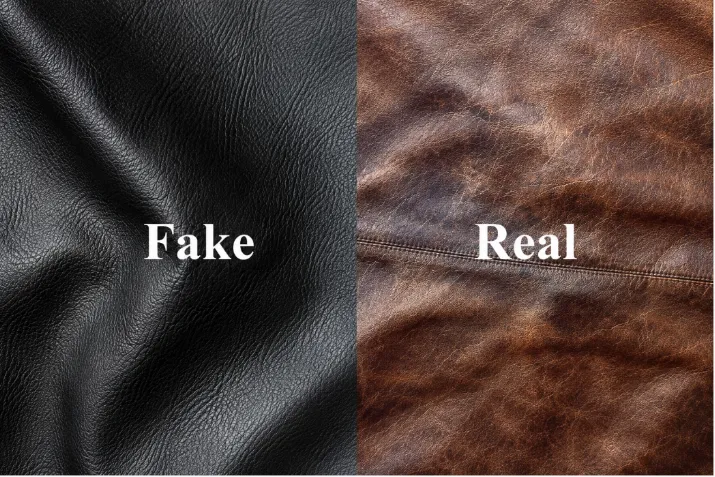
Real leather:
Has irregular, uneven pores
Shows natural variations and small imperfections
Does not repeat in a perfect pattern
Fake leather:
Has uniform, machine-printed texture
Often repeats identical grain patterns
Looks overly smooth or symmetrical
Natural inconsistency is a strong sign of authenticity.
3. Perform the Touch Test
Gently press your fingers into the surface.
Real leather:
Feels soft and slightly warm after contact
Wrinkles naturally when pressed
Has slight elasticity
Fake leather:
Feels cold and plasticky
Does not wrinkle naturally
Springs back instantly without natural creasing
Authentic leather responds organically to pressure.
4. The Smell Test
Smell is one of the easiest indicators.
Real leather:
Has a rich, earthy, natural scent
Fake leather:
Smells like plastic or chemicals
May have a strong synthetic odor
Synthetic materials cannot replicate the natural scent of animal hide.
5. Check the Edges
If you can see a cut edge (for example, on a strap or seam), examine it closely.
Real leather:
Has a rough, fibrous structure
Shows dense natural fibers
Fake leather:
Has smooth, sealed, or layered edges
Often reveals a fabric backing
The edge test is one of the most reliable professional methods.
6. Try the Water Drop Test (With Caution)
Place a small drop of water on an inconspicuous area.
Real leather:
Absorbs water slowly
Darkens slightly
Fake leather:
Repels water
Water beads up and rolls off
Note: Avoid testing expensive items unless permitted.
7. The Bend Test
Gently bend or flex the material.
Real leather:
Forms natural wrinkles
Returns to shape gradually
Fake leather:
May create sharp creases
Can show cracking in lower-quality materials
Over time, fake leather is more prone to peeling and cracking.
Real Leather vs Fake Leather: Quick Comparison
| Feature | Real Leather | Fake Leather |
|---|---|---|
| Texture | Irregular and natural | Uniform and repetitive |
| Smell | Earthy and organic | Plastic or chemical |
| Edge | Fibrous and rough | Smooth or layered |
| Water Reaction | Absorbs slowly | Repels water |
| Durability | 5–10+ years | 1–3 years |
| Aging | Develops patina | Cracks or peels |
If durability is your priority, you can read our detailed comparison in The Ultimate Guide to Leather Durability: Which Type Lasts Longest?
What About Bonded Leather?
Bonded leather is made from shredded leather scraps combined with polyurethane binders.
It contains some real leather fibers but:
Has lower durability
Can peel over time
Typically lasts 1–3 years
Bonded leather is not fake, but it does not perform like full grain or top grain leather.
For product teams comparing this material for commercial use, pair the material decision with OEM and ODM production planning, quality control checklist, and the undefined so appearance, durability, MOQ, and inspection standards are reviewed together.
Frequently Asked Questions
Is genuine leather real leather?
Yes. Genuine leather is real leather, but it is usually a lower grade compared to full grain or top grain leather.
Does real leather peel?
High-quality full grain leather does not peel. Peeling usually occurs in bonded leather or synthetic leather products.
Is vegan leather fake leather?
Vegan leather is synthetic material designed to mimic leather. It does not contain animal hide.
What is the strongest type of real leather?
Full grain leather is the strongest and most durable type of real leather.
Final Thoughts
Knowing how to tell real leather from fake helps you make smarter purchasing decisions and avoid overpaying for synthetic materials.
By checking the grain pattern, texture, smell, edges, and durability characteristics, you can confidently identify genuine leather and choose products that will age beautifully over time.
If you’re investing in leather goods for long-term use, understanding these differences ensures both value and quality.