
Leather Phone Cases With Card Holders: How to Choose the Right Design, Factory, and Customization Options
Leather phone cases with card holders combine phone protection and card storage in one product. For brands, wholesale buyers, gift companies, and private label sellers, they offer a useful mix of higher perceived value, everyday practicality, and strong customization potential.
That is exactly why leather phone cases with card holders work so well in international markets. They solve a clear end-user problem, namely carrying fewer items, while also giving buyers more room to build a premium-looking product line with stronger differentiation.
Leather phone cases with card holders also fit naturally into broader leather-accessory collections, especially alongside wallet-style cases, MagSafe wallets, and premium phone-case lines.
Why Leather Phone Cases With Card Holders Appeal to Brands and Buyers
Leather phone cases with card holders appeal to brands and buyers for several reasons.
First, they usually support higher selling prices than basic TPU or PC cases. Buyers are not only paying for protection. They are also paying for function, material quality, and a more premium presentation.
Second, leather phone cases with card holders create natural differentiation. A plain phone case is easy to compare on price alone. By contrast, a leather case with card storage adds more visual value and a more useful daily function.
Third, leather phone cases with card holders work across multiple sales channels. For example, they can fit private label retail, branded gifts, cross-border e-commerce, and business gifting programs.
In short, leather phone cases with card holders help brands move beyond low-margin commodity accessories.
Two Main Card-Holder Structures
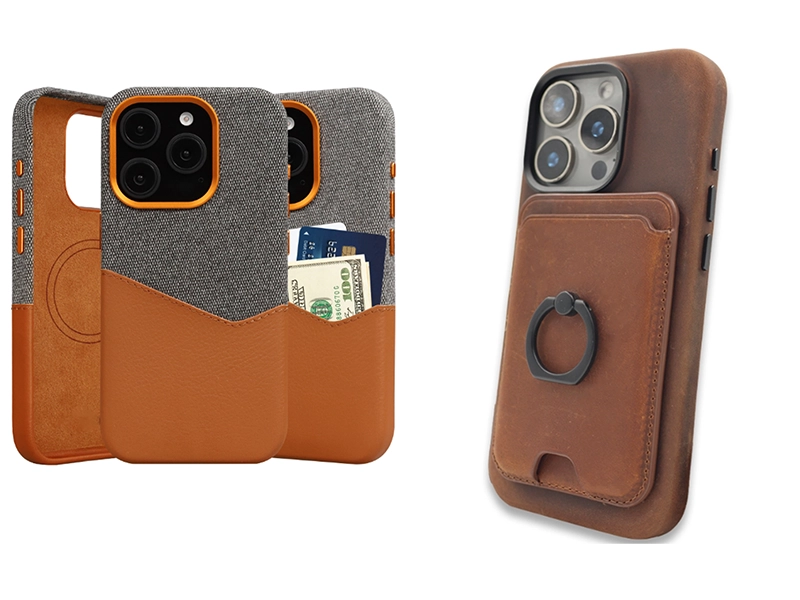
Most leather phone cases with card holders follow one of two mature structures:
- stitched-in card holder
- magnetic detachable wallet
Both structures are proven. However, they serve different product goals and user expectations.
- Stitched-In Card Holder
A stitched-in card holder attaches the card slot or card pocket directly to the phone case body through sewing. As a result, the entire product feels integrated, stable, and straightforward.
This is the more traditional option. It works especially well when buyers want a dependable product with lower after-sales risk.
Key advantages:
- strong structural stability
- lower risk of card detachment
- simple and familiar user experience
- easier quality control in larger production runs
Best for:
- business gifts
- bulk promotional orders
- practical everyday-use markets
- buyers who prefer stability over modular design
- Magnetic Detachable Wallet
A magnetic detachable wallet connects the wallet and the phone case through magnetic alignment. Users can remove the wallet when they want a lighter setup and reattach it when they need card storage.
Because of that, magnetic wallet phone cases feel more flexible and more design-led. They also give brands more room to build modular collections and matched accessory sets.
Key advantages:
- detachable and flexible use
- stronger premium and lifestyle appeal
- more room for product-line variation
- easier to create coordinated accessories
Best for:
- premium custom projects
- fashion-oriented brands
- lifestyle gifting
- users who want modular functionality
Magnetic wallet formats also fit naturally alongside dedicated MagSafe wallet products and other coordinated small leather accessories.
Structure Comparison Table
| Comparison Point | Stitched-In Card Holder | Magnetic Detachable Wallet |
|---|---|---|
| Structural stability | Very high | High, but depends on magnet strength and alignment |
| Flexibility | Fixed structure | Detachable and modular |
| Design appeal | Classic and practical | More premium and lifestyle-driven |
| Customization space | Good | Excellent |
| Maintenance risk | Low | Moderate |
| Best-fit market | Business gifting, bulk orders, practical users | Premium gifting, trend brands, modular users |
Why Leather Phone Cases With Card Holders Offer Strong Commercial Value
Higher Margin Potential
Leather phone cases with card holders often support better margins than basic plastic cases. Leather adds a more premium feel, while built-in storage adds practical value. Together, those two features make it easier to justify a higher selling price.
In many markets, that matters more than chasing the lowest possible unit cost. A product that looks better and works harder usually earns stronger positioning.
Built-In Differentiation
Leather phone cases with card holders stand out more easily than standard back-cover cases. Material, structure, stitching detail, and wallet function all help them look more purposeful and less interchangeable.
That makes them especially useful in crowded marketplaces where visual differentiation matters.
Accessible Customization
Leather phone cases with card holders also work well for custom programs. Buyers can add brand identity through embossing, foil stamping, debossing, printed graphics, edge details, packaging, or matching accessories.
At the same time, the product stays commercially practical. It is not a niche concept item. It is a real everyday accessory with broad market demand.
Wide Application Scenarios
Leather phone cases with card holders adapt well to:
- corporate gifts
- employee welcome kits
- private label retail
- cross-border e-commerce
- premium event merchandise
- brand collaborations
- tech-accessory collections
Because of this, they sit in a strong middle ground between function and branding.
How to Choose the Right Structure for Your Market
Choose a stitched-in card holder if you want:
- simpler production
- lower after-sales risk
- a more traditional business look
- a stable product for larger-volume orders
Choose a magnetic detachable wallet if you want:
- stronger design appeal
- more flexibility for users
- modular product storytelling
- more opportunities for mix-and-match collections
In practice, the better structure depends less on which option is universally better and more on which one matches your target customer, sales channel, and product positioning.
How to Choose the Right Leather or Case Material
Material choice affects appearance, durability, customization, and price. So buyers should treat it as a strategic product decision, not just a visual one.
Here is a practical material guide for leather phone cases with card holders.
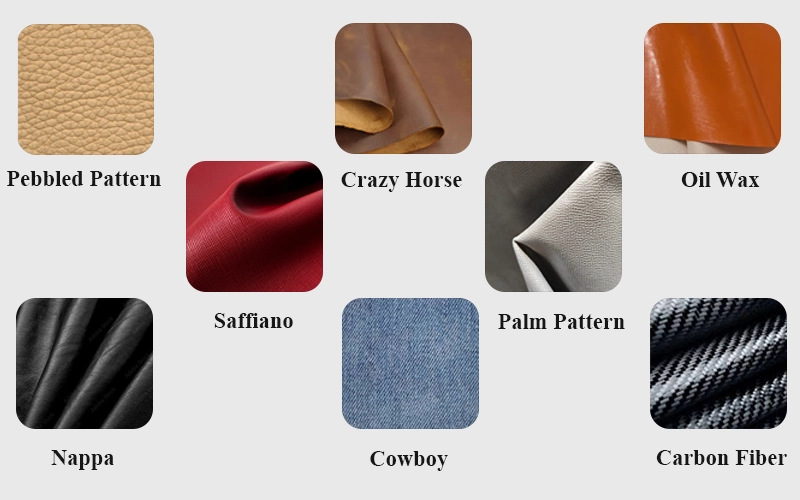
Material Selection Table
| Material | Works Well For | Less Suitable For | Typical Style |
|---|---|---|---|
| Crazy horse leather | Laser engraving, debossing, hot stamping | Large full-color printing | Vintage, rugged, character-rich |
| Nappa or fine-grain genuine leather | Foil stamping, embossing, fine engraving | Rough or distressed decoration | Clean, refined, business premium |
| Microfiber or PU | Full-color printing, transfer printing, detailed embossing | Harsh heat or chemical exposure | Flexible, colorful, cost-efficient |
| Pebbled leather | Debossing, hot stamping, broad branding | Ultra-fine micro-detail engraving | Relaxed premium, textured, modern |
Buyers often compare real leather, bonded leather, and faux leather before deciding which direction fits the product best, especially when balancing price, perceived value, and durability. Genuine leather typically lasts 2–5 years with proper use, while PU or microfiber options usually offer 1–2 years of functional lifespan, depending on usage conditions. From a cost perspective, PU and microfiber materials can reduce unit cost by 30%–50% compared to genuine leather, making them suitable for high-volume promotional projects.
Material choice also shapes the final product story. For example, a premium leather phone-case line can lean toward cleaner business styling or more casual textured styling depending on the finish and grain used.
How to Plan Customization by Product Area
Customization should follow the structure of the product. Different parts of a leather phone case with card holder support different branding methods.
Front or back panel:
- best for larger logos
- best for signature graphics or patterns
- works well for embossing, foil stamping, or print depending on the material
Side edge:
- good for subtle branding
- works well for small foil details or fine engraving
- adds a more premium finish without dominating the design
Card holder or detachable wallet:
- ideal for logo placement
- useful for monograms or secondary graphics
- especially valuable when the wallet should carry its own visual identity
This becomes even more useful in modular designs. A magnetic detachable wallet allows brands to customize the phone case body and wallet module separately, which creates more visual flexibility.
How to Choose the Right Factory to Leather Phone Case with Card Holders.
Strong factories do more than produce goods. They reduce product risk and speed up decision-making.
A reliable supplier should offer three core capabilities.
- Model Adaptation Capability
The factory should cover mainstream phone models and respond quickly when new models launch. That matters because even the best-looking leather phone case with card holder will lose value if the supplier cannot keep up with device updates.
- Stable Material Supply
The supplier should have a stable leather or cover-material supply chain and explain material differences clearly. Buyers should also ask whether the supplier can support material reports or compliance-related documentation when needed.
- Mature Production Processes
The factory should handle stitching, magnetic integration, edge finishing, embossing, and fit consistency with stable quality control. Leather phone cases with card holders combine multiple functional parts, so execution quality matters more than it does in a simple one-piece case.
Phone-case lines that already cover multiple leather options, wallet styles, and OEM/ODM builds often suggest broader process maturity.
What Service Strengths Matter Most
Service quality often determines whether a leather phone case with card holder project runs smoothly.
A stronger supplier should be able to support:
- material selection guidance
- process recommendations for different finishes
- logo placement suggestions
- sample development
- small-batch trial orders
- packaging coordination
- artwork and structure alignment
In practice, buyers should favor factories that explain which materials fit laser engraving, foil stamping, embossing, or print, rather than simply claiming every finish will work on every leather.
That kind of guidance reduces sampling mistakes and shortens development time.
Common Mistakes to Avoid
Avoid factories that:
- only want large orders from the start
- offer little or no customization guidance
- support too few material options
- cannot explain the limits of each finish
- do not help with sampling logic
- treat wallet cases like standard low-complexity phone cases
Also, do not choose a leather phone case with card holder based on appearance alone. A good-looking sample can still become a weak bulk product if magnet strength, stitching quality, leather temper, or card-slot tolerance is unstable.
[Image suggestion: factory or QC image showing stitching inspection, edge finishing, and fit testing]
Final Buying Advice for Custom Leather Phone Case with Card Holders.
If your goal is a low-risk, practical, and scalable product, start with a stitched-in leather phone case with card holder in a proven leather or microfiber option.
If your goal is stronger design differentiation, premium gifting, or a modular accessory story, a magnetic detachable wallet case usually gives you more room to build a stronger branded offer.
Either way, the smartest path is simple:
- choose the structure based on the sales channel
- choose the material based on the target price and finish
- choose the factory based on service depth, not only factory size
Final Answer
Leather phone cases with card holders are a strong product choice because they combine premium appearance, practical storage, and strong customization potential. For most brands and buyers, the key decision is not whether the product is attractive, but which structure, material, and factory setup will fit the market best.
If you want stability and lower risk, choose a stitched-in card-holder design. If you want flexibility and stronger design differentiation, choose a magnetic detachable wallet design. Then match that structure with the right material, branding method, and supplier capability.
For sourcing teams turning this guide into a production brief, the next practical checks are MOQ planning, OEM and ODM manufacturing choices, and the quality control checklist before confirming samples or bulk orders.
Related Buyer Paths for Wallet-Style Phone Case Sourcing
If you are comparing card-holder structures for OEM or private label projects, review our custom leather wallet phone case page alongside the custom leather phone case manufacturer guide to confirm structure, branding, packaging, and fit decisions. Buyers preparing sampling rounds can also use the MOQ planning guide for custom leather goods before locking quantity targets and price expectations.
FAQ
Which card-holder structure usually has the lower MOQ?
In many sourcing programs, both stitched and magnetic options can support small trial orders. MOQ usually depends more on the supplier’s setup than on the structure itself.
Will custom leather or special materials affect lead time?
Yes, sometimes. Standard materials usually move faster, while special colors, uncommon textures, or custom-developed materials may need more lead time.
Can buyers customize both the case body and the wallet area?
Yes. This is especially useful in magnetic detachable designs, where the case and wallet can carry different logos, graphics, or branding details.
What is typical card capacity?
A: Most designs support 1–3 cards.